

The success of LEDs is not the reason the lighting industry finds itself at a crossroads. But it has made the limits of the old growth model impossible to ignore.
LED technology has made light more energy-efficient, longer-lasting, smaller, and easier to control. At the same time, it has driven the core performance of many lighting products toward parity. Increasingly, luminaires are reduced to rows in a comparison table—measured by specifications, price, and delivery time.
LEDs have not failed. Quite the opposite. They completed the last lighting revolution so thoroughly that differentiation based on efficiency alone is no longer enough.
The real question is this:
When “producing more light with less energy” is no longer sufficient to sustain growth, what problem must the next lighting revolution solve?
1 |The last revolution transformed the light source
From incandescent bulbs to fluorescent lamps and then to LEDs, the lighting industry advanced along a clear trajectory: improving luminous efficacy, extending service life, reducing costs, and increasing reliability. It was a remarkable engineering achievement that also made a significant contribution to global energy conservation.
But across many mature product categories, as the incremental gains from ever-higher efficacy continue to diminish, an industry that sells only lumens, watts, and hardware inevitably becomes trapped in commoditization and price competition.
Connectivity, sensing, and artificial intelligence have undoubtedly introduced powerful new capabilities.
Yet simply connecting a luminaire to a network does not, by itself, create new lighting value. If the control logic, spatial intelligence, and operational decision-making all reside on someone else’s platform, connected lighting may ultimately amount to nothing more than this: The luminaires are connected—but to someone else’s system.
2 | The next revolution must redefine the unit of value
In the past, we measured lighting by how much light a luminaire produced. In the future, we must answer a more important question:
What kind of light, in what space, at what time, and for what activity, is truly right for the person in front of it?
This means the unit of value in lighting must evolve from product output to real-world outcomes:
- From luminous flux to the benefits people actually experience.
- From design specifications to performance in actual use.
- From project completion to continuous operational optimization.
- From “We delivered a great luminaire” to “We can demonstrate that this space achieved its intended outcomes.”
Those outcomes may be improved health, sustainability, productivity, emotional well-being—or even just one of these.
The point is not how ambitious the promise sounds. The point is whether the outcome can be delivered, measured, and verified.
3 | A revolution is not about piling on more technology
The next generation of lighting does not mean every project needs to be packed with sensors, AI algorithms, and cloud platforms. Schools, hospitals, senior care facilities, offices, and industrial environments each face different challenges—and they do not require the same solution.
True innovation begins by defining the context and the desired outcome, then selecting only the products, controls, measurement methods, and operational tools that are genuinely necessary.
If a well-designed daylight harvesting strategy is sufficient to achieve the objective, there is no reason to introduce unnecessary complexity simply for the sake of being “smart.”
Hardware, optics, reliability, and energy efficiency remain the foundation of quality lighting.
But the foundation can no longer be mistaken for the destination.
4 | From more efficient light to more appropriate light
The next lighting revolution may begin with a single closed loop:
What does the luminaire produce? How does the space change? What does the eye actually receive? How do people respond? Does the outcome match the intended objective? Can the system continuously maintain and optimize that result?
The last revolution asked: How can we produce more light with less energy?
The next revolution must ask: How can we use the right light to create measurable, verifiable value in real-world environments?
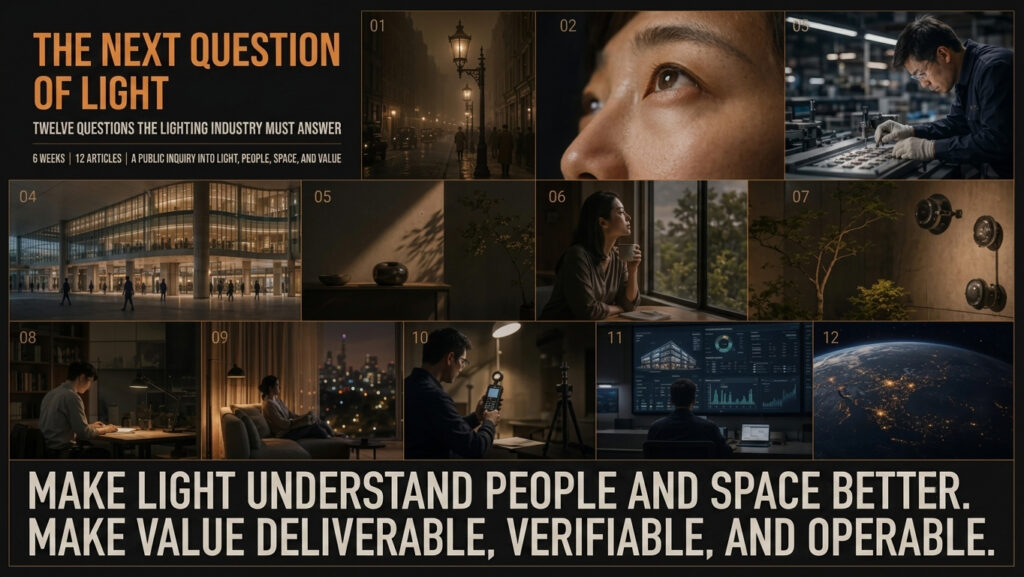
This is The Next Question of Light – Question Three: If the lighting industry could establish only one new shared capability for verification, what should it be?
Rather than naming a single metric, please also describe:
- Application scenario
- Desired outcome
- Possible validation method
This is not the conclusion. It is the third question.

 English
  Chinese (China)
  Chinese (Taiwan)