

We have become highly capable of measuring the physical properties of light.
Luminous flux, illuminance, power, color temperature, color rendering, glare, flicker, spectral distribution… Instruments are becoming increasingly precise, and the data we collect is becoming increasingly abundant.
But there is one question the lighting industry has never fully answered:
What do people actually see, feel, and experience under light — and what do they endure over time?
For nearly 150 years, we have been creating artificial electric light, yet we still often treat “people” as an abstract average.
Perhaps this is the deepest cognitive gap in the lighting industry.
1 | Luminaire Data Does Not Equal Human Experience
A luminaire can demonstrate impressive spectral performance, distribution characteristics, and flicker metrics in a laboratory environment.
But once it is installed in a building, the light is shaped by many factors: spatial scale, surface materials, windows and daylight, installation position, control strategies, and the timing of use.
The light that ultimately reaches the human eye is no longer simply a set of luminaire specifications.
The same luminaire, installed at different heights, directed toward different materials, or experienced by people of different ages, postures, and viewing directions, can create completely different lighting environments.
Therefore, achieving the required illuminance on a working plane only proves the calculated or measured result of a specific surface under specific conditions. It does not fully represent what people actually receive through their eyes, from their viewing direction, and over time in a real environment.
2 | Humans Are Not Standard Measuring Instruments
The impact of light on people is not only about whether they can see clearly.
It also involves visual comfort, alertness, sleep–wake rhythms, task performance, and subjective experience.
But these outcomes are never determined by light alone.
Age, sleep patterns, previous light exposure, physical condition, activity, psychological expectations, and social environment can all influence how people respond to light.
This is why we cannot look at a single spectral metric and directly claim that it will inevitably improve health, focus, or well-being.
Light can be an important influencing factor — but it should not be presented as a universal solution.
3 | The Problem Is Not That Existing Standards Are Wrong — It Is That the Validation Chain Is Incomplete
Illuminance, color rendering, glare, flicker, and safety standards are all essential. They form the fundamental baseline of lighting engineering.
But a baseline is not the same as the full value.
If a project claims to improve learning, support health, or enhance workplace performance, it must continue to answer:
Who is experiencing the improvement?
Under what conditions, activities, and time periods does it occur?
What is the person actually receiving from their real viewing position?
What is the expected outcome?
And how will that outcome be verified?
True human-centered lighting cannot stop at a label on a product specification sheet.
4 | From Manufacturing Light to Understanding People
The lighting industry can begin with a simple but meaningful validation pathway:
- Define the user, space, time, and activity
- Establish clear and realistic value hypotheses
- Measure the light people actually receive from their real viewing positions
- Record spatial conditions and control strategies
- Use subjective feedback, behavioral performance, or appropriate physiological indicators to evaluate whether the intended outcomes are achieved
This does not mean every project must become a medical experiment.
It means our claims must be supported by evidence that matches their ambition.
Manufacturing light is an engineering capability.
Understanding people requires the combined participation of optics, architecture, life sciences, behavioral research, and real-world environments.
For nearly 150 years, we have focused on making artificial light more efficient.
Now, perhaps we need to seriously answer a deeper question:
How can we make light more responsible for people?
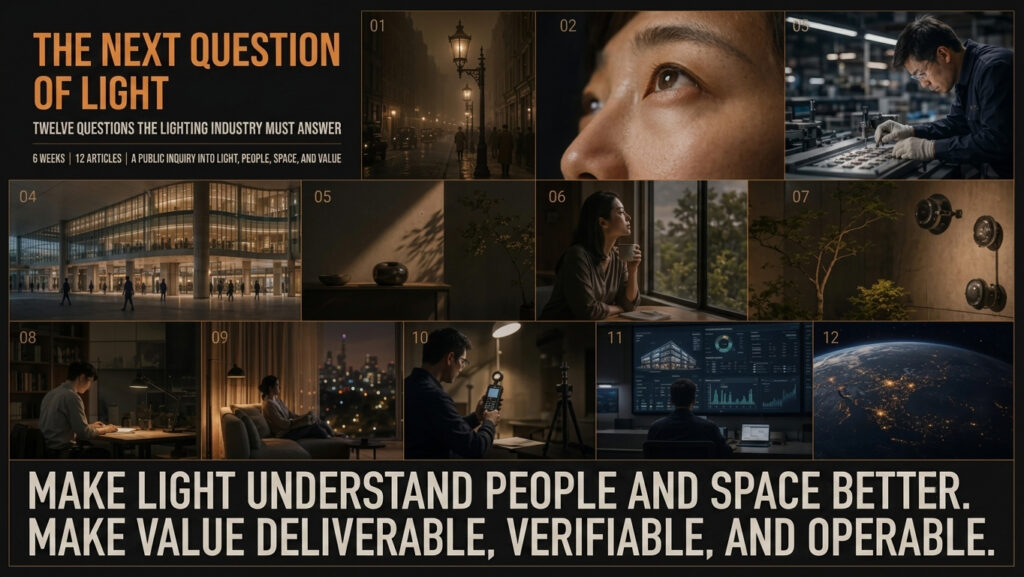
This is the second question of “The Next Question of Light”:
In your recent lighting projects, beyond illuminance and energy consumption, what human outcome did you explicitly promise? And what method did you use to prove that it was achieved?
Please answer in this format:
Application scenario | Expected human outcome | Verification method
This is not the conclusion.
This is the second question.

 English
  Chinese (China)
  Chinese (Taiwan)