

Raising the color temperature does not automatically prove that people will become more alert.
Adding “mel-EDI” to product specifications does not automatically prove that a lighting solution is truly “human-centric.”
Human Centric Lighting (HCL) has been widely adopted in recent years. The issue is not that this direction is wrong, but that we often fail to clarify:
Who is the “human” we are designing for?
What outcome are we trying to support?
Where is the evidence?
1 | An undefined “human” is only a slogan
Children, night-shift workers, hospital patients, older adults, and typical office workers do not face the same visual tasks, schedules, or physiological conditions.
Even for the same person, the light they need in the morning, afternoon, and before sleep may be different.
Without specifying age, activity, time of day, viewing position, and previous light exposure, applying a fixed color temperature or illuminance level to everyone is difficult to call truly “human-centric.”
A scientific question must be defined, measurable, and open to being challenged.
“This light is beneficial for health” is not a sufficiently rigorous statement.
“Under specific timing and at a specific eye position, does a certain level of light exposure help support an intended state for a defined population?” — this begins to approach a question that can be tested.
2 | Product metrics cannot directly replace human outcomes
mel-EDI is an important engineering metric used to describe melanopic equivalent daylight illuminance and biologically relevant light exposure.
Only when factors such as eye position, direction, timing, and duration are clearly defined can it help characterize actual light exposure in a specific environment.
However, mel-EDI is not a health diagnosis, nor can it independently predict a person’s sleep, mood, or work performance.
The CIE S 026 standard establishes a measurement framework for describing optical radiation relevant to ipRGC-mediated responses. However, the standard itself also makes clear that these quantities alone cannot complete a specific application design, nor can they directly quantify a specific human response.
Between product data and human outcomes, there are still multiple layers: control strategy, real spatial conditions, light received at the eye, exposure patterns, and individual differences.
3 | Scientific restraint does not mean denying the value of light
Current scientific evidence has confirmed that light does more than support vision. It also participates in regulating circadian rhythms, alertness, and other physiological responses.
Recognizing these effects is different from exaggerating product benefits.
Scientific restraint does not mean saying “light has no impact.”
It means clearly explaining the conditions under which effects occur, the strength of the evidence, and the aspects that cannot be explained by light alone.
Sleep, mood, and productivity are all influenced by multiple factors.
Lighting can be an important variable, but it should not be promoted as the sole cause or as a therapeutic tool.
4 | Making “human-centric” a commitment that can be tested again
Any human-centric lighting project should first answer five questions:
- Who is it designed for?
- Under what time conditions and activities does it occur?
- What light does the person actually receive at the eye?
- Which specific value or outcome is the project intended to support?
- After completion, how will the result be verified?
Define the human before defining the light.
Establish the hypothesis before selecting the products.
Create a baseline before discussing improvement.
Only when design intent, on-site measurement, and human feedback form a complete chain of evidence does “human-centric” become more than a marketing phrase.
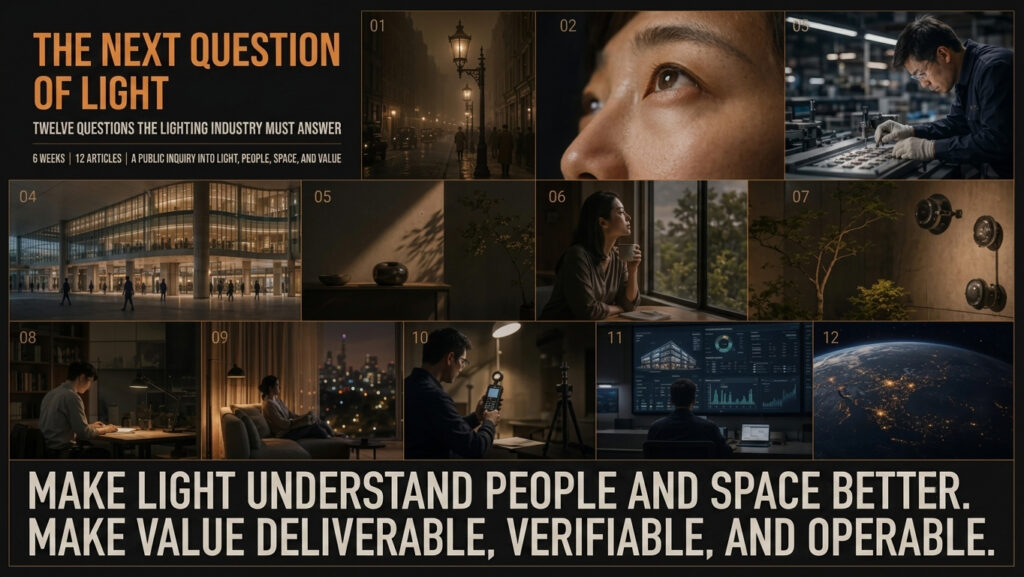
This is the fourth question from 《The Next Question About Light》: Among the “human-centric lighting” projects you have seen, which part is most often missing?
Human definition | Eye-level measurement | Time conditions | Outcome metrics | Post-delivery verification
Please answer with a real-world example.
This is not the conclusion.
This is the fourth question.

 English
  Chinese (China)
  Chinese (Taiwan)