

Cities will never stop falling into night. Buildings will always need light, and people will never stop using it to see, work, learn, heal, and live. Therefore, the demand for lighting has not disappeared.
But the fact that an industry is still needed does not mean it still controls its own future.
Today, what should truly concern us may not be whether “lights can still be sold,” but that the lighting industry is gradually losing three things that matter even more: the power to define value, the customer interface, and the gateway to data.
1 | What Is Being Lost Is Not Demand, but the Power to Define Value
For more than a century, lighting companies have been answering a relatively clear question: How can we create more light that is stable, safer, and more efficient?
LED completed the previous revolution in lighting technology. Luminous efficacy improved, lifespans increased, form factors became smaller, control capabilities became more flexible, and the cost per unit of luminous output dropped significantly.
LED did not fail. On the contrary, it succeeded almost too completely.
As core technologies matured and performance gaps continued to narrow, many lighting products began to be evaluated within the same procurement spreadsheet: lumens, wattage, efficacy, color temperature, color rendering, glare, lifespan, price, and lead time. These metrics are all important, and existing standards remain indispensable.
The challenge is that when an industry can only describe value through product specifications, competition is easily pushed toward price, delivery time, and compliance. Meeting standards gradually becomes merely the entry ticket, rather than something sufficient to shape the narrative of the future.
2 | Customers Still Need Light, But They May No Longer Ask the Lighting Industry What Light Should Do
Customers still need light, but they may no longer turn to the lighting industry to ask the question: “What should light do?”
Today’s building owners care about energy, health, operational efficiency, spatial experience, asset performance, and return on investment. All of these issues are connected to light. Yet in an increasing number of projects, these conversations are being led by architects, interior designers, energy consultants, health certification organizations, building system providers, digital platforms, and operations teams.
Lighting companies, meanwhile, may only enter the conversation at a later stage of decision-making, when they are asked: “Please provide a fixture that meets the specifications, integrates with the system, and is competitively priced.”
Once lighting appears only as an item on a product list, the industry loses the opportunity to directly understand the context, the users, and the goals of the owner.
This is the loss of the customer interface.
Without a customer interface, it becomes difficult to understand the real problems. And without understanding the problems, companies can only wait for others to define what their products are expected to accomplish.
3 | Being Connected to the Network Does Not Necessarily Mean Owning the Value
Lighting was originally one of the most promising digital infrastructures within architecture. It is distributed throughout spaces, continuously powered, located close to human activity, and capable of sensing changes in time, occupancy patterns, daylight conditions, and environmental factors.
However, if lighting companies are responsible only for supplying hardware, while control strategies, spatial data, algorithms, and operational decisions are all controlled by other platforms, then “connected lighting” may ultimately mean only one thing: the fixtures have been connected to someone else’s system.
The hardware may still come from the lighting industry, but the usage data and decision-making access remain elsewhere. The cost is carried by lighting equipment, while the longer-term system value is created in other parts of the ecosystem.
This is not merely a technology issue. It is a question of industry positioning and value ownership.
4 | “Losing Light” Does Not Mean the Lights Will Stop Shining
To be clear: this article is not predicting that lighting demand will disappear, nor does it suggest that software can replace optics, luminaires, controls, or engineering expertise. Without reliable products and professional engineering, no smart building or healthy environment can truly exist.
The question I am exploring is the position of the lighting industry within the value chain:
Do we still have the ability to explain why this kind of light is needed?
Who should it serve? In what spaces, at what times, and during what activities?
Does it create health, sustainability, productivity, or emotional value?
How are these values designed, delivered, validated, and continuously maintained throughout the user experience?
If these questions are all answered by others, lighting companies may continue to manufacture luminaires, yet gradually be redefined as merely a hardware supply segment.
The light itself has not disappeared.
What may be disappearing is the lighting industry’s authority to explain light, define light, and demonstrate the value of light.
5 | The Next Competition Is Not Simply About Who Can Manufacture Better Lights
Not every luminaire needs to solve every problem at once, and not every project requires massive sensor networks, data platforms, or complex algorithms. The true starting point is actually quite simple:
First, clearly define who the value is being created for, what scenario it serves, and what outcome it is meant to achieve. Then transform that value into results that can be delivered, measured, and continuously evaluated.
The real upgrade the lighting industry needs is not merely adding another feature to a luminaire. It is a shift:
- From selling luminous output to delivering verifiable value
- From describing products to understanding people and spaces
- From completing installation to supporting long-term operations
The lights will, of course, continue to shine.
But if lighting companies no longer define what good light means, no longer understand the relationship between light and people, and cannot prove what value light creates in real spaces, then what disappears may not be the demand for lighting — it may be the lighting industry’s leadership and ownership of the conversation.
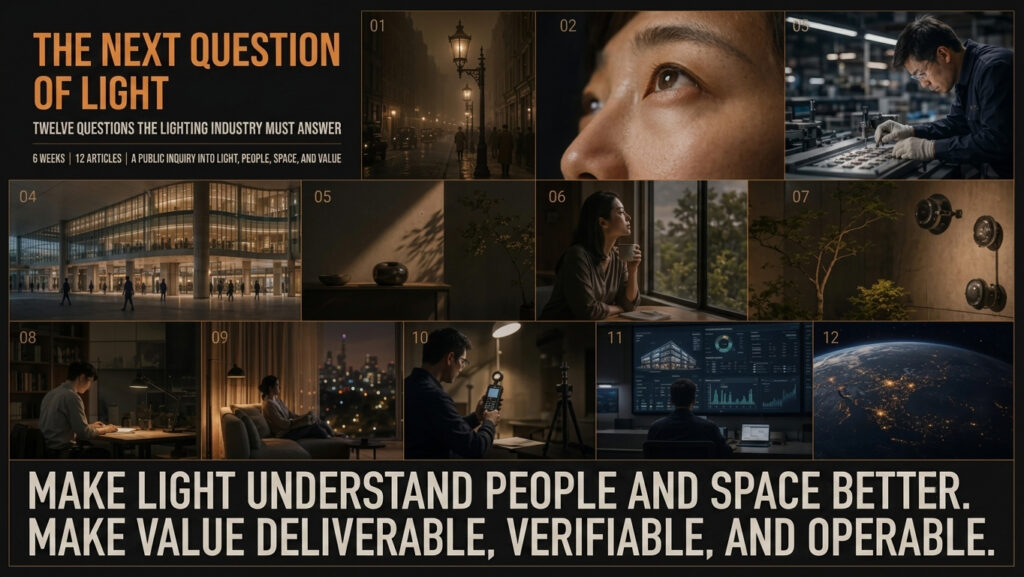
This is the first question of “The Next Question of Light”:
If price, power consumption, and lumens were removed, could your company still prove what value it creates for people and spaces?
Please answer with three elements:
Application scenario | Expected outcome | Verification method
This is not the conclusion.
This is the first question.

 English
  Chinese (China)
  Chinese (Taiwan)