
deLIGHTed talks Asia @ GILE 2026
Good Light Wake-up Call Series Report 13
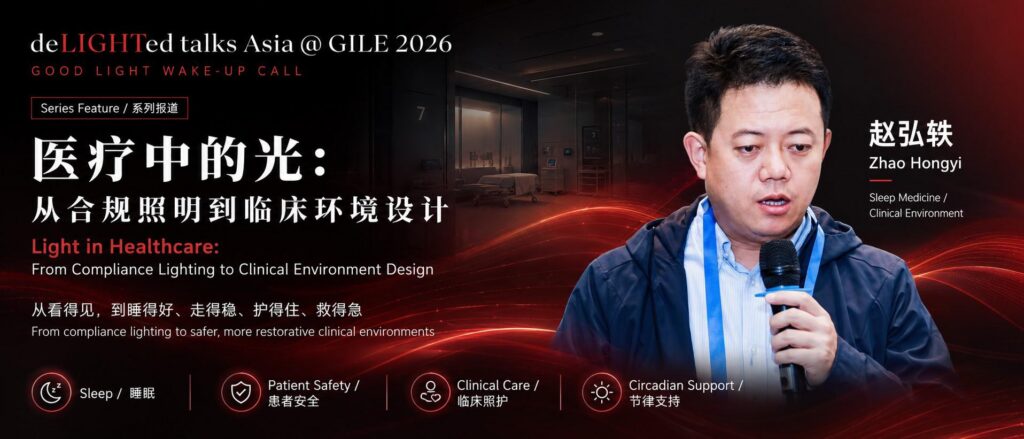
Zhao Hongyi: Light in Healthcare — From Compliance Lighting to Clinical Environment Design
In the previous reports of the Good Light Wake-up Call series, we explored healthy lighting from science, circadian rhythm, LED spectral innovation and the boundaries of emerging technologies.
Professor Robert Lucas reminded us that traditional lux is not enough to describe how light tells the body time.
Dr. Marijke Gordijn emphasized that Good Light means the right light at the right time.
Jan Denneman called on the lighting industry to move from illumination to human outcomes.
Kei Haraguchi of Nichia showed how LED spectral innovation can support circadian-oriented applications.
Dr. Anne Berends expanded the discussion beyond visible light, toward near-infrared light, dose and scientific boundaries.
Zhao Hongyi’s presentation brings this conversation into one of the most demanding and sensitive environments:
Healthcare.
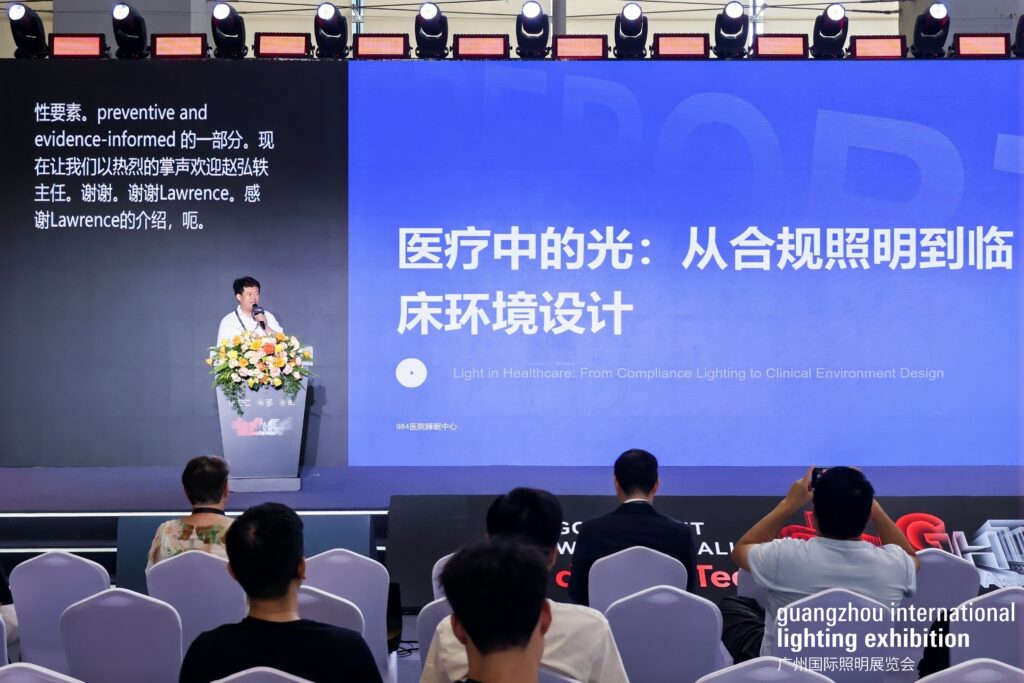
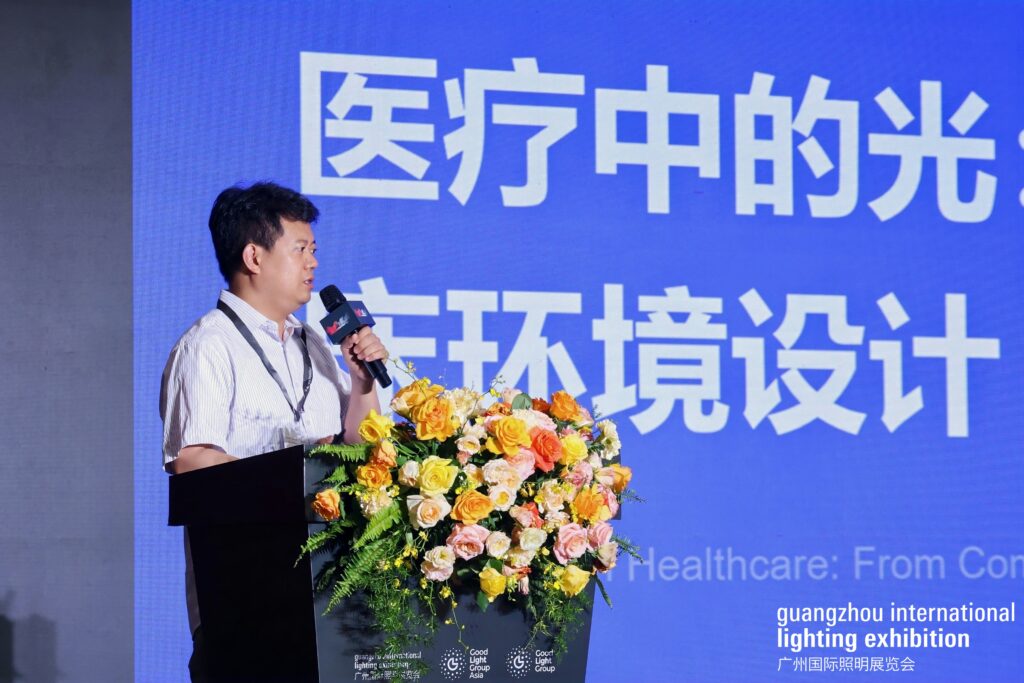
His topic was: Light in Healthcare: From Compliance Lighting to Clinical Environment Design
This title matters. Because in hospitals, light cannot be understood only as “enough brightness.” Healthcare lighting must first be compliant. It must be safe. It must support diagnosis, nursing, rescue, patient movement, medical procedures and hospital operations.
But if healthcare lighting stops at compliance, it remains incomplete.
Hospitals are not ordinary buildings. They include patients with sleep disruption. Older adults with higher fall risk. Nurses working at night. Infants in neonatal intensive care. Patients under pain, anxiety, fatigue and treatment. Clinical teams who must make decisions under pressure.
Sleep centres where the light environment itself may become part of a therapeutic context. In these environments, light is not only a visual condition. Light may affect sleep. Circadian rhythm. Fatigue. Pain. Patient safety. Care quality. Clinical workflow. And the overall experience of healing.
This is why healthcare lighting must move: From compliance lighting to clinical environment design.
1 | Hospital lighting must begin with compliance, but cannot stop there
The first responsibility of healthcare lighting is safety and function. Doctors must see clearly. Nurses must work safely. Patients must move without risk. Medication, equipment, monitoring, bedside care, emergency response and night rounds all require reliable lighting.
Therefore, healthcare lighting cannot be separated from standards and regulations. Illuminance. Colour rendering. Glare control. Flicker. Emergency lighting. Maintenance. Infection control. Visual comfort. Compatibility with medical workflows.
These are essential.
But compliance does not automatically create a good healing environment. A ward may meet illuminance requirements but still make sleep difficult. A corridor may be bright enough but disturb patients at night. A nursing station may support work tasks but contribute to staff fatigue. An ICU may satisfy rescue lighting requirements but lack a day-night rhythm. A sleep centre may have advanced equipment but still fail to manage light, sound, air, curtains, bedding and spatial experience as one integrated environment.
This is the shift Zhao Hongyi’s presentation highlights.
Hospital lighting must not only meet regulations. It must support clinical needs.
This does not mean lighting replaces medicine. It means that light should be treated as part of clinical environment design. That is a more cautious and more valuable pathway for healthy lighting in healthcare.
2 | Hospitalization often means sleep loss
The first major theme in Zhao Hongyi’s presentation is: Light for sleep.
This is one of the most direct and often overlooked issues in healthcare environments.
Many patients do not sleep well in hospitals. Not only because of illness. Not only because of anxiety. But also because of the environment. Ward lighting. Corridor lighting. Night rounds. Medical equipment indicators. Other patients in the same room. Nursing interventions. Noise. Unfamiliar surroundings. Too little daylight during the day. Too much light at night.
Together, these factors may contribute to hospital-acquired insomnia and sleep loss.
This is important for the lighting industry. It reminds us that hospital sleep is not only a matter of beds, medication or quietness. Light environment can be part of the problem.
If patients receive weak daytime signals and excessive night-time light exposure, the body may struggle to maintain a clear circadian rhythm. This may affect recovery experience, fatigue, mood, pain perception, cognitive state and overall wellbeing.
Therefore, healthcare lighting must learn to respect the patient’s night.
3 | Night-time ward lighting is not about total darkness. It is about low disruption, care usability and recovery.
Hospitals cannot simply turn all lights off at night. Nursing still needs to happen. Patients still need to move. Medication and infusion may need checking. Staff may need to assess patient status. Emergencies may occur.
So the challenge of night-time ward lighting is not simply to make everything dark.
It is to balance three goals: Patient sleep. Clinical care. Night-time safety.
Zhao’s presentation discusses the importance of night-time lighting control in hospital wards and references the use of blue-depleted lighting to support circadian rhythm and sleep quality.
This is highly relevant to hospital design.
Night-time lighting should not only be “low illuminance.”
It should also ask: Does it reduce circadian stimulation? Does it avoid direct eye exposure? Does it reduce glare? Does it avoid sudden bright activation? Does it still allow safe clinical operation? Can it be zoned and dimmed? Can it support care without unnecessarily disturbing patients?
A mature night-time ward lighting strategy is not a binary choice between bright and dark.
It should include layers: Sleep-protective ambient light. Low-stimulation bedside care light. Path lighting for night-time movement. Bathroom guidance light. Emergency lighting. Nursing task light. Medical equipment visibility.
These layers require different intensity, direction, spectrum, timing and control logic.
This is where ordinary ward lighting becomes clinical environment design.
4 | Fall risk: night light must protect both sleep and movement.
The second major theme in Zhao Hongyi’s presentation is: Light for reducing falling risk.
This is a very practical and serious healthcare issue.
In hospitals and elder-care environments, falls are a major risk. Older patients, people with insomnia, those who wake frequently at night, those who need to use the toilet, those with medication changes or neurological conditions may be especially vulnerable.
But there is a real contradiction: If night-time light is too bright, it may disturb sleep. If night-time light is too dim, it may increase fall risk.
Therefore, healthcare night lighting cannot focus only on reducing stimulation. It must also support safe movement.
A good night-time fall-prevention light environment should consider: Is the path from bed to bathroom clear? Does the patient need to search for switches in darkness? Are floor obstacles visible? Does the light turn on too abruptly? Is there low-level guidance lighting? Can sensors provide support without startling patients? Can the lighting protect one patient without disturbing others in the same ward? Can it protect sleep while reducing fall risk?
This is the complexity of healthcare lighting. It is never a single metric. It must support sleep, care, safety and human behaviour at the same time.
5 | Light, fatigue, HRV and pain: healthcare lighting must consider the whole human state.
Zhao Hongyi’s presentation also touches on the relationship between light, HRV, fatigue, sleep and pain.
This further expands the role of healthcare lighting.
In hospitals, patients may experience: Pain. Anxiety. Insomnia. Fatigue. Disorientation. Limited mobility. Uncertainty. Emotional stress.
Healthcare workers may experience: Night shifts. High pressure. Long hours. Visual fatigue. Alertness demands. Sleep disruption.
Lighting cannot solve these issues alone. But it is a long-duration environmental exposure. It can add burden, or it can provide support.
For example:
- Harsh, bright or glare-heavy night lighting may make it harder for patients to rest.
- Monotonous indoor lighting without day-night variation may contribute to fatigue.
- Poorly designed night rounds may repeatedly disrupt sleep.
- Staff areas without appropriate lighting strategies may make night shift recovery harder.
This is why healthcare lighting should be integrated into a broader view of clinical environment quality: Sleep. Fatigue. Pain. Mood. Safety. Nursing efficiency. Patient and staff experience.
This is not overclaiming the medical power of light. It is recognizing that the environment itself is part of care.
6 | Neonatal intensive care: light must be handled with exceptional caution
Another important part of Zhao Hongyi’s presentation is: Light for rescue.
Within this theme, neonatal intensive care is especially important. NICU is an extremely sensitive lighting environment. The users are not healthy adults. They may be premature infants whose sensory and circadian systems are still developing. In the womb, the fetus receives timing signals from the mother. After premature birth, the infant is suddenly placed in a hospital environment.
That environment includes equipment, monitoring, noise, medical procedures, artificial lighting and care routines.
In this context, light is both necessary and potentially disruptive. It can support clinical care. But it must also be controlled as an environmental stimulus.
Zhao’s presentation refers to practical recommendations for neonatal ward lighting, including control of light exposure levels, gradual transitions, protection for infants below certain developmental stages and the possible value of cycled lighting before discharge.
This has major implications for lighting design. NICU lighting cannot simply copy adult ward lighting. It cannot focus only on staff task visibility. It cannot apply generic “healthy lighting” concepts without clinical boundaries.
It must consider: Strict illuminance control. Avoidance of continuous high light exposure. Gradual transitions. Individualized protection. Clinical care needs. Circadian development. Infant developmental stage. Staff health and performance. Operational practicality.
This type of environment reminds the lighting industry: The closer we move toward clinically vulnerable users, the more we need scientific humility, evidence and multidisciplinary collaboration.
7 | Light in healthcare should not be oversimplified into product claims
When healthy lighting enters healthcare, one of the greatest risks is over-productization.
For example: This light improves sleep. This spectrum reduces pain. This frequency treats disease. This lighting system supports recovery. This product improves clinical outcomes. These statements may sound attractive.
But without rigorous evidence, they can become irresponsible health claims. Zhao Hongyi’s presentation discusses sleep, light therapy, pain, neonatal care and disease-related applications. But the most important message is not that the industry should rush to sell “medical healthy lighting.”
The real message is: Healthcare lighting must follow an evidence pathway.
In healthcare environments, the lighting industry must be more careful.
It is appropriate to say: A light environment may support sleep and circadian rhythm. Night-time lighting strategies may reduce disruption. Certain clinical environments require special lighting design. Light therapy should be applied under professional guidance and evidence-based protocols. Lighting can be part of clinical environment optimization.
But it is not responsible to say casually: Lighting treats disease. Luminaires replace therapy. A space lighting solution guarantees clinical improvement.
Healthcare is one of the most valuable fields for healthy lighting. It is also one of the fields that requires the highest level of scientific restraint.
8 | Sleep medicine centres may become an important entry point for clinical collaboration
Zhao Hongyi is associated with a sleep centre, and his presentation also refers to the development of sleep clinics, sleep medicine centres and sleep health management.
This is highly relevant for the healthy lighting industry.
Sleep medicine may become one of the most practical clinical entry points for healthy lighting collaboration.
The reason is clear: Sleep is closely connected with circadian rhythms. Light therapy already has recognized applications in some sleep and circadian rhythm disorders. Sleep centres have professional staff, assessment tools and patient groups.
Light environment can be combined with sound, air quality, bedding, curtains, smart systems and behavioural interventions.
Clinical settings offer a clearer pathway for research cooperation and validation.
This suggests future opportunities: Demonstration light environments in sleep centres or wards. Studies of different night-time lighting strategies. Integration of smart home systems into sleep management. Use of wearable devices, sleep monitoring, light exposure data and subjective reports. Development of light environment services for sleep health management.
This is an important direction.
But it must be built on: Medical collaboration. Research collaboration. Ethical compliance. Clinical protocol. Patient safety. Evidence-based practice.
9 | From hospital luminaires to healthcare light environment systems
Traditionally, hospital lighting products are often categorized by space: Ward luminaires. Surgical lights. Examination lights. Corridor lights. Nursing station lights. Waiting area lights. ICU lights. Bathroom lights.
This is a product logic.
Zhao Hongyi’s presentation suggests that future healthcare lighting needs a system logic.
The question is not only: Which luminaire fits this space?
The better question is: What light environment does this clinical scenario require?
A ward needs sleep protection and care efficiency. A corridor needs night-time safety and low disruption. A nursing station needs work support and fatigue management. An ICU needs clinical operation and day-night order. A NICU needs infant protection and individualized light control. A sleep centre needs coordination between environment and clinical workflow. Rehabilitation and elder-care spaces need rhythm, safety and psychological support.
This shifts healthcare lighting from hospital luminaires to healthcare light environment systems.
Such systems may include: Light sources and luminaires. Spectrum and time strategy. Low-stimulation night lighting. Bedside and nursing zoning. Path lighting. Emergency and rescue modes. Daylight management. Curtains and shading. Smart controls. Scene scheduling. Measurement and verification. Staff training. Maintenance procedures.
This is the real upgrade path for healthcare lighting.
10 | What this means for China’s lighting industry: healthcare healthy lighting is not a new gimmick. It is a new specialty.
China’s lighting industry is highly capable of rapidly developing new products.
When healthy lighting becomes a trend, the market quickly produces: Eye-care lights. Full-spectrum lights. Classroom lights. Senior-care lights. Hospital healthy lights. Sleep lights. Circadian lights. Smart ward lighting.
But healthcare cannot be handled only through market speed. It requires professional depth.
Healthcare healthy lighting must deal with: Clinical workflow. Patient safety. Nursing work. Night care. Infection control. Emergency requirements. Psychological experience. Sleep and circadian rhythm. Protection of vulnerable users. Clinical evidence. Long-term operation.
If a company simply renames ordinary lighting as “medical healthy lighting,” that is not progress.
The real upgrade is building professional capability in healthcare light environments.
This includes understanding: Hospital scenarios. Patient and staff needs. Sleep and circadian science. Boundaries of light therapy. Nursing workflows. Measurement and verification. Clinical collaboration. Responsible communication.
The companies with the strongest future in healthcare healthy lighting may not be those with the loudest health claims. They will be those that can work with doctors, hospitals, designers, researchers, testing bodies and operation teams to deliver real scenario outcomes.
11 | From compliance lighting to clinical environment design: what does the shift mean?
The phrase “from compliance lighting to clinical environment design” can be understood in three levels.
First: compliance.
Illuminance, colour rendering, glare, flicker, safety, emergency lighting and maintenance must meet standards.
This is the baseline.
Second: human factors.
Patients, nurses, older adults, infants and people with sleep disorders have different light environment needs.
This changes the design subject.
Third: clinical environment.
Light is no longer only part of building services. It becomes an environmental support factor for sleep, care, safety, recovery, behaviour, psychology and clinical workflow. This expands the value boundary of lighting.
All three levels are necessary.
Without compliance, healthy lighting is dangerous.
Without human factors, healthcare lighting is incomplete.
Without the clinical environment perspective, lighting remains only equipment.
Zhao Hongyi’s topic reminds us: The future of healthcare lighting is not simply more complex luminaires. It is light environments that understand clinical needs, human needs and evidence.
Closing: Good Light in hospitals must be cautious, reliable and evidence-based
Zhao Hongyi’s presentation brings an important healthcare perspective to the Good Light Wake-up Call.
It reminds us: Light in healthcare cannot only mean visibility. But it also cannot be casually marketed as therapy.
It must find the right balance between compliance, safety, clinical need and scientific evidence.
Good Light in hospitals must first be reliable. Safe. Compliant. Useful for diagnosis and care. Supportive of nursing work.
But it should also move further to support: Patient sleep. Low-disruption night-time care. Fall-risk reduction. Neonatal protection. Staff fatigue management. Sleep medicine environments. Clinical environment quality.
No single luminaire can achieve all of this. It requires doctors, nurses, lighting designers, architects, engineers, manufacturers, control providers, testing bodies and operators to work together.
Healthcare healthy lighting should never depend on exaggerated claims.
It needs evidence. Verification. Clinical context. Boundaries. Long-term observation.
From compliance lighting to clinical environment design. From seeing clearly to sleeping better, moving safely, caring gently and responding urgently. From product parameters to healthcare scenarios. From health claims to clinical evidence. From lighting engineering to care environments.
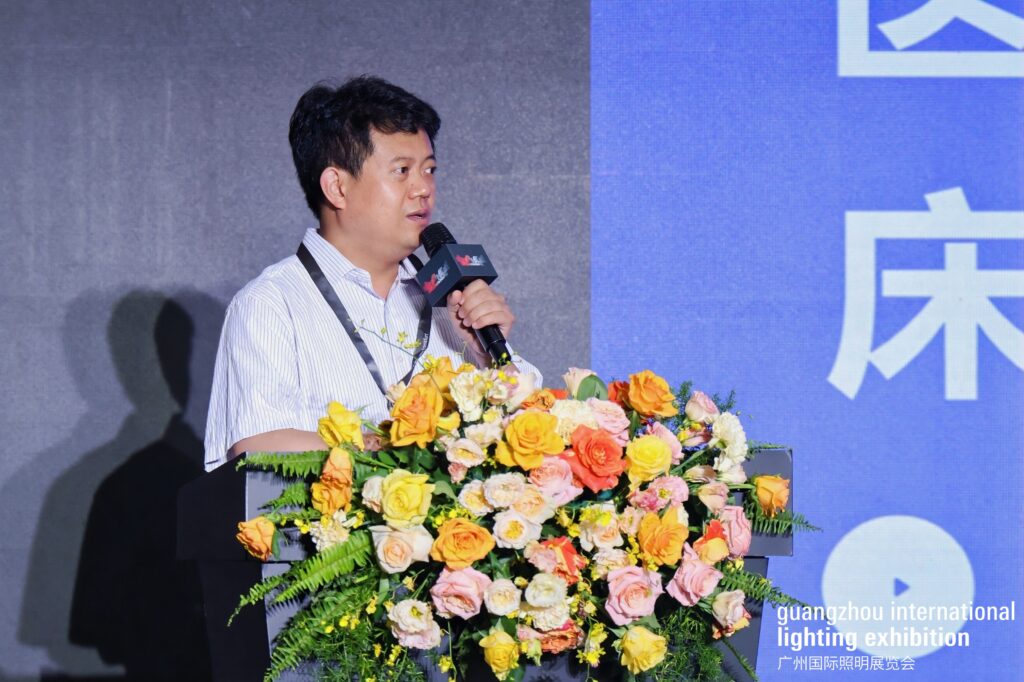
This is the important message Zhao Hongyi brought to deLIGHTed talks Asia @ GILE 2026.
It is also one of the most important boundaries and opportunities for healthy lighting as it enters healthcare.
Good Light Wake-up Call.

 English
  Chinese (China)
  Chinese (Taiwan)