
deLIGHTed talks Asia @ GILE 2026
Good Light Wake-up Call Series Report 14
Professor Yandan Lin: Healthy Homes — The Next Upgrade Beyond Smart and Aesthetic Lighting
In the previous reports of the Good Light Wake-up Call series, we explored healthy lighting from multiple perspectives.
Professor Robert Lucas reminded us that traditional lux is not enough to describe how light tells the body time.
Dr. Marijke Gordijn emphasized that Good Light means the right light at the right time.
Jan Denneman called on the industry to move from illumination to human outcomes.
Kei Haraguchi of Nichia showed how LED spectral innovation can support circadian-oriented lighting applications.
Dr. Anne Berends expanded the discussion beyond visible light, toward near-infrared light, dose and scientific boundaries.
Zhao Hongyi brought healthy lighting into healthcare, reminding us that light in hospitals must move from compliance lighting to clinical environment design.
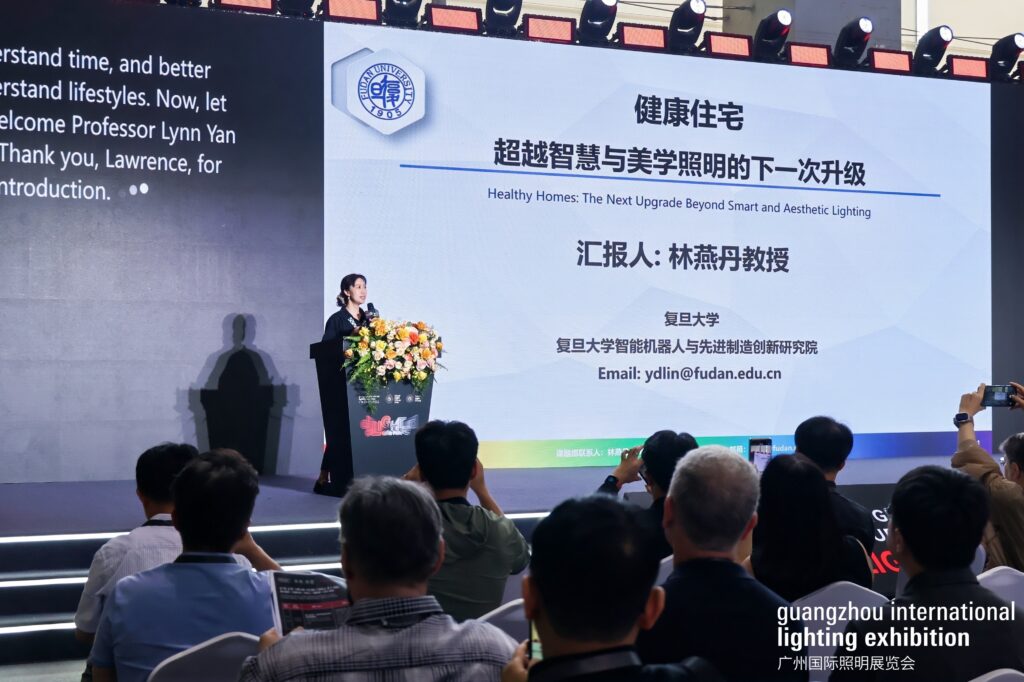
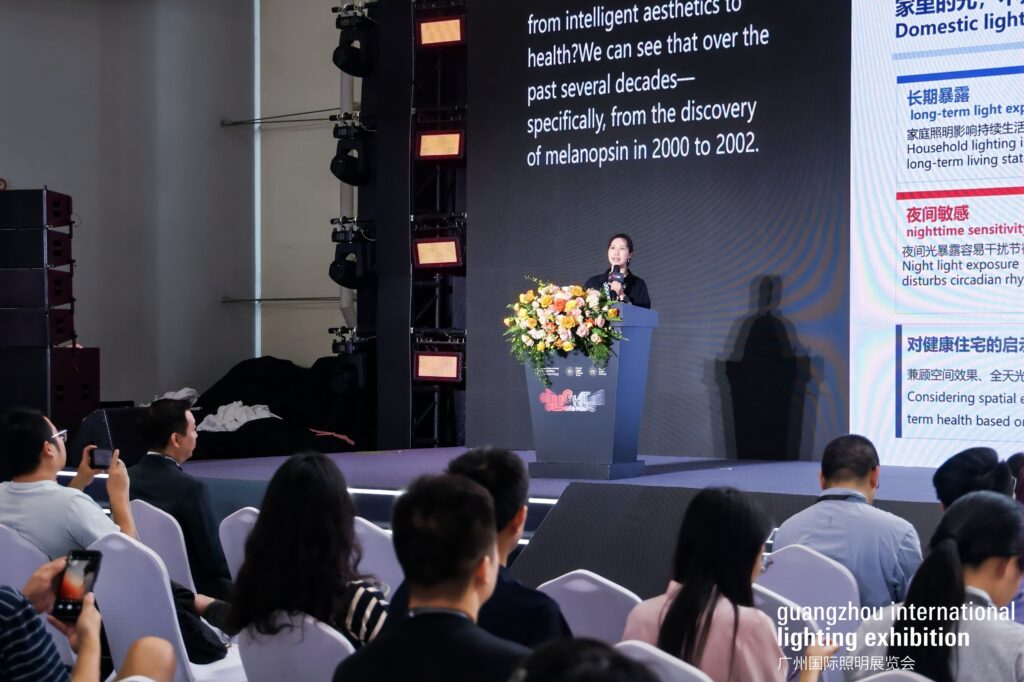
Professor Yandan Lin’s presentation brings the conversation back to the space where people spend some of their longest and most intimate hours: The home.
Her topic was: Healthy Homes: The Next Upgrade Beyond Smart and Aesthetic Lighting
This title is important.
For many years, residential lighting has developed along three major directions.
First, functional lighting.
The goal was visibility, safety and energy efficiency.
Second, aesthetic lighting.
The goal was spatial layering, material expression, ambience and emotional atmosphere.
Third, smart lighting.
The goal was connectivity, sensors, automation, app control, voice control and scene switching.
All three upgrades are valuable.
But Professor Lin reminds us that residential lighting still lacks something more fundamental: a health objective function.
In other words, the next generation of residential lighting should not only ask: Can the lights be controlled? Does the space look beautiful? How many scenes does the system provide? Is the home intelligent?
It must ask a more important question: Does this lighting environment support sleep, circadian rhythm, mood, cognition, night-time safety and long-term health?
This is the real question behind healthy homes.
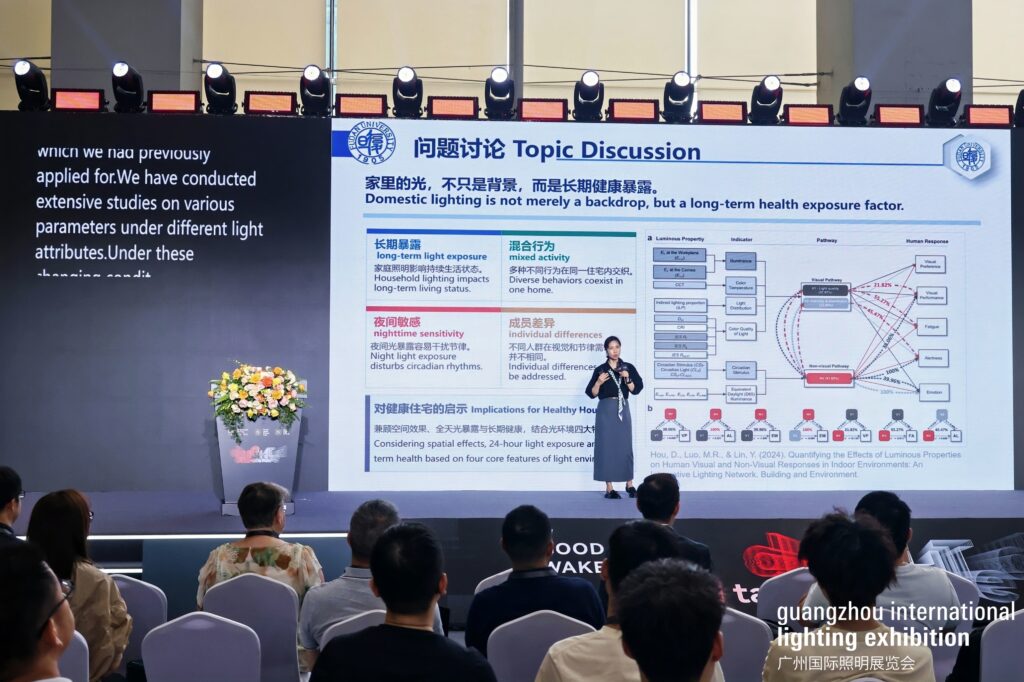
1 | Domestic lighting is not merely a background. It is a long-term health exposure.
Residential lighting is different from lighting in offices, hotels or hospitals.
A home is one of the spaces where people stay the longest. It is also one of the most behaviourally complex environments.
Children study, play and sleep at home. Older adults may spend long hours indoors. People working from home may remain under domestic lighting for most of the day. Family members move between the living room, bedroom, kitchen, bathroom and corridor. Evening and night-time light directly affect sleep preparation, night waking and circadian protection.
Yet many people still treat home lighting as background. As long as it is bright enough. As long as it feels warm. As long as it looks elegant. As long as it is convenient to control.
But from the perspective of healthy lighting, residential light is not background. It is long-term health exposure.
The light people experience every day at home may influence their daily state, their rhythm, their sleep, their mood and their ability to recover.
This is why healthy homes must redefine the role of light.
Light is not a secondary decoration in the home. Light is part of the rhythm of family life.
2 | Residential lighting has gone through three upgrades, but it still needs a health objective
The evolution of residential lighting can be understood through several stages.
The first stage was functional lighting.
The focus was illuminance, safety and energy efficiency.
The question was: Can people see?
The kitchen must be bright enough for cooking. The bathroom must be safe. The bedroom must provide basic lighting. Children and older adults should not move in darkness.
This was the foundation.
The second stage was aesthetic lighting.
The focus shifted to spatial hierarchy, materiality, ambience and emotional atmosphere.
Cove lighting. Wall washing. Linear lighting. Cabinet lighting. Accent lighting. Warm decorative layers. More sophisticated visual expression.
This helped residential lighting move from “bright enough” to “beautiful.”
The third stage was smart lighting.
The focus became connectivity, sensing, automation, voice control, app control and whole-home scenes.
Lights could be controlled remotely. Timed. Linked with curtains. Changed by one button. Activated by presence. Integrated into smart home systems.
This helped lighting move from “beautiful” to “convenient.”
But after these three upgrades, a deeper question remains: What is the health goal?
Functional lighting asks: Is it bright enough?
Aesthetic lighting asks: Does the space feel good?
Smart lighting asks: Is it easy to control?
Health-oriented lighting asks: Does this light environment support human health outcomes?
Sleep. Circadian rhythm. Mood. Cognition. Night-time safety. Aging in place. Individual differences. Long-term wellbeing.
Health-oriented lighting does not reject function, aesthetics or intelligence. It redefines the common goal they should serve.
3 | Smart lighting answers “how to control.” Healthy lighting answers “why we control this way.”
Today, many homes are becoming smart.
But intelligence does not automatically mean health.
A lighting system can be highly intelligent and still be biologically inappropriate. It can support voice control. It can offer colour tuning. It can provide app-based scenes. It can respond to sensors. It can connect with curtains, air conditioning and other devices.
But if it does not understand why light should be controlled in a certain way, it remains only a control technology.
For example:
At 11 p.m., a system may turn on bright cool-white light in the living room. That may be smart, but it is not necessarily healthy.
A child may finish studying under high-intensity light and immediately try to sleep. That may be convenient, but it is not necessarily rhythm-friendly.
An older adult may get up at night and trigger a sensor light that turns on too abruptly. That may be automatic, but it may not be comfortable or safe.
A bedroom lamp may offer millions of colours but no low-stimulation pre-sleep logic. That may be rich in function, but not necessarily meaningful.
Smart lighting answers: How do we control the lights?
Healthy lighting answers: Why should the light be controlled this way?
This is the fundamental difference.
From controlling lamps to managing light exposure.
From switching scenes to supporting health goals.
From convenient operation to 24-hour rhythm support.
The next generation of residential lighting should not be only a smarter lamp. It should be a lighting environment that understands people.
4 | A healthy residential light environment depends on at least four factors
Professor Lin emphasizes that a healthy light environment is determined by at least four factors: Time. Spectrum. Individual differences. Context.
These four factors are essential.
First, time.
The same light has different meanings in the morning, at noon, in the evening, before sleep and during the night.
Daytime light should support alertness and circadian synchronization. Evening light should gradually reduce stimulation. Pre-sleep light should help the body transition toward rest. Night-time light should support safety with minimal disruption.
Healthy lighting cannot only ask: Is it bright?
It must also ask: When should it be bright? When should it be dim? When should biological stimulation be increased? When should it be reduced?
Second, spectrum.
Traditional residential lighting has focused on CCT, CRI and illuminance. Healthy lighting must also consider spectral composition and non-visual effects.
The movement from photopic lux to melanopic EDI and alpha-opic quantities represents a major evolution in evaluation language.
Third, individualization.
Different people have different light needs.
Age, chronotype, visual ability, sleep status, sensitivity and daily routine all matter.
Children, older adults, shift workers, people with sleep difficulties, home workers and sensitive users should not all be treated by the same lighting curve.
Fourth, context.
The living room, bedroom, kitchen, bathroom, children’s room and older adult’s room all involve different tasks and different health goals.
One home contains many overlapping behaviours: Studying. Cooking. Socializing. Relaxing. Sleeping. Night-time movement. Caregiving. Remote working.
Therefore, healthy residential lighting is not simply about fixed colour temperature or fixed brightness. It is a multi-variable, synergistically designed health environment.
5 | The evaluation language is changing: from “is it bright enough?” to “when, what light, for whom and for which health goal?”
Traditional lighting evaluation focuses on: Horizontal illuminance. Colour temperature. Colour rendering. Glare. Uniformity. Energy efficiency.
These remain important.
But healthy homes require a new evaluation language.
The question is no longer only: Is it bright enough?
The better questions are: When? What kind of light? For whom? For which health goal? Can the effect be verified?
This means that residential lighting evaluation is moving through several layers.
First, engineering vision.
Can people see clearly and comfortably?
Second, biological effectiveness.
Does the light support circadian stimulation during the day? Does it reduce unnecessary stimulation at night? Does it consider eye-level exposure?
Third, health outcomes.
Does it support sleep, rhythm, mood, cognition and night-time safety?
Fourth, validation evidence.
Can the effect be measured? Can it be evaluated? Can data support optimization? Can long-term feedback be collected?
This is the major difference between traditional residential lighting and health-oriented residential lighting.
The future is not about more modes. It is about clearer health goals and stronger evidence chains.
6 | Sleep is the most direct pain point in healthy homes
In residential environments, the most immediate and understandable health goal is sleep.
Everyone needs sleep. Every family cares about sleep. Children, adolescents, adults and older people all face different sleep challenges. And the home is where sleep mainly happens.
Therefore, healthy residential lighting should first ask:
- Does daytime light help the body recognize day?
- Does evening light gradually reduce stimulation?
- Does pre-sleep lighting avoid excessive brightness and direct eye exposure?
- Does night-time lighting provide safe navigation without strong disruption?
- Does the bedroom reduce unnecessary screen and light intrusion?
- Do children and older adults need different night strategies?
This is not simply about making all light warmer. Nor is it only about adding one “sleep mode.”
A sleep-friendly home must begin with 24-hour light exposure management.
The day should not be chronically dim. The evening should not remain as bright as daytime. The night should not become visually unsafe. The pre-sleep period should not continuously send daytime signals to the body.
Healthy homes are not only about turning lights off at bedtime. They are about helping the body understand time throughout the day.
7 | Healthy homes must also consider daytime brain state. Health is not only eye-care.
In many consumer markets, residential healthy lighting is strongly associated with eye-care.
This is important.
Flicker, glare, illuminance, colour quality and blue-light-related concerns all affect visual comfort.
But healthy homes cannot stop at eye-care.
Professor Lin’s research also points to the influence of light on emotion, cognition and brain state.
This means that residential lighting should also consider daytime human state:
- Is the person working from home alert?
- Can children focus while studying?
- Do older adults receive enough daytime light exposure?
- Does the living room support active social life during the day?
- Does long-term indoor life affect mood and circadian rhythm?
Health is not only about reducing visual fatigue. It also includes sleep, rhythm, emotion, cognition, behaviour and everyday living state.
Therefore, healthy home lighting should provide 24-hour benefits. Daytime support for activity. Evening support for transition. Night-time support for rest.
Different spaces supporting different people and states.
This is the shift from eye-care lighting to whole-home healthy lighting environments.
8 | Aging in place and night-time safety are essential needs
As populations age, residential lighting must pay closer attention to older adults.
Older adults may experience: Reduced visual ability. Greater glare sensitivity. More frequent night waking. Higher fall risk. Lighter sleep. Weaker circadian rhythms. Cognitive changes. Greater need for spatial clarity.
Therefore, healthy homes are not only a lifestyle upgrade for young families.
They are also essential to aging-in-place design.
Older adults’ rooms need more carefully designed light strategies.
During the day, sufficient light exposure can support activity, reading, rhythm and cognitive engagement. In the evening, stimulation should be gradually reduced. At night, lighting should provide low-stimulation, low-glare and easily accessible path guidance.
The route from bed to bathroom must be clear. Switches, sensors and automation should not confuse users. Night-time light should not be too bright, but also not too dim.
Healthy lighting for older adults is not simply about giving them brighter lights. It is about balancing visibility, sleep, safety and usability.
This will become one of the strongest demands in future healthy homes.
9 | There is no one-size-fits-all curve for healthy residential lighting
Many smart lighting systems provide fixed scenes: Reading mode. Movie mode. Guest mode. Sleep mode. Night mode. Children’s mode. Elderly mode.
These can be useful as entry points.
But Professor Lin reminds us that there is no one universal curve for healthy homes. Spaces differ. People differ. Routines differ. Times of day differ. Behaviours differ. Health goals differ.
The living room may need alertness, social interaction and visual comfort during the day. Before sleep, it may need a low-stimulation transition.
The bedroom may need morning wake-up light. Before sleep, it needs sleep protection.
At night, it needs low-disruption guidance.
The kitchen needs visibility, colour discrimination and shadow control.
But a brief night-time visit to the kitchen should not trigger harsh bright light.
The bathroom needs cleanliness and visibility. But at night, it needs low-glare guidance and fall prevention.
An older adult’s room may need reading, circadian support and cognitive engagement during the day. At night, it needs safety, low stimulation and accessibility.
Therefore, future healthy home lighting should not chase one universal algorithm. It should build strategies by space, time, user group and health goal.
10 | Future trend 1: individual circadian portraits
The first future trend is the individual circadian portrait.
Today’s smart lighting is often based on preset scenes.
Future healthy homes need to understand:
- When does this person wake up?
- When do they sleep?
- Do they stay at home during the day?
- Do they work night shifts?
- Are they older adults?
- Are they students?
- Do they have sleep difficulties?
- Are they light-sensitive?
- Do they need a different strategy from other family members?
This is the shift from preset scenes to individual circadian profiles.
Not everyone should use the same light curve. Not every family follows the same routine. Not every age group needs the same brightness and timing.
Future healthy homes should gradually learn the daily rhythm of their users.
But this must be built with privacy boundaries. Data collection must be minimized. Non-identifiable. Explainable. Closable. Based on trust.
Healthy home intelligence must never sacrifice privacy in the name of health.
11 | Future trend 2: from single-lamp intelligence to a whole-home light environment operating system
Much of today’s smart lighting is still single-lamp intelligence. One lamp can dim. One lamp can change colour. One room can be linked. One app can control multiple devices.
But true healthy homes require a whole-home light environment system.
The system should understand:
- What time is it?
- Which space is occupied?
- What is the likely activity?
- Is the goal visual task, social interaction or rest?
- What is the daylight condition?
- Are the curtains open?
- What are the routines of family members?
- Is low-stimulation path lighting needed at night?
- Which spaces should avoid abrupt brightness?
This is closer to a home light operating system. It does not only control lamps. It manages whole-home light exposure.
From perception to assessment. From assessment to intervention. From intervention to validation. From validation to optimization.
This is the closed-loop logic Professor Lin describes: First understand human light exposure. Then assess health goals. Then intervene. Finally validate and optimize with data.
That is the real direction of healthy home intelligence.
12 | Future trend 3: interdisciplinary collaboration
Healthy residential lighting cannot be developed by one discipline alone.
It requires: Lighting science. Architecture. Interior design. Visual science. Circadian biology. Brain science. Behavioural science. Smart controls. Sensors. Data science. Sleep medicine. Aging-in-place design. Ethics and privacy protection.
In the past, residential lighting was mainly a design and product issue.
Future healthy homes are interdisciplinary systems.
This means lighting companies should not only work with channels, decorators and smart home brands. They should also work with universities, sleep medicine teams, building research institutes, standards organizations, testing bodies and healthy building platforms.
Healthy homes cannot be established by sales language alone. They require science, experimental validation, standards language and long-term feedback.
13 | Future trend 4: long-term validation and evidence
One of the greatest risks in healthy residential lighting is that marketing moves faster than evidence.
A lamp claims to help sleep. A scene claims to protect the eyes. A system claims to support circadian rhythms.A whole-home package claims to improve health.
But the real questions are:
- Is there a standards basis?
- Is there experimental validation?
- Is there field measurement?
- Is there long-term feedback?
- Are user boundaries clearly defined?
- Does the system explain what it cannot guarantee?
Professor Lin’s presentation emphasizes that the future threshold is not who has more scene modes, but whose health strategies are supported by standards, validation and long-term feedback.
This is a message the industry should remember.
Healthy homes should not become a competition of more modes. They should become a competition of stronger evidence.
Without validation, healthy lighting remains a claim. With validation, it can become part of residential quality.
14 | Future trend 5: from product sales to healthy home services
The final trend is not only about selling luminaires. It is the shift from product sales to healthy home services.
In the past, companies sold: Luminaires. Switches. Control systems. Smart panels. Apps. Interior lighting packages.
In the future, they may provide: Sleep-friendly light environments. Children’s study and pre-sleep transition strategies. Night-time safety lighting for older adults. Circadian-friendly whole-home systems. Work-from-home light environments. Long-term light exposure monitoring and optimization. Healthy home assessment and commissioning services.
This changes the business model.
From hardware profit to system service. From one-time delivery to long-term operation. From decoration effect to health value. From product sales to home light environment management.
This is not a slogan upgrade. It requires real system capability.
15 | What this means for the residential lighting industry
Residential lighting is upgrading quickly. Minimalist lighting and indirect lighting have become popular. Smart lighting is entering more homes. Whole-home control, voice activation, sensing, ambience scenes and app-based systems are now common selling points. Eye-care, full spectrum, low blue light and low flicker have become familiar consumer terms.
But the next stage cannot be only about smarter lights.It must be about healthier homes.
This means:
Do not compete only on the number of scenes. Compete on health logic.
Do not compete only on control methods. Compete on light exposure management.
Do not compete only on CCT range. Compete on day-night rhythm strategy.
Do not compete only on smart panels. Compete on whole-home closed-loop systems.
Do not compete only on eye-care. Compete on sleep, rhythm, mood, cognition and night-time safety.
Do not compete only on renderings. Compete on measured data and long-term feedback.
The future competition in residential lighting is not: Whose lamp is more impressive?
It is: Who can provide the right light at the right time for different family members?
Closing: the next high-quality home is not a smarter lamp, but a healthier home
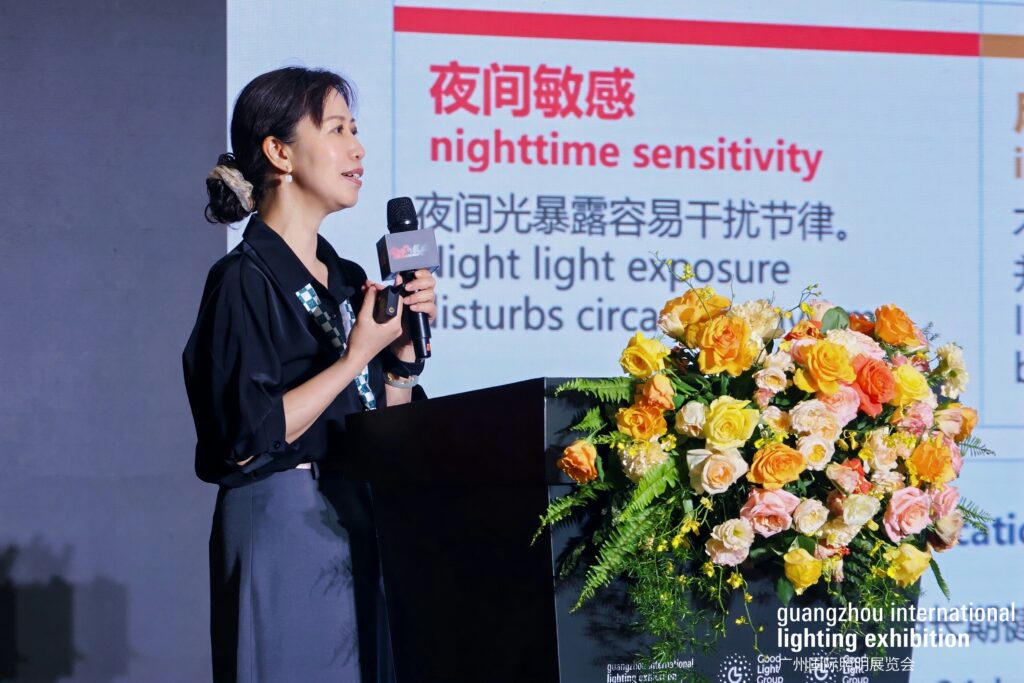
Professor Yandan Lin’s presentation brings a crucial residential perspective to the Good Light Wake-up Call.
It tells us: Domestic lighting is not merely a background. It is long-term health exposure.
Smart lighting is not the same as healthy lighting. Aesthetic lighting is not the same as human effectiveness. Functional lighting is not the same as long-term health.
Healthy home lighting must combine time, spectrum, individual differences and context. It must move from controlling lamps to managing light exposure.
From fixed scenes to individual circadian portraits.
From single-lamp intelligence to whole-home light environment systems.
From product sales to healthy home services.
From marketing concepts to standards, experiments and long-term validation.
The next high-quality home should not only be more beautiful. Not only more intelligent. Not only more convenient.
It should better understand the 24-hour life of the people who live inside it. Support alertness during the day. Help transition in the evening. Reduce stimulation before sleep. Protect safety at night.
Help older adults move with confidence. Help children sleep better. Help families live with better rhythm.
This is the true direction of healthy residential lighting.
The next upgrade is not a smarter lamp, but a healthier home.
Good Light Wake-up Call.

 English
  Chinese (China)
  Chinese (Taiwan)