
From GLG, GLGA, to IWBI… Healthy lighting demands cross-organizational consensus and industry action.
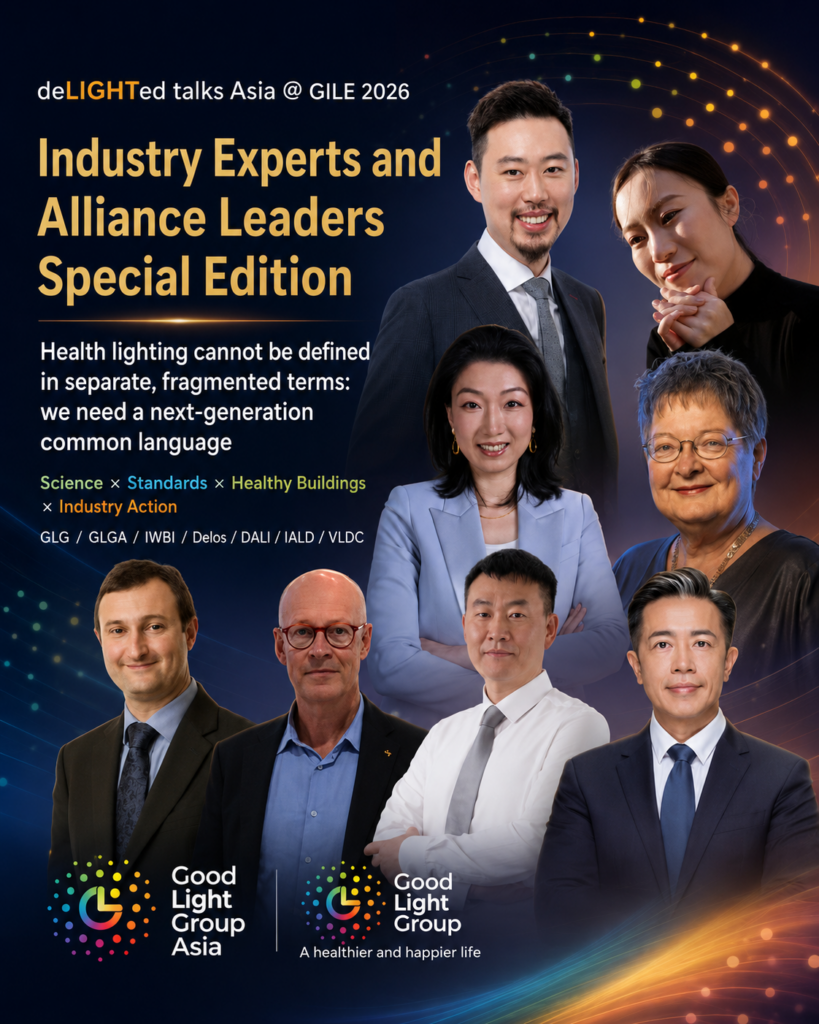
Health lighting cannot be defined in separate, fragmented terms: these industry experts and alliance leaders are driving a next-generation common language.
From GLG, GLGA, IWBI, Delos, DALI, IALD, VLDC, to ELCOMA, health lighting requires cross-organizational consensus and coordinated industry action.
Health lighting is becoming one of the most important emerging topics in the lighting industry.
But it is also entering a very dangerous stage.
Everyone is talking about health lighting.
Yet what each person means by “health lighting” may not be the same thing.
- Some define health lighting through circadian rhythm.
- Some define it through eye protection.
- Some define it through full-spectrum lighting.
- Some define it through sleep enhancement.
- Some define it through healthy buildings.
- Some define it through office productivity.
- Some define it through medical and elderly care applications.
- Some define it through smart control systems.
- Some define it as a product feature.
- Some define it through design experience.
None of these are wrong.
But without a shared language across the industry, health lighting will quickly become a conceptual free-for-all.
- Scientists speak the language of science.
- Designers speak the language of design.
- Companies speak the language of products.
- Control systems speak the language of protocols.
- Healthy building frameworks speak the language of certification.
- Owners speak the language of return on investment.
- Testing bodies speak the language of reports.
- Marketing speaks the language of communication.
If these languages cannot connect, health lighting will struggle to move from concept to standard, from standard to product, from product to design, from design to verification, and from verification to owner value.
This is precisely one of the core missions of deLIGHTed talks Asia @ GILE 2026 / Good Light Wake-up Call:
to move health lighting from fragmented narratives toward a next-generation common language.
1 | Why does health lighting need alliances and industry leaders?
Because health lighting is not a single product.
It is not a single LED.
Not a single luminaire.
Not a control system.
Not a sensor.
Not a report.
Not a WELL clause.
Not a research paper.
And not a conference presentation.
Health lighting is a cross-disciplinary, cross-industry, and cross-application system.
It involves at least:
- light sources and spectral design;
- luminaires and optical engineering;
- control protocols and intelligent systems;
- design software and spatial simulation;
- on-site measurement and verification;
- healthy buildings and owner value;
- medicine, sleep science, circadian biology, and neuroscience;
- offices, education, healthcare, residential, hospitality, and public buildings;
- standards, associations, alliances, and industry consensus.
Such a system cannot be defined by any single company.
Nor should it be monopolized by any single organization.
And it cannot be left to market communication alone to form order.
- It requires alliances.
- It requires standards bodies.
- It requires professional associations.
- It requires scientists.
- It requires designers.
- It requires industry leaders.
- It requires healthy building experts.
- It requires control and data platforms.
- It requires owners and pilot projects.
The real next step for health lighting is not to produce more slogans.
It is to establish a new shared language that the industry can use, validate, and deliver together.
2 | Good Light Group: From a Global Good Light Initiative to Action in Asia
Good Light Group represents a very clear global direction:
Light is more than illumination.
Light is an important environmental factor that influences human health, sleep, circadian rhythm, mood, performance, and quality of life.
Over the past several decades, the lighting industry has successfully completed the transition from conventional light sources to LED.
But after LEDification, the industry has gradually fallen into a cycle of homogenized competition.
- Efficiency continues to increase.
- Prices continue to fall.
- Products are becoming increasingly similar.
- Competition is becoming more intense.
- Yet meaningful innovation is becoming harder to see.
The significance of Good Light is to help the industry rediscover the value of light itself.
Light does not exist solely for energy efficiency.
Nor is light merely a tool for decorating spaces.
And it is certainly not just a collection of hardware specifications.
Light is one of the most important connections between people and their environment.
Through deLIGHTed talks Asia, we hope to bring the global vision of Good Light to Asia and further transform it into:
- scientific questions that can be discussed;
- standards topics that can be advanced and tracked;
- industry actions that can be implemented;
- demonstration projects that can be validated;
- and an Asian healthy lighting network that people can actively participate in.
This is the true meaning of the Good Light Wake-up Call.
It is not a slogan.
It is a wake-up call of the industry.
3 | Jan Denneman: The Global Perspective and Industry Responsibility Behind Good Light
Jan Denneman is Chairman of the Board of Good Light Group (GLG), Honorary Ambassador and past President of the Global Lighting Association, and former Vice President Industry Associations at Philips Lighting.
Jan will participate virtually in the June 8 Good Light Wake-up Call / LED WG closed-door meeting and deliver an opening keynote video address, bringing a global perspective to this Asian initiative.
Jan’s role is particularly important.
Because he represents more than an individual.
He represents the experience and judgment accumulated through decades of global lighting industry development.
The lighting industry has historically been highly successful at transforming technological innovation into industrial scale.
From incandescent lamps and fluorescent lighting to LEDs, the industry has repeatedly driven transformation through standards, associations, manufacturing, distribution, applications, and market education.
Today, however, the industry faces a different challenge.
Health lighting is not simply about replacing one light source with another.
Nor is it merely about improving efficiency.
And it is certainly not just about connecting luminaires to intelligent control systems.
Health lighting requires the industry to rethink fundamental questions:
- What is good light?
- What is human value?
- What is scientific responsibility?
- What are the boundaries of products?
- What is the language of design?
- What constitutes verifiable delivery?
- What is the role of the lighting industry in the future of society?
Jan’s participation will help us explore these questions through the lens of global industry development, association collaboration, and the spirit of Good Light, while considering how Asia’s health lighting movement can avoid becoming short-term, fragmented, or driven primarily by marketing narratives.
4 | GLGA: The Mission of the Good Light Group Asia
If Good Light Group provides the global direction, then the mission of GLGA /Good Light Group Asia is to translate that direction into action across Asia.
Asia is one of the world’s most complex and dynamic regions for lighting manufacturing, supply chains, application scenarios, and market demand.
It is home to the most comprehensive LED industry ecosystem.
It possesses some of the world’s most important luminaire manufacturing capabilities.
It is experiencing rapid growth in healthy buildings, smart buildings, healthcare and wellness, offices, education, residential developments, and hospitality markets.
And it has strong capabilities in design, engineering, distribution, and project implementation.
Yet Asia faces many of the same challenges.
- There is no shortage of health lighting concepts, but industry consensus remains limited.
- There are many products, but insufficient validation.
- There are numerous applications, but not enough standards.
- There is extensive promotion, but insufficient clarity around scientific boundaries.
- There is abundant technology, but inadequate cross-disciplinary collaboration.
What GLGA seeks to do is not create another isolated organization.
Rather, it aims to build a platform for connection:
- connecting science and industry;
- connecting the global community and Asia;
- connecting standards and design;
- connecting products and real-world applications;
- connecting companies and building owners;
- and connecting forums with long-term action.

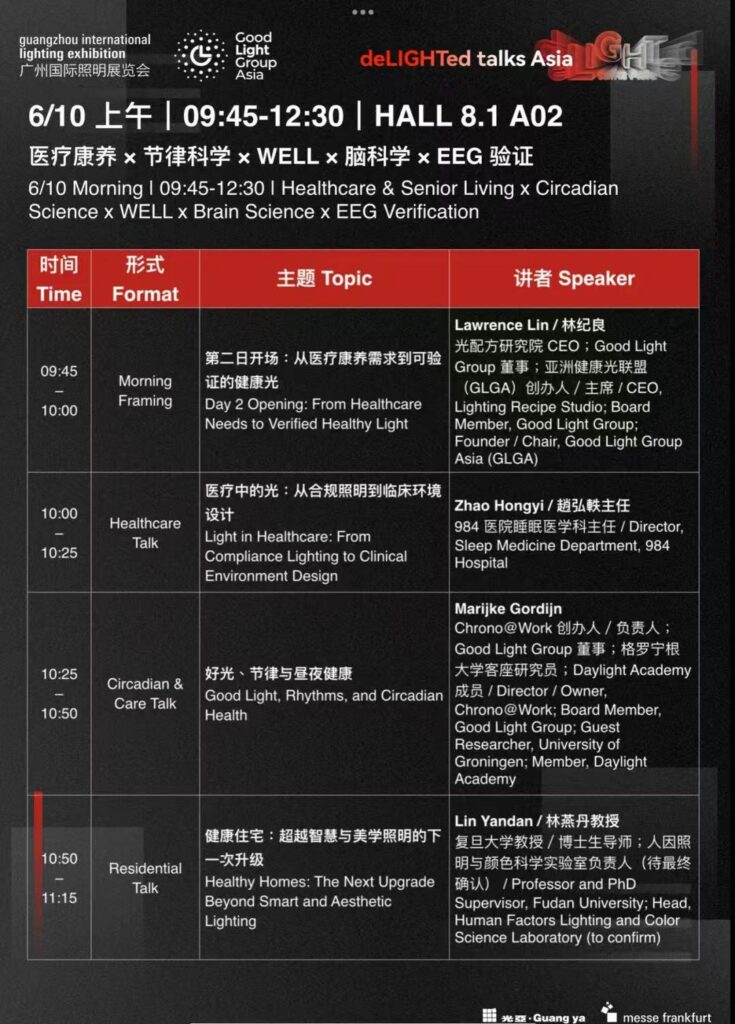
Lawrence Lin, Board Member of Good Light Group and Founder/Chairman of GLGA, will lead the Good Light Wake-up Call Asia initiative during this event and co-chair FG-05 HCL-ready IES Profile and FG-06 Good Light Wake-up Call Full Value-chain Action Consensus.

Daniel Cheng, Secretary General of GLGA, will be responsible for on-site coordination of the Focus Group and Action Day sessions, agenda consolidation, and the advancement of follow-up actions.
This means that deLIGHTed talks Asia is not just a forum.
It is also an important starting point for GLGA’s efforts to promote collaborative development of the health lighting industry across Asia.
5 | IWBI: How Can Healthy Buildings Turn Health Lighting into Measurable Value?
For health lighting to truly become part of projects, building owners must understand its value.
Owners are concerned with more than technical specifications.
They will ask:
- Why should I invest in health lighting?
- Does it affect occupant health and performance?
- Does it enhance asset value?
- Can it be integrated with WELL, ESG, green building, and healthy building strategies?
- Are the outcomes measurable?
- Can users actually experience the benefits?
- Can it become a point of differentiation for the project?
This is where the importance of IWBI / WELL comes in.
IWBI represents one of the most important languages within the healthy building ecosystem.

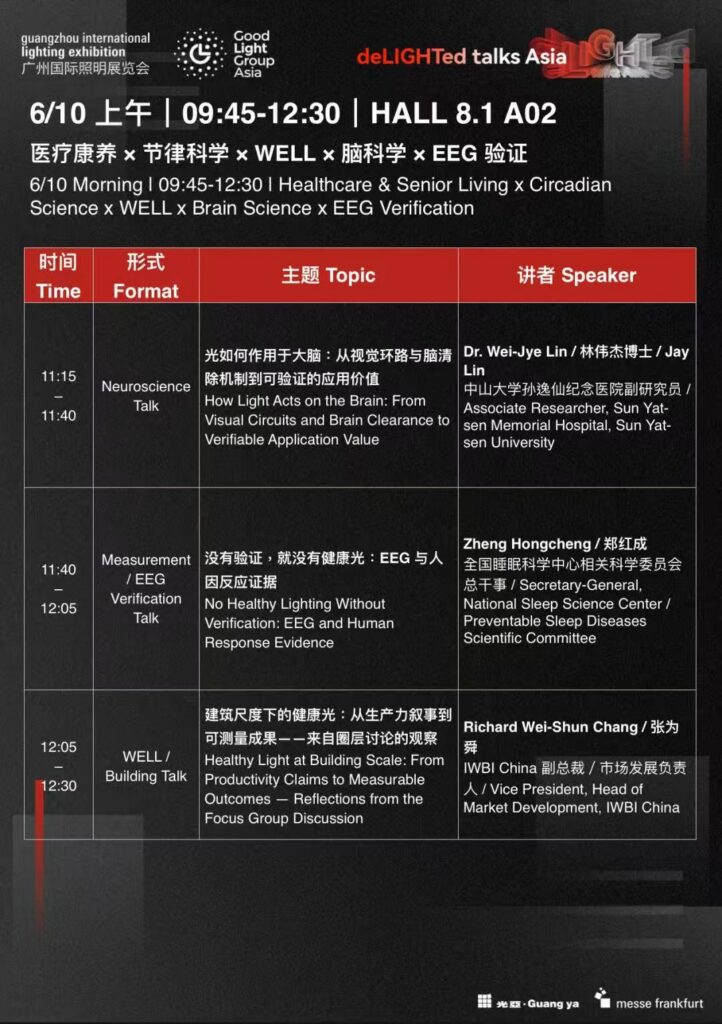
Richard Chang, Vice President and Head of Market Development at IWBI China, will participate in the main forum and related focus group discussions, bringing perspectives from WELL, healthy buildings, owner value, and measurable outcomes.

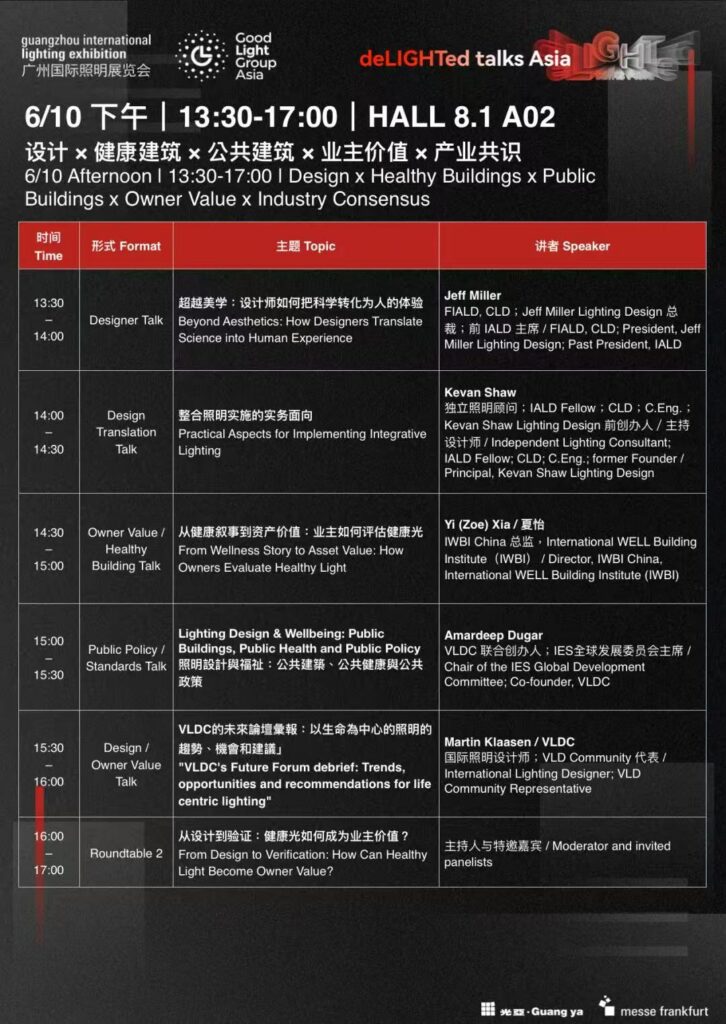
Yi / Zoe Xia, Director of China at International WELL Building Institute (IWBI), will share insights around how building owners evaluate healthy lighting, and the shift from health narratives to asset value.
IWBI’s participation is a reminder to the industry:
- If healthy lighting cannot be understood by building owners, it is difficult to integrate it into real projects.
- If it cannot enter real projects, it is difficult to achieve scale.
- If it cannot generate measurable outcomes, it is difficult to establish long-term market trust.
Healthy lighting must evolve from a “product feature” into a “spatial value.”
WELL Building Standard and the language of healthy buildings serve as an important bridge connecting science, design, building owners, and asset value.

6 | Delos and Well Living Lab: Healthy Lighting Requires Validation in Real Living Environments

Tori Hui Ren, PhD, is the China Director at Delos and a researcher at the Well Living Lab.
The significance of Delos and Well Living Lab lies in shifting the discussion of healthy lighting away from isolated luminaires or single performance metrics, and toward real-world living environments.
People in a space are not influenced by light alone.
They are simultaneously affected by air quality, acoustics, thermal conditions, spatial layout, materials, behavioral patterns, psychological perception, work stress, sleep states, and social relationships.
For this reason, the validation of healthy lighting cannot remain limited to laboratory settings.
Nor can it remain limited to the product level.
It must enter real environments and observe real human responses.
This is where the value of a Living Lab becomes critical.
It enables us to examine questions such as:
- How does healthy lighting perform in office environments?
- How does it function in residential settings?
- How can it be applied in hospitality and wellness-care environments?
- How can it be analyzed together with air, sound, thermal, and behavioral data?
- How do we move from experience to evidence?
- How do we translate evidence into asset value communication for building owners?
Tori’s participation will bring an important perspective to deLIGHTed talks Asia on healthy buildings, Living Lab methodologies, value communication, and the generation of verifiable outcomes.
7 | DALI Alliance: Without a Control Protocol, Healthy Lighting Cannot Be Truly Operated
Many discussions about healthy lighting tend to focus only on spectra and luminaires.
But true healthy lighting is inherently dynamic.
Because human life itself is dynamic.
Morning, late morning, noon, afternoon, evening, night, and deep night each require fundamentally different lighting conditions.
Office work, studying, resting, medical care, nighttime movement, hotel sleep environments, and rehabilitation activities all demand different lighting responses.
This means healthy lighting cannot rely on a fixed luminaire alone.
It must be integrated into a control system.
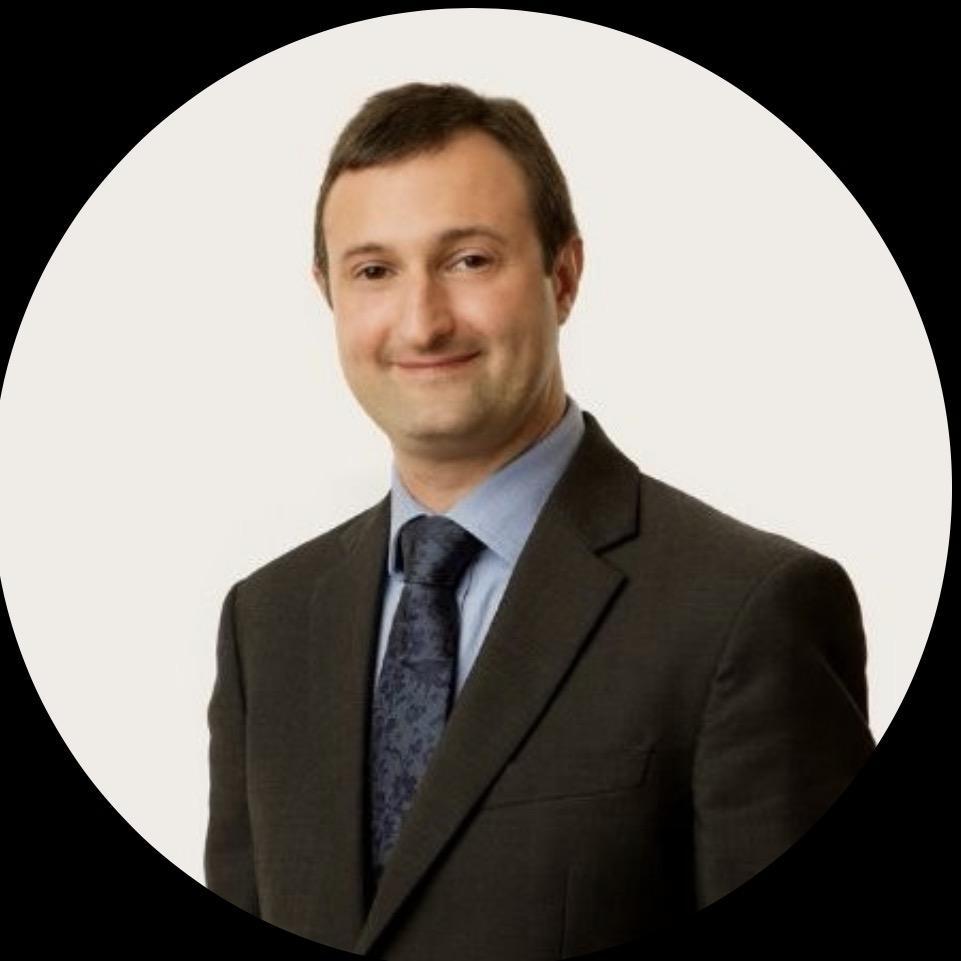
Paul Drosihn is the General Manager of DALI Alliance / DiiA and will participate in discussions around the Good Light Wake-up Call, connecting healthy lighting data, control protocols, DALI, BMS/LMS systems, and system-level operations.
The involvement of DALI is critical.
Because if healthy lighting is to be implemented in real projects, it must address fundamental operational questions:
- How are luminaires controlled?
- How is spectral tuning managed?
- How are lighting scenes defined and governed?
- How are time-based strategies executed?
- How do sensors participate in the system?
- How do design intents translate into control logic?
- How is field measurement feedback integrated into building operations?
- How does future HCL-ready data enter device and protocol languages?
Without control, healthy lighting remains a static product.
Without protocols, healthy lighting cannot scale effectively.
Without system-level operations, healthy lighting cannot sustain its performance over time.
Therefore, the participation of the DALI Alliance represents a key step in shifting healthy lighting from design intent to operational reality.
8 | International Association of Lighting Designers (IALD) and VLDC: How Can the International Design Community Participate in Healthy Lighting Consensus?
Healthy lighting cannot be defined by scientists and industry alone.
Designers must be involved.
The international design community represented by International Association of Lighting Designers (IALD), VLDC, and the VLD Community plays a critical role in helping the industry address a set of fundamental questions:
- How is scientific knowledge translated into spatial experience?
- How is healthy lighting understood by designers?
- How do data enter the design process?
- How is value for building owners expressed?
- How are demonstration projects designed and communicated?
- How does the lighting design profession redefine its value in the era of healthy lighting?
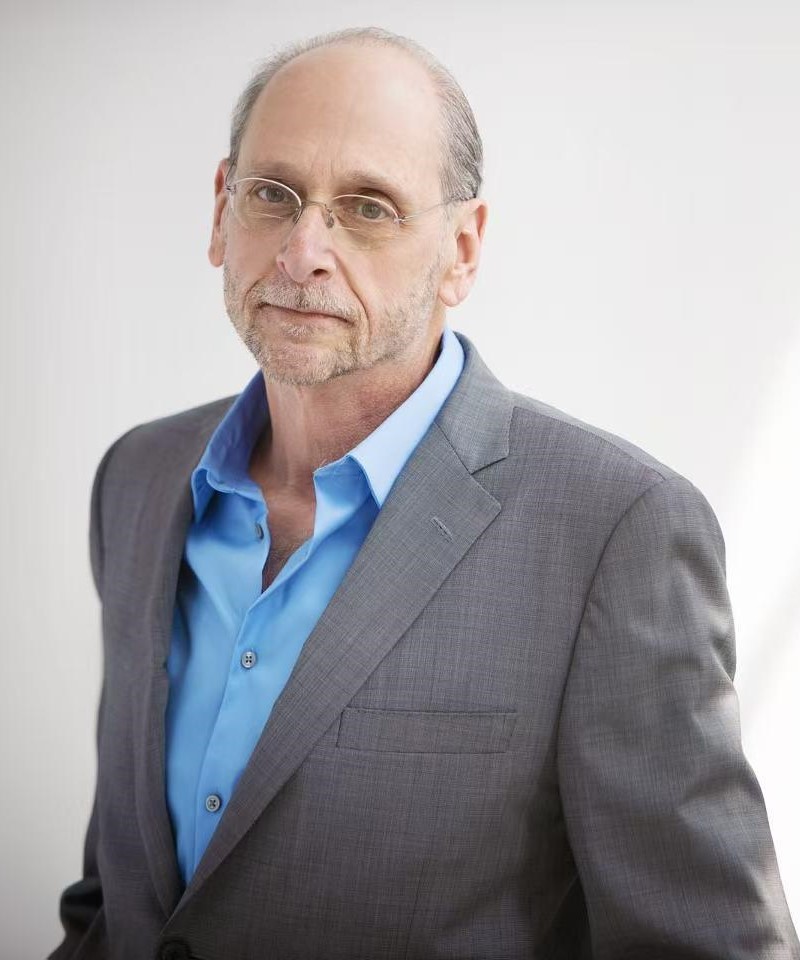
Jeff Miller
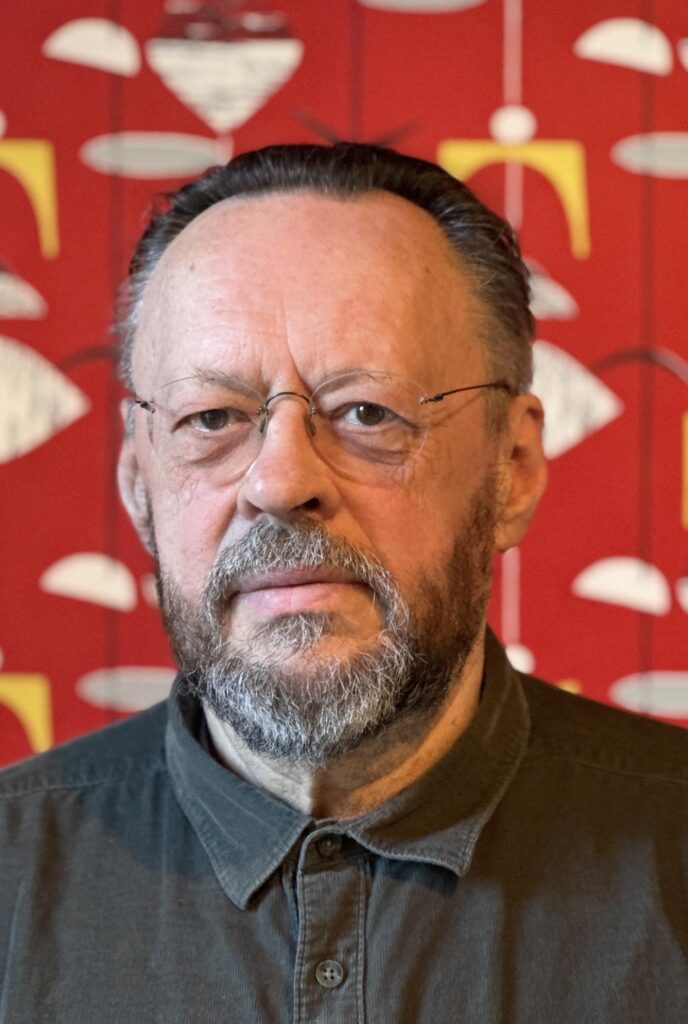
Kevan Shaw

Martin Klaasen
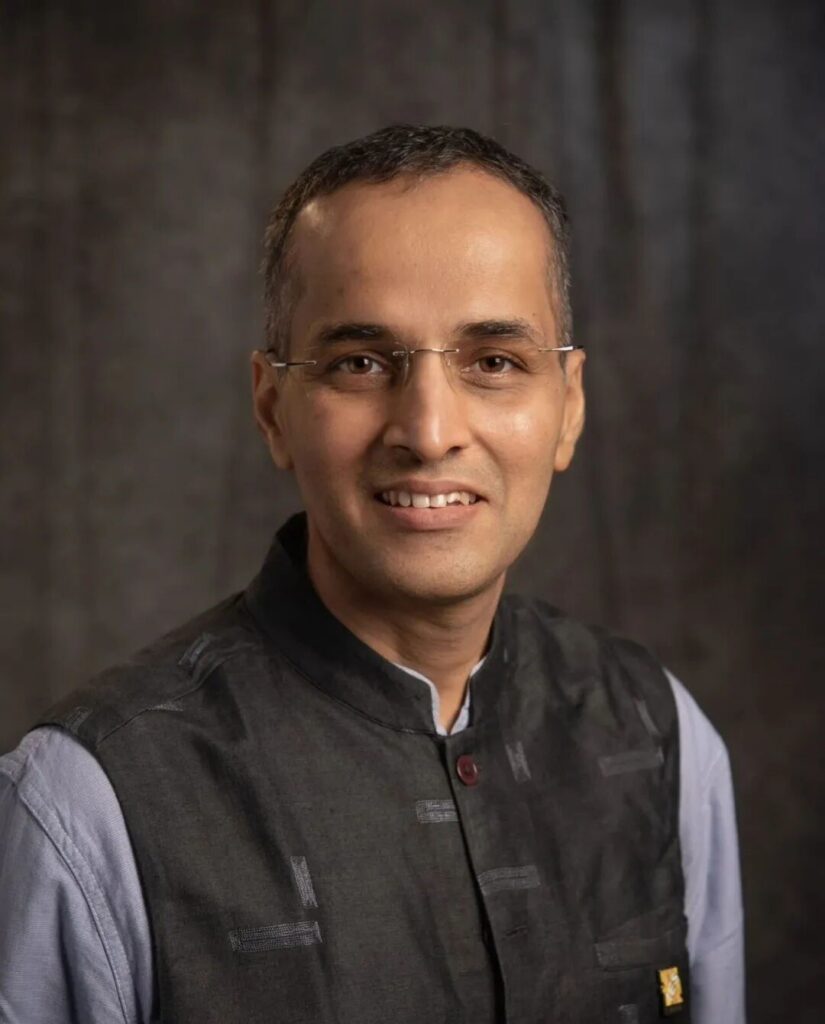
Amardeep Dugar
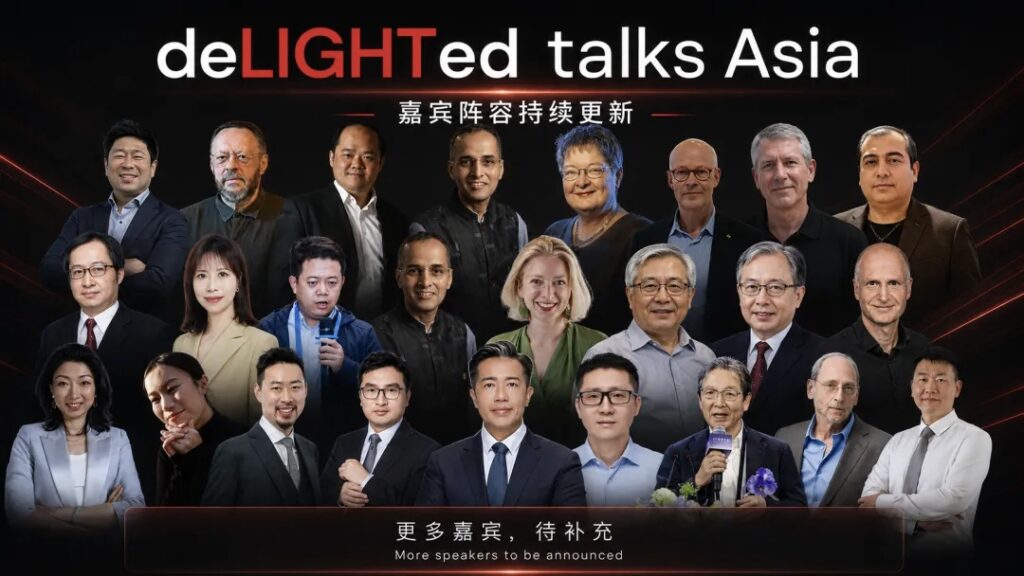
Jeff Miller, Kevan Shaw, Martin Klaasen, Amardeep Dugar and other international design and industry representatives will provide key perspectives at deLIGHTed talks Asia.
Among them, Martin Klaasen will be involved in planning FG-05 HCL-ready IES Profile and FG-06 Good Light Wake-up Call Full Value-chain Action Consensus.
This is significant.
Because the HCL-ready IES Profile is not merely a technical document.
It is directly related to whether designers can read healthy lighting data in design software, simulate human eye-level exposure, and translate EDI / DER, spectral data, dimming states, and spatial models into design decisions.
- If healthy lighting data does not enter design, healthy lighting cannot enter space.
- If design does not enter owner communication, healthy lighting cannot become project value.
- If project value cannot be validated, healthy lighting cannot become an industry-wide action.
9 | Electric Lamp and Component Manufacturers Association of India (ELCOMA) and the Asian industry network: Healthy lighting requires cross-regional collaboration.
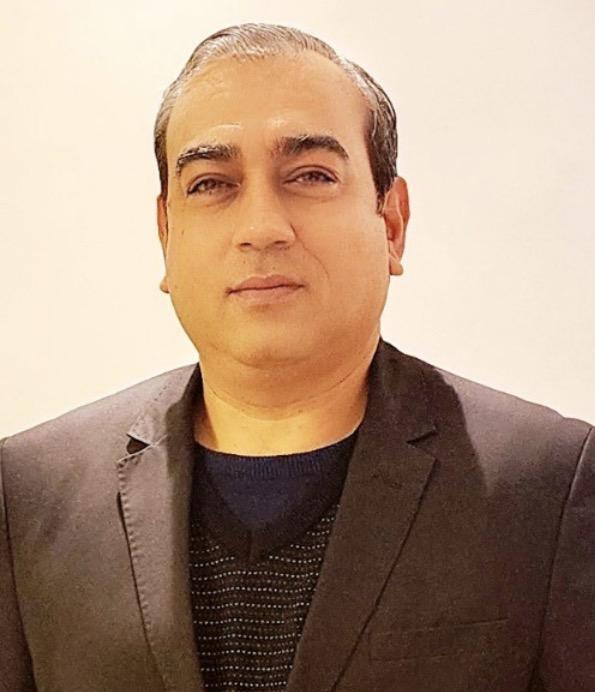
Krishan Sujan will represent Electric Lamp and Component Manufacturers Association of India (ELCOMA) in the related exchanges.
This makes deLIGHTed talks Asia not only a discussion within the Chinese market, but also a connection to a broader Asian lighting industry network.
Asia is a large market, but different regions are at different stages of development.
China has a complete manufacturing and application supply chain.
India has a rapidly growing lighting market and a strong industry association network.
Southeast Asia, the Middle East, Japan, Korea, Taiwan, and Hong Kong each have their own application contexts, standards environments, and industrial characteristics.
If healthy lighting is to become an Asian initiative, it cannot remain within a single market.
It requires cross-regional exchange:
- Which healthy lighting topics are universal?
- Which standard languages can be shared?
- Which demonstration projects can be mutually referenced?
- Which companies can collaborate across regions?
- Which associations can jointly advance industry education and market awareness?
The participation of ELCOMA and other Asian industry networks will help the Good Light Wake-up Call gradually evolve toward broader regional collaboration.
10 | Why are FG-05 and FG-06 critical action tables?
If the main forum is responsible for articulation, then the working groups are responsible for action.
This section particularly encourages industry experts, alliance representatives, corporate leaders, standards organizations, design communities, healthy building consultants, and industry partners to focus on two sessions:
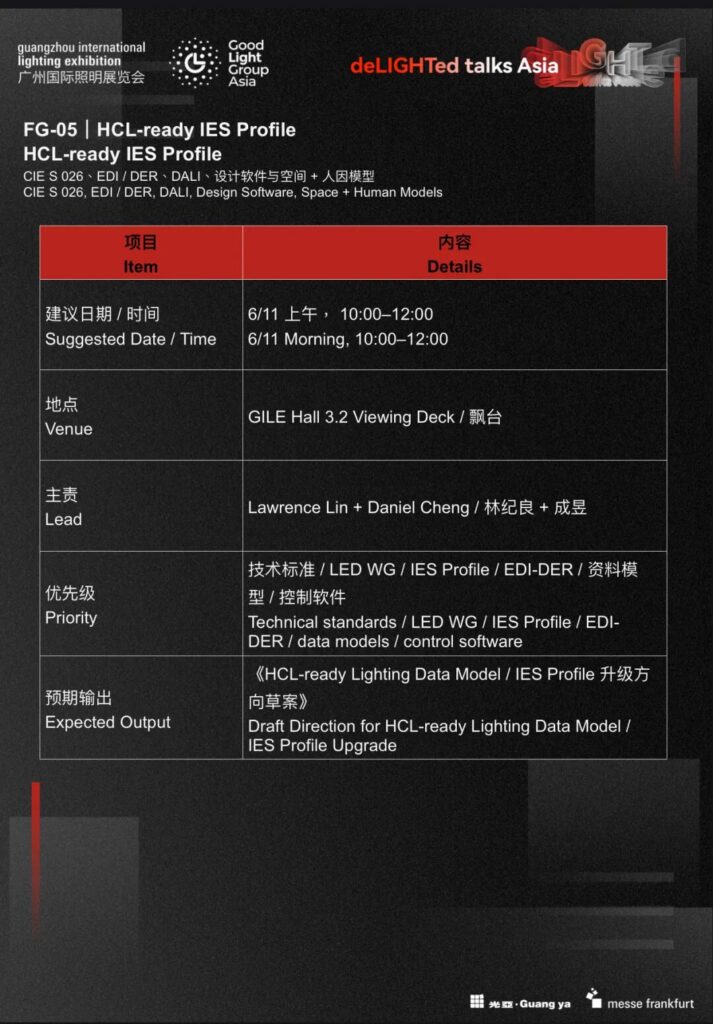
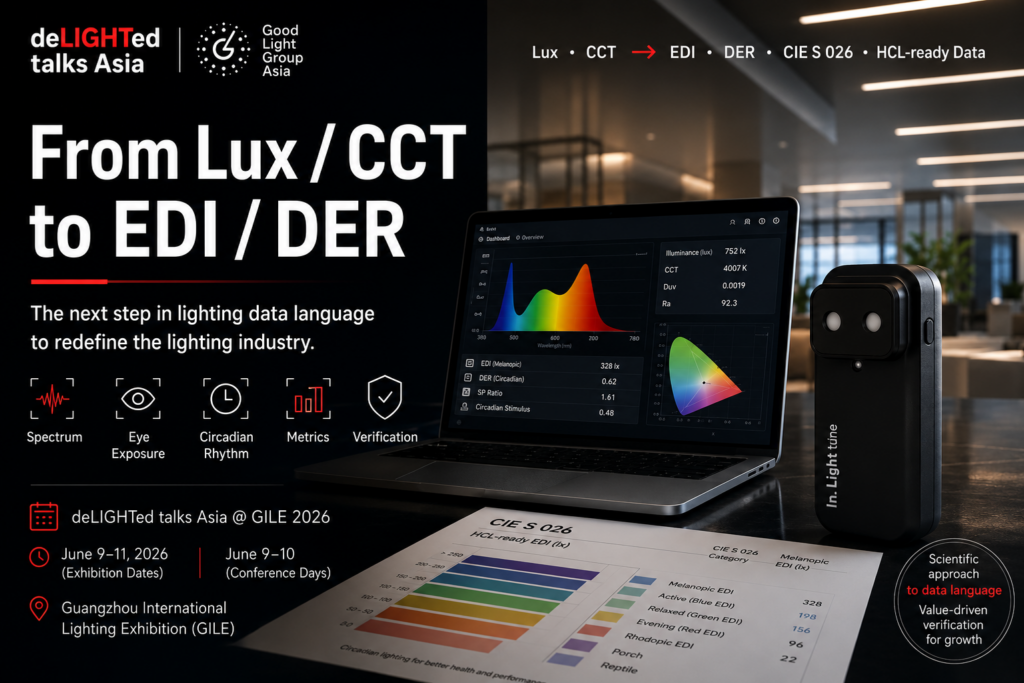
FG-05|HCL-ready IES Profile
Time: June 11, 10:00–12:00
Location: GILE Hall 3.2 Viewing Deck / HCL Demonstration Zone
Keywords:
CIE S 026, EDI / DER, DALI, design software, spatial models, human factor models, HCL-ready data.
The core of this session is how healthy lighting enters the next generation of product data and design data language.
Existing IES files primarily serve traditional lighting design and photometric data representation.
But healthy lighting requires more information:
- spectral data
- different dimming states
- melanopic EDI
- DER
- eye-level exposure
- time-based strategies
- spatial models
- human factor models
- control interfaces
- on-site measurement feedback loops
If this information cannot be defined, healthy lighting cannot enter design software.
If it cannot enter design software, it cannot enter the design process.
If it cannot enter the design process, it is difficult to become project delivery.
If it cannot become project delivery, it is difficult to form industry standards.
Therefore, FG-05 is a critical session that moves from concept to engineering language.
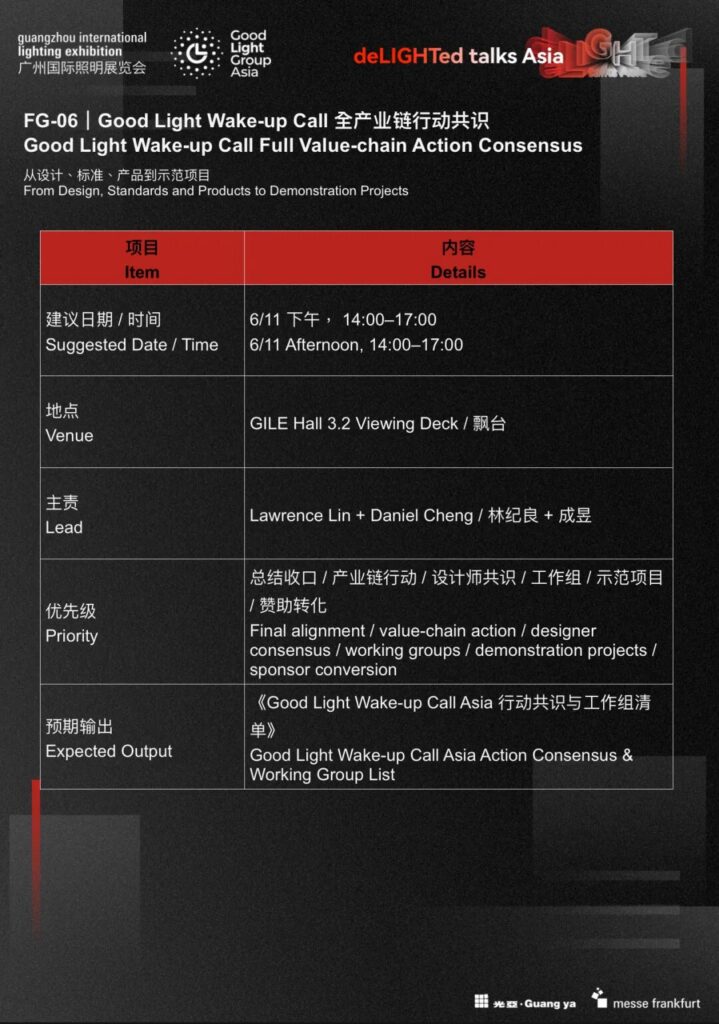
FG-06|Good Light Wake-up Call Full Value-chain Action Consensus
Time: June 11, 14:00–17:00
Location: GILE Hall 3.2 Viewing Deck / HCL Demonstration Zone
This session serves as the key conclusion of the Action Day.
It will build upon:
June 8 Good Light Wake-up Call / LED WG closed-door meeting;
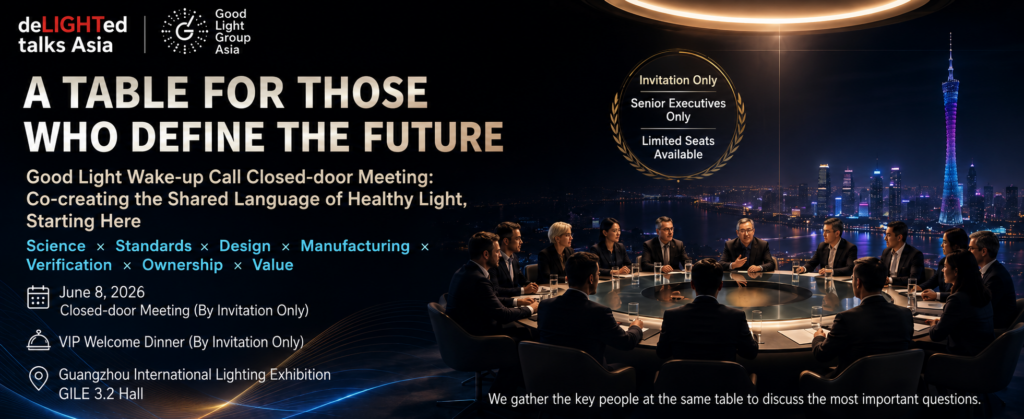
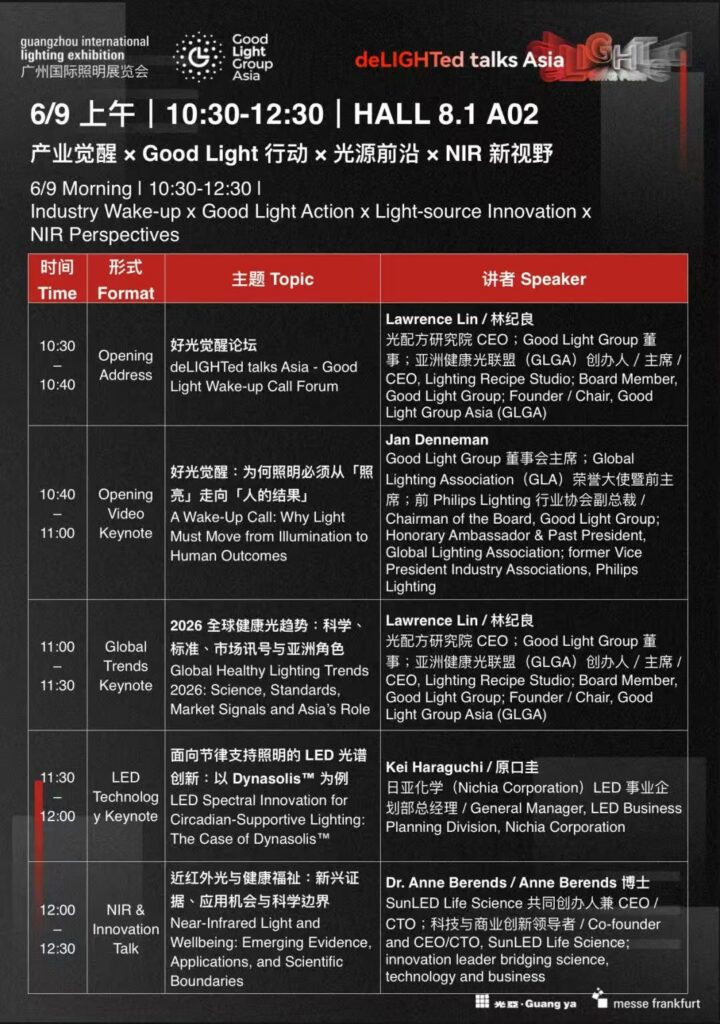
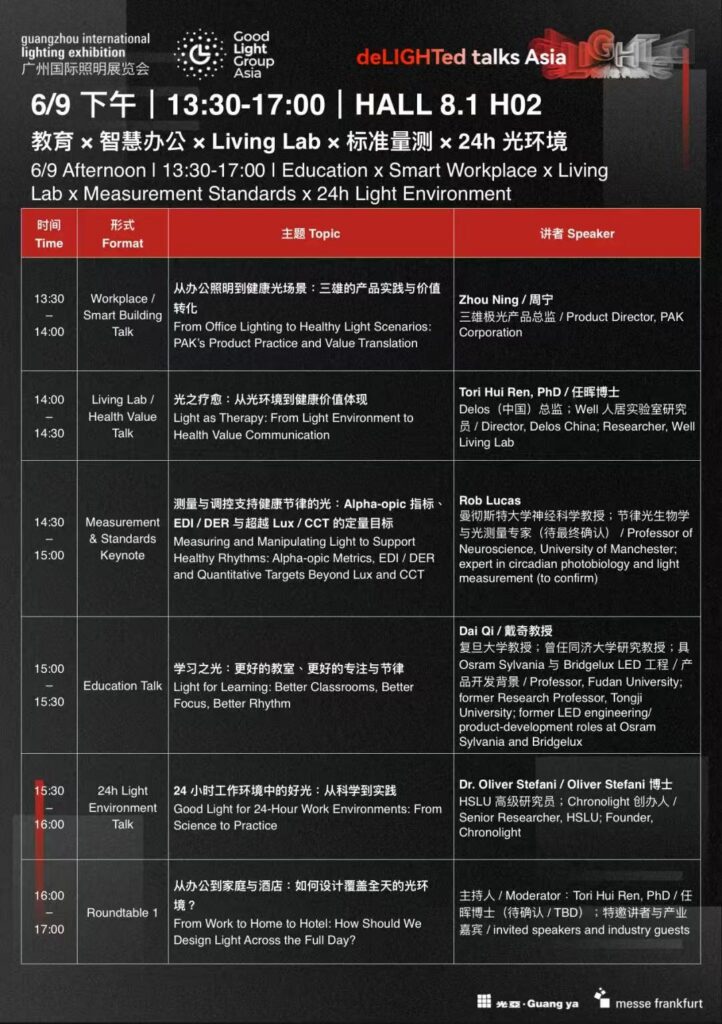
June 9–10 main forum;
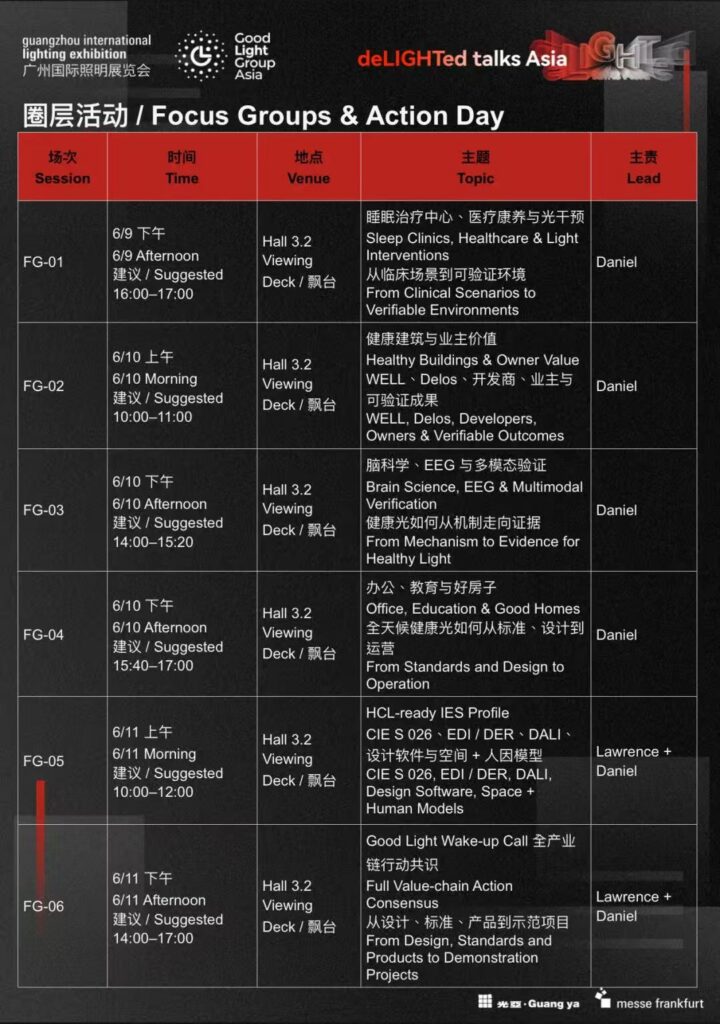
FG-01 to FG-05 issue list;
Multi-stakeholder perspectives from Good Light Group (GLG), GLGA, International WELL Building Institute (IWBI), Delos, DALI Alliance, International Association of Lighting Designers (IALD), VLDC, Electric Lamp and Component Manufacturers Association of India (ELCOMA), and industry chain partners.
FG-06 is not about “how well the forum was executed.”
It is about:
- What happens next?
- How should the Good Light Wake-up Call continue?
- Does the LED WG form a clear direction for future work?
- Does HCL-ready data require a dedicated working group?
- Which scenarios can become the first wave of pilot projects?
- Which companies are willing to participate in co-development?
- Which associations and organizations can collaborate?
- How can science, design, standards, products, controls, measurement, and building owner value be connected?
- How can forum outcomes be translated into continuous action?
This is not a closing session.
This is an action table.
11 | Healthy lighting requires a shared map
Today, healthy lighting resembles a new continent still taking shape.
- Scientists see mechanisms.
- Designers see spatial experience.
- Industry sees products.
- Control systems see protocols.
- Healthy building frameworks see certification and asset value.
- Clinicians see medical scenarios.
- Building owners see investment and operations.
- End users see experience and quality of life.
- Everyone sees only a part of the whole.
But the industry needs a shared map.
This map should tell us:
- Which scientific findings are relatively established?
- Which applications still require caution?
- Which metrics can enter design workflows?
- Which data should be included in product documentation?
- Which control strategies can be implemented?
- Which measurement methods can be validated?
- Which scenarios are suitable as demonstration projects?
- Which standards bodies and alliances can co-develop the framework?
deLIGHTed talks Asia @ GILE 2026 is attempting to sketch the first version of this map.
It will not be completed at once.
But someone has to begin.
Special Acknowledgements
We sincerely thank PAK / 三雄极光, NVC Lighting / 雷士照明, Traxon e:cue / 卓生照明, and Nationstar / 国星光电 for their generous sponsorship and support of deLIGHTed talks Asia @ GILE 2026 / Good Light Wake-up Call.


It is precisely through the involvement of these industry partners that healthy lighting has the opportunity to move beyond science, standards, and concepts, and further into products, systems, real-world applications, and live projects.
Conclusion: The future of healthy lighting does not belong to those who speak in isolated voices.
Healthy lighting is emerging as a new direction.
But what will truly endure is not those who are best at slogans.
Nor those who are best at packaging concepts.
And certainly not those who treat healthy lighting as a short-term marketing tool.
What will define the future are those willing to co-develop a shared language, accept validation, participate in demonstration projects, and drive industry evolution together.
- Science must be translated.
- Design must be supported.
- Products must be defined.
- Controls must be integrated.
- Projects must be validated.
- Building owners must be convinced.
- The industry must be organized.
This is why collaboration among Good Light Group (GLG), GLGA, International WELL Building Institute (IWBI), Delos, DALI Alliance, International Association of Lighting Designers (IALD), VLDC, Electric Lamp and Component Manufacturers Association of India (ELCOMA), and broader industry partners is essential.
Healthy lighting cannot be spoken in fragmented voices.
June, Guangzhou.
deLIGHTed talks Asia @ GILE 2026 / Good Light Wake-up Call invites those who genuinely care about the future of the industry to participate in building the next-generation shared language of healthy lighting.
Because without a shared language, there is no real industrial future.

 English
  Chinese (China)
  Chinese (Taiwan)
Excellent Interaction of the world leaders. Sure Conference will have good outcome to move forward. We need to implement Healthy Lighting in Projects and step by step Technical guideline/ procedure to implement will be useful to not only the Lighting Designer but also to the user and all channel Partners .
Anil Valia , Lighting Designer Educator and Consultant, MIES ( Emeritus), IALD Educator Member
INDIA