
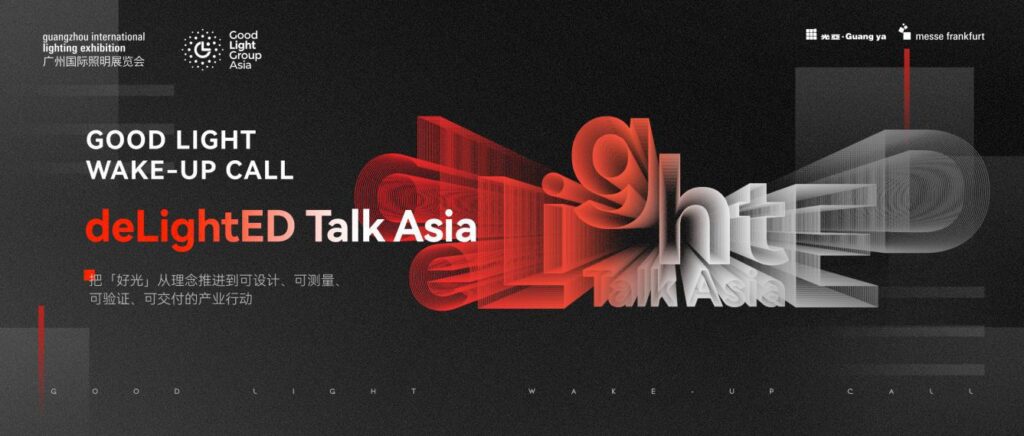
deLIGHTed talks Asia @ GILE 2026 enters its final week, calling on science, design, industry and standards communities to move together
The lighting industry is not operating in easy times.
Global economic recovery remains uncertain. Geopolitical tension and military conflicts are intensifying. Energy prices continue to fluctuate, while climate change is placing growing pressure on every part of the built environment, manufacturing, real estate, infrastructure and global supply chains.
Lighting is part of this reality.
On one hand, energy efficiency has never stopped being important. In fact, under renewed energy and climate pressure, efficient, low-carbon and sustainable lighting systems are becoming even more essential.
On the other hand, a new vocabulary is rapidly entering the lighting market: health, AIoT, smart lighting, emotional lighting, sleep-supportive lighting, full spectrum, ageing-friendly environments, healthy buildings and better homes.
These words represent real needs.
They also represent new opportunities.
But we must ask an honest question:
Is the lighting industry truly ready for them?
When health becomes a marketing language, do we have enough scientific evidence behind it?
When AIoT becomes a fashionable label, do we know what kind of people, spaces and outcomes it should ultimately serve?
When full spectrum, sleep, eye comfort and circadian lighting are widely promoted, do we have clear standards, boundaries and verification methods?
When lighting enters healthcare, senior living, education, workplaces, homes and healthy buildings, do we have methods that are measurable, verifiable, designable, deliverable and operable?
If not, the more fashionable words we create, the more noise we may generate.
And in an era full of noise but short of constructive direction, the most important questions can easily be lost.
1. The lighting industry cannot compete only with old language
For decades, the lighting industry has been answering one basic question:
How do we illuminate spaces?
In response, we developed more efficient light sources, better luminaires, mature optical design, reliable drivers, richer control systems and a large global industrial chain.
Illuminance, CCT, colour rendering, glare, efficacy, lifetime, cost, channels and delivery capability have formed the familiar competitive language of the lighting industry.
These remain important.
But they are no longer enough to answer the questions ahead.
When light enters sleep, alertness, emotion, learning, work, recovery and long-term health;
when light enters schools, hospitals, offices, hotels, homes, senior living environments and public buildings;
when light moves from isolated products into intelligent systems, building operation, health certification and asset value;
when AI, IoT, sensing, controls, data, algorithms and spatial operation begin to shape the luminous environment together;
the lighting industry must face a deeper question:
How does light actually affect people?
This is not just a slogan.
It is about science, standards, design, products, verification, ethics and the future voice of the lighting industry itself.
If the lighting industry does not actively build a healthy, orderly and credible common language, future conversations around healthy buildings, smart spaces, human-centric environments and public health may be defined by other industries.
At that point, what we lose will not only be market share.
We may lose the ability to define the future of light.
2. Why do we need a Good Light Wake-up Call now?
We are not talking about Good Light because the industry needs another fashionable term.
Quite the opposite.
We are talking about Good Light because the industry already has too many fashionable terms, but not yet enough shared foundation.
Healthy lighting cannot rely only on “feeling more comfortable”.
Sleep-supportive lighting cannot simply mean “warmer light”.
Eye-friendly lighting cannot only mean “not glaring”.
Full spectrum cannot automatically be equated with health.
AIoT cannot remain only about connectivity, control and scene switching.
Healthy buildings cannot rely only on attractive storytelling.
True good light must answer more difficult questions:
What spectrum is suitable for which people and which scenarios?
At what time, at what intensity, from what direction and with what exposure geometry may light support circadian health?
How should eye-level exposure be measured?
How can EDI / DER and related metrics enter design, products and verification?
How can dynamic control serve real behaviour instead of merely creating complicated functions?
How should healthcare, senior living, education, workplace, residential and hospitality environments develop different lighting strategies?
How can product claims remain scientifically responsible?
How can owners understand the long-term value of healthy light?
How can the industry avoid moving from one buzzword to another?
This is the meaning of the Good Light Wake-up Call.
It is not about creating a bigger concept.
It is about awakening the industry’s self-awareness and self-determination.
Self-awareness means seeing the real issues.
Self-determination means not leaving the future to market noise, short-term price competition or external narratives, but building the next-stage language of good light through science, design, industry, standards and real applications.
3. In the era of Light-Enhanced Living, we must rethink light
The Guangzhou International Lighting Exhibition 2026 carries the core theme of Light-Enhanced Living.
This is an important signal.
Light-Enhanced Living means light is no longer merely a fixture added after architecture is completed. It is no longer only a functional device in a space. It is no longer only a competition between energy efficiency, cost and form.
Light is entering lifestyle.
Light is entering health.
Light is entering emotion.
Light is entering sleep and circadian rhythm.
Light is entering work performance.
Light is entering learning.
Light is entering healthcare and senior living.
Light is entering building asset value.
Light is entering public space and social responsibility.
Within this larger theme, deLIGHTed talks Asia @ GILE 2026 asks a deeper question:
In the era of Light-Enhanced Living, what kind of light is truly good for people?
If we say light enhances life, it must be open to scientific questioning.
If we say light supports health, it must be measurable and verifiable.
If we say light creates value, it must be designable, deliverable, operable and assessable.
If we say light represents the future, the lighting industry must take responsibility for defining that future.
4. deLIGHTed talks Asia is not just another forum
In June, deLIGHTed talks Asia will take place during GILE 2026 in Guangzhou.
It is not a conventional forum that only discusses trends, concepts or brand visibility.
It is intended as a Good Light Wake-up Call for the Asian lighting industry.
We aim to bring together international scientists, lighting designers, healthy building experts, LED and lighting companies, controls and sensing partners, measurement experts, standards organisations, WELL / Delos-related experts, and representatives from healthcare, education, workplace, residential, hospitality and senior living applications.
The question is bigger than any single product or project:
How can healthy light move from an idea into a measurable, verifiable, designable, deliverable and operable industrial practice that creates real value for people and owners?
This path is not simple.
It requires scientists to clarify mechanisms and boundaries.
It requires standards organisations to build language and methods.
It requires companies to translate science into reliable products.
It requires controls and sensing systems to make light truly dynamic.
It requires measurement tools to make results visible.
It requires designers to translate technology into human experience.
It requires owners to understand the long-term value of good light.
It requires industry organizations to drive consensus, working groups and demonstration projects.
Therefore, deLIGHTed talks Asia is not only a forum.
It is a connection point.
A connection between science and industry.
Between standards and design.
Between products and applications.
Between verification and market value.
Between global trends and Asian action.
5. From “dare to innovate” to “dare to verify”
GILE 2026 emphasizes the spirit of daring to innovate and daring to go beyond.
This spirit is important.
The lighting industry certainly needs courage to innovate, to break through and to redefine the value of light.
But for healthy lighting, innovation alone is not enough.
We must also dare to verify.
Dare to verify our claims with science.
Dare to explain the effects of light with data.
Dare to acknowledge boundaries instead of exaggerating.
Dare to test product parameters in real spaces.
Dare to let design, measurement, controls, standards and operation share responsibility for outcomes.
Healthy light is not about who speaks louder.
It is not about whose spectral curve looks more attractive.
It is not about who uses more words such as AIoT, full spectrum, sleep or eye comfort.
The good light of the future must be:
scientifically grounded,
standards-aware,
designable,
field-verifiable,
boundary-conscious,
valuable to owners,
and responsible to people.
That is Good Light.
6. To scientists: bring research into the real world
Healthy light needs science.
Without science, healthy lighting easily becomes marketing language.
Without evidence, healthy lighting is easily oversimplified.
Without boundaries, healthy lighting can create new misunderstandings.
We sincerely invite researchers in circadian science, sleep, neuroscience, ophthalmology, medicine, human factors, photobiology and building environments to join this conversation.
The real world needs science.
Science also needs to enter the real world.
From laboratories to offices,
from papers to hospital wards,
from circadian models to classrooms,
from brain science to verifiable environments,
from spectral data to building operation,
there is a long chain of translation.
deLIGHTed talks Asia aims to be one of those bridges: ensuring that science is not reduced to slogans, and industry does not move forward only by intuition.
7. To designers: healthy light needs new translators
Healthy light does not ultimately happen in a data sheet.
It happens in real spaces.
The same spectrum, illuminance and control strategy may produce very different outcomes depending on space, time, people, visual tasks and operation.
This is why designers are crucial.
Future lighting designers will not only be creators of visual aesthetics.
They will also become translators between science, technology, space and human experience.
Designers need to understand science without being trapped by terminology.
They need to use metrics without turning spaces into stacks of parameters.
They need to respond to owner value without sacrificing human experience.
They need to embrace AI, smart controls and data tools while preserving sensitivity to people, scenes and culture.
If healthy light is to enter the real world, designers will be one of the most important bridges.
8. To companies: this is a positioning decision
For companies, this event is more than an opportunity to attend.
It is a positioning decision.
Healthy light is moving from concept to standards,
from single products to systems,
from product claims to spatial applications,
from marketing to verification,
from the lighting industry into architecture, healthcare, education, workplace, residential, hospitality and public health.
At this stage, companies need to ask:
Are we watching the trend, or helping define it?
Are we following market buzzwords, or building credible language?
Are we only selling products, or entering scenario-based solutions?
Are we only seeking exposure, or connecting with working groups, demonstration projects and industry collaboration?
For LED, luminaires, controls, sensing, measurement, testing, design software, healthy buildings, healthcare, senior living, workplace, education, residential and hospitality-related companies, the value of this event is not just visibility.
More importantly, it allows companies that truly want to build a long-term position in healthy lighting to sit at a more meaningful place while the next common language is being formed.
9. To industry organizations and leaders: common language requires common work
Healthy light is not an isolated niche.
It connects lighting, architecture, healthcare, education, sleep, public health, urban renewal, green buildings, smart buildings, aging societies and future lifestyles.
Therefore, it requires more than companies.
It requires industry organisations, standards bodies, academic platforms, design communities, testing institutions and public-policy-related forces to participate together.
We need to avoid the gap between overheated concepts and underdeveloped standards.
We need to translate scientific research into industrial practice.
We need clearer terminology, metrics, boundaries and application pathways.
We need to help the market distinguish real healthy-light innovation from simple marketing packaging.
This is the meaning of the Good Light Wake-up Call.
It is not the voice of a single brand.
It is not the project of a single organization.
It is a shared reminder for the industry:
The future of light should not be defined only by brightness, efficiency and cost.
It must also be defined by people, health, experience, evidence and responsibility.
10. The final week begins
From 1 June, deLIGHTed talks Asia @ GILE 2026 enters its final week of promotion and registration.
In the coming days, we will share highlights of the main forum, topics of the focus groups, key speaker directions, partnership opportunities, on-site reminders and follow-up action plans.
The main forum will take place from 9–10 June during GILE 2026.
The Focus Groups and Action Day will take place from 9–11 June, creating smaller, deeper and more action-oriented working conversations.
We hope this will not be just one more forum among many events at GILE 2026.
We hope it becomes a starting point for healthy light to move toward scientific verification, common language and industrial action within the era of Light-Enhanced Living.
From Guangzhou,
from GILE,
from the Good Light Wake-up Call,
let good light enter life,
enter buildings,
enter healthcare,
enter education,
enter workplaces,
and enter the next common language of the lighting industry.
How to participate
Main Forum|9–10 June
Open to the industry. We welcome participants from lighting, architecture, design, healthy buildings, healthcare and senior living, education, workplace, residential, hospitality, smart spaces, standards organizations and industry platforms.


Focus Groups|9–11 June
Invitation-based and subject to registration review. Professionals with relevant backgrounds and collaboration interests are welcome to register and indicate their preferred topics.

Partnership and Sponsorship
Companies and institutions committed to the long-term development of healthy light are welcome to participate as partners or sponsors, helping move healthy light from ideas to evidence, from products to spaces, and from forums to action.
To all fellow travelers
This is an uncertain era.
It is also an era in which value must be redefined.
The lighting industry cannot continue to rely only on internal competition, fashionable terms or waiting for other sectors to define the future of light.
We must rethink light.
Redefine value.
Rebuild common language.
And take responsibility for people, health, environment and the future.
The Good Light Wake-up call is happening.
This June, in Guangzhou,
we look forward to starting this journey together.

 English
  Chinese (China)
  Chinese (Taiwan)