
deLIGHTed talks Asia @ GILE 2026
Good Light Wake-up Call Series Report 07
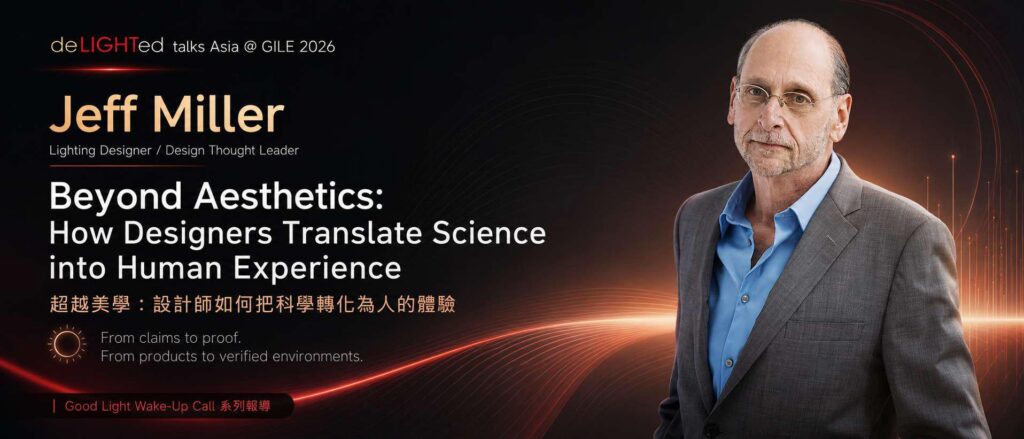
Jeff Miller: Beyond Aesthetics — How Designers Translate Science into Human Experience
In the previous reports of the Good Light Wake-up Call series, we have approached healthy lighting from multiple directions.
Professor Robert Lucas reminded us that healthy lighting requires a new way to measure how light tells the body time.
Dr. Marijke Gordijn reminded us that Good Light means the right light at the right time.
Jan Denneman called on the lighting industry to move from illumination to human outcomes.
Kei Haraguchi of Nichia showed how white LED technology, after 30 years, must move beyond LPW and toward new human value.
Dr. Anne Berends of SunLED Life Science opened the discussion beyond visible light, toward near-infrared light, dose, photobiomodulation and scientific boundaries.
Each of these perspectives is essential.
But science, standards and technology still need one critical translator. Science does not automatically become space. Standards do not automatically become experience. Metrics do not automatically become quality of life. Products do not automatically become healthy environments. That translator is the lighting designer.
At deLIGHTed talks Asia @ GILE 2026, Jeff Miller’s message addressed one of the most important questions in the Good Light Wake-up Call: How can designers translate science into human experience?
His theme was: Beyond Aesthetics: How Designers Translate Science into Human Experience
This is not a rejection of aesthetics. On the contrary, it is a reminder that great lighting design has never been only about making a space look beautiful. Lighting design is about how people enter a space, perceive a space, move through a space, work in a space, rest in a space, and ultimately live within a space.
As healthy lighting becomes part of the future of the industry, the role of designers is not becoming less important. It is becoming more important than ever.
Because without design, healthy lighting is only a set of metrics. Without context, it is only a group of technical parameters. Without experience, it will never truly enter people’s lives.
1 | Lighting is a contact sport
One of Jeff Miller’s most memorable messages was: Lighting is a contact sport.
This simple sentence says a great deal. Lighting is not something completed by one person alone.
- It is not completed by a luminaire manufacturer alone.
- It is not completed by a designer alone.
- It is not completed by a control system alone.
- It is not completed by a standards body alone.
A successful lighting project requires many players:
- Lighting designers.
- Architects.
- Interior designers.
- Owners.
- Operators.
- Manufacturers.
- LED and optical suppliers.
- Control system providers.
- Sensor and software teams.
- Commissioning specialists.
- Measurement teams.
- Contractors.
- And ultimately, users.
If any one part of the chain is disconnected, the final result may move far away from the original intent.
This is especially true for healthy lighting.
- A luminaire may have a high-quality spectrum. But if it is installed in the wrong place, the eye may never receive the intended exposure.
- A control scene may be called “daytime circadian mode.” But if the vertical eye-level exposure is too low, the timing is wrong, or the system is not commissioned properly, the label means very little.
- A project may claim to support wellbeing. But without measurement, verification and operation, trust is difficult to build.
So “lighting is a contact sport” is not only a clever phrase. It is a reminder that healthy lighting is not a single technology.
Healthy lighting is a collaborative outcome.
Good Light is not one product. Good Light is an environment created through design, products, systems, controls, verification and operation.
2 | HCL is not simply a new label
Human Centric Lighting, or HCL, has been discussed for many years.
But because the term has been used so widely, it can also become simplified.
- Sometimes HCL is reduced to cool-to-warm tuning.
- Sometimes it is reduced to full spectrum.
- Sometimes it is reduced to eye-care lighting.
- Sometimes it becomes a “wellness mode” on a control panel.
- Sometimes it is simply printed on product packaging.
Jeff’s message is clear: HCL is not simply a new label.
In fact, good lighting designers have always been concerned with people. They have always considered emotion. Atmosphere. Comfort. Dignity. Perception. Gathering. Rest. Focus. Hospitality. Safety. The feeling of being welcomed. The feeling of being cared for.
In this sense, designers were practicing human-centered lighting long before the term became fashionable.
What has changed today is not the need to care about people. What has changed is that science gives us new evidence. Standards give us new language. Metrics give us new tools. Controls give us new possibilities. And measurement gives us new responsibility.
In the past, designers often relied on experience, sensitivity, spatial understanding and artistic judgement. They still need all of these. But now they also need to understand:
- Spectrum.
- Eye-level exposure.
- Timing.
- Duration.
- Circadian stimulation.
- m-EDI.
- Flicker.
- Glare.
- Control logic.
- Commissioning.
- Operation.
- Verification.
This does not mean designers must become scientists. It means designers become translators between science and space.
3 | The success of the LED revolution has also created new blind spots
The LED revolution has transformed the lighting industry. It brought higher efficacy. Smaller sources. Greater design freedom. Better controllability. Dynamic colour. Longer life. Lower energy use. And the possibility of integrating lighting into intelligent building systems.
This is a major achievement.
But Jeff’s message also reminds us that the success of LED has created new blind spots.
The market is now filled with many similar products. Differentiation is harder. Efficacy is higher, but value is not always higher. Control systems are more complex, but user experience is not always better. Technical specifications are more complete, but spaces are not always more human.
Too often, the industry still works within an old value model:
- Higher efficiency.
- Lower cost.
- More features.
- More product lines.
- More technical claims.
But these are no longer enough to define the next stage of lighting value.
Here, Jeff’s message strongly echoes Jan Denneman’s Wake-up Call.
The future of lighting is not simply to produce more efficient products. It is to create more valuable environments. From more efficient products to more meaningful spaces. From product performance to human experience.
4 | HCL is an opportunity for the whole ecosystem
Jeff does not frame HCL as a single product category. He sees it as a broader opportunity for the entire lighting ecosystem.
If HCL is understood correctly, it can create:
- New products.
- New services.
- New education needs.
- New owner value.
- New design methods.
- New verification processes.
- New forms of industry collaboration.
- New public benefits.
But this depends on one condition: HCL must be both measurable and useful.
These two words matter.
- Measurable means it cannot remain a story.
- Useful means it cannot become only a technical table.
Healthy lighting cannot be built only on emotional narratives. Nor can it be reduced to abstract metrics that nobody can translate into real spaces.
It must answer real questions:
- What does it do for users?
- What does it mean for owners?
- How does it help designers?
- What does it require from manufacturers?
- How is it operated?
- How is it verified?
- How does it contribute to buildings, workplaces, schools, hospitals, homes and public life?
That is why HCL should not be treated as another short-term LED trend. If done responsibly, it may become a foundation for redefining the value of lighting. If done poorly, it may become another concept bubble.
5 | Manufacturers must provide HCL-ready products and data
Jeff’s message to manufacturers is clear. In the age of healthy lighting, manufacturers cannot provide only conventional product data.
Traditionally, luminaire and light-source data focused on:
- Power.
- Luminous flux.
- Luminous efficacy.
- CCT.
- CRI.
- Distribution.
- Lifetime.
- Dimensions.
- Installation.
- Dimming protocol.
These are still necessary. But they are no longer sufficient.
If lighting is to become part of human health and wellbeing strategies, manufacturers must provide data and capabilities that help designers work responsibly.
This includes:
- Reliable spectral data.
- Spectral change under dimming.
- Circadian-relevant metrics.
- m-EDI, DER or melanopic ratio where appropriate.
- Temporal light modulation information.
- High-quality dimming performance.
- Control compatibility.
- Scene-based operating data.
- Data formats that can be used by design software and control systems.
- Product language that is verifiable, traceable and usable in projects.
Designers do not only need a product that claims to be healthy. They need to know:
- Under what conditions is it useful?
- For what application?
- At what eye-level exposure?
- At what time of day?
- At what dimming state?
- With what control strategy?
- Can it support WELL or other healthy building goals?
- Can it be measured and verified on site?
This is the meaning of HCL-ready. It does not mean that a product alone “delivers health.” It means the product is ready to participate in a design, calculation, control, verification and operation process for healthy lighting environments.
6 | Designers turn healthy lighting from claims into experience
Manufacturers provide light sources, luminaires, drivers, controls and data. But these alone do not create a healthy lighting environment.
Design turns them into experience. The value of the designer is the ability to understand people in context.
- The same light source can mean very different things in a classroom, office, hospital ward, hotel, bedroom, senior-care facility or exhibition space.
- The same m-EDI value has a different meaning in the morning and at night.
- The same colour temperature feels different in a clinic and in a home.
- The same high-CRI source may serve different purposes in a museum, restaurant, workplace or senior living room.
- The same low-glare strategy may have different priorities in task spaces and rest spaces.
Designers must ask more than:
Where should the light come from?
They must ask:
- Where are the people?
- What are they looking at?
- When do they use the space?
- What are they trying to do?
- Do they need alertness, focus, relaxation, recovery, social interaction or sleep preparation?
- Does the light reach the eye?
- How much?
- For how long?
- Does it disturb others?
- Can it be maintained?
- Can it be operated?
- Does it belong to the character of the space?
This is why Jeff describes designers as translators of science into human experience. Designers are not simply specifiers. They are the people who translate science, technology, product performance and spatial purpose into environments that people can actually feel and use.
7 | Healthy lighting must move from products to verified environments
Jeff’s message includes several powerful transitions:
- From claims to proof.
- From products to verified environments.
- From conventional metrics to human exposure.
These phrases could almost serve as an action agenda for the healthy lighting industry.
Because one of the biggest risks today is product-level health claims. A product claims to be healthy. A system claims to be circadian. A scene is called “sleep mode.” A fixture is called “eye-care.” A space claims to support wellbeing.
But the real questions are:
- Where is the evidence?
- Where is the measurement?
- What is the eye-level exposure?
- Is daytime exposure sufficient?
- Does evening exposure decrease?
- Is flicker controlled?
- Is glare controlled?
- Do users operate the system as intended?
- Was the system commissioned properly?
- Is performance maintained over time?
Healthy lighting cannot remain in product catalogues. It must enter real spaces. It must reach the human eye. It must respect time. It must be measured. It must be verified. It must be operated.
This is what designers, manufacturers, control providers and verification teams must achieve together.
8 | Aesthetics has not disappeared. It has entered a larger responsibility.
“Beyond aesthetics” does not mean aesthetics is no longer important.
On the contrary, healthy lighting without aesthetics will not succeed. A space may meet technical criteria, but if it feels unpleasant, people will not want to stay in it. A lighting system may perform well on paper, but if it damages atmosphere, comfort or identity, it will not be accepted.
Aesthetics remains one of the fundamental languages of lighting design.
But today, aesthetics must be placed within a larger framework:
- Beauty.
- Comfort.
- Circadian support.
- Visual tasks.
- Glare control.
- Spectral quality.
- Eye-level exposure.
- Emotional experience.
- Spatial meaning.
- Operational reliability.
- Verified outcomes.
Healthy lighting does not mean turning buildings into medical devices. It does not mean turning homes, offices or hotels into laboratories. It means creating spaces that support people more intelligently, more gently and more responsibly.
Good healthy lighting should not constantly remind people that they are receiving healthy lighting. It should simply make the environment work better. People see more comfortably. Work more effectively. Rest more naturally. Move more safely. Socialize more easily. Prepare for sleep more smoothly. And live with better rhythm and dignity.
This is the power of design.
9 | What this means for the international lighting industry
The global lighting industry already has strong manufacturing capability. We can produce efficient luminaires. We can build sophisticated control systems. We can generate more spectral options. We can provide sensors, data and digital platforms.
But the next stage of healthy lighting cannot be achieved by manufacturing alone. It requires design leadership. If designers are not involved, healthy lighting can become product stacking. If architects and interior designers are not involved, healthy lighting will not become part of spatial systems. If owners and operators are not involved, healthy lighting will not be maintained. If measurement and verification specialists are not involved, healthy lighting will not be trusted.
Across markets, we already see many healthy lighting products:
- Eye-care luminaires.
- School lighting.
- Full-spectrum lighting.
- Circadian lighting.
- Sleep-support lighting.
- Senior-care lighting.
- Hospitality lighting.
- Office wellbeing systems.
But the deeper questions remain:
- Who designs how these products enter space?
- Who defines the needs of different users at different times?
- Who verifies whether the intended light reaches the eye?
- Who translates product parameters into spatial experience?
- Who helps owners understand long-term value?
- Who takes responsibility for commissioning, verification and operation?
If these questions are not answered, healthy lighting will remain product-level language. It will not become spatial value.
Therefore, the next stage is not only more healthy lighting products. It is a mature healthy lighting design ecosystem. Manufacturers, designers, architects, controls providers, measurement teams, certification bodies, owners and operators must work together.
Lighting is a contact sport.
10 | Designers are central to the Good Light Wake-up Call
The Good Light Wake-up Call is not simply a slogan.
It is a movement from concept to action. From science to design. From products to systems. From scenes to verification. From claims to trust. From illumination to human outcomes.
In this process, designers are essential.
Science needs translation. Data needs organization. Products need selection. Controls need scenarios. Spaces need shaping. People need understanding.
Designers connect these layers. They must understand beauty and scientific boundaries. Owner needs and user experience. Product data and spatial logic. Illuminance and glare. Spectrum, time and eye-level exposure. Atmosphere and verification.
This does not reduce the freedom of designers. It increases their influence.
In the era of healthy lighting, designers are not simply deciding where luminaires go. They are translating light into human value.
11 | Closing: Good Light does not happen by product alone. It is designed.
Jeff Miller’s message offers a critical reminder: Good Light does not happen by product alone. Good Light must be designed.
- A good light source does not automatically create Good Light.
- A good luminaire does not automatically create Good Light.
- A good control system does not automatically create Good Light.
- A good scientific metric does not automatically create Good Light.
Good Light must be understood. Designed. Integrated. Commissioned. Measured. Verified. Operated. And experienced by people.
This is why lighting designers become even more important in the age of healthy lighting.
They turn science into space. Data into experience. Products into environments. Technology into life.
Beyond Aesthetics does not mean leaving aesthetics behind.
It means building on aesthetics with science, responsibility, verification and human outcomes.
Truly good lighting does not only make spaces look better. It helps people live better in those spaces. From claims to proof. From products to verified environments. From conventional metrics to human exposure. From lighting design to human experience.
This is the message Jeff Miller brought to deLIGHTed talks Asia @ GILE 2026.
And it is one of the essential next steps of the Good Light Wake-up Call.

 English
  Chinese (China)
  Chinese (Taiwan)