
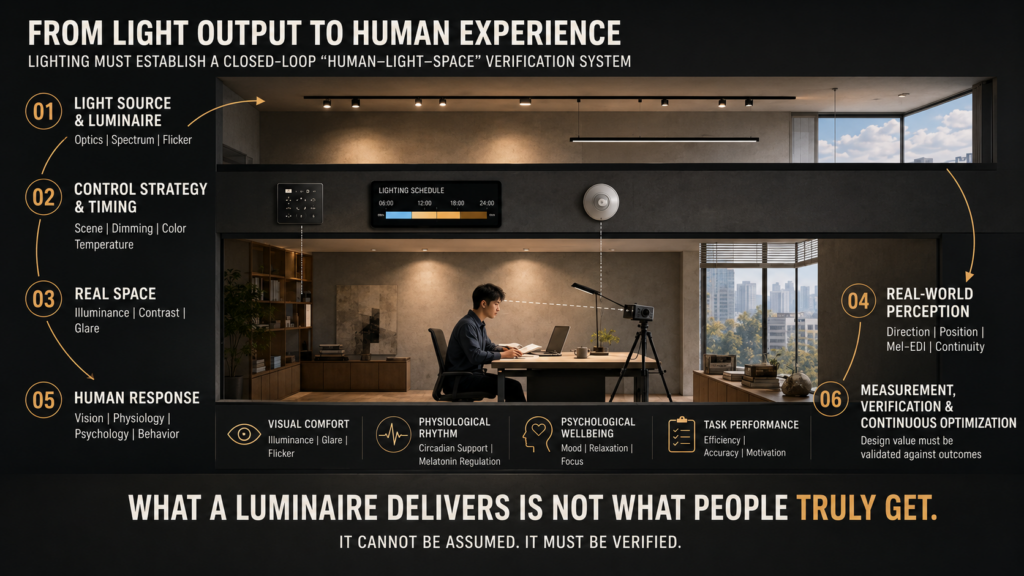
The day a project passes acceptance is often the first day that the value of lighting begins to drift.
Workstations are rearranged, walls are renovated, curtains and furniture are changed; sensors may shift out of position, control schedules may be overridden, luminaires age, daylight changes with the seasons, and users may bypass control systems they do not understand.
A year later, the lights may still be on.
But who can ensure that the visual comfort, energy performance, eye-level light exposure, or lighting experience originally promised is still being delivered?
If no one continues to answer this question, “human-centered lighting” exists only in the design specification.
1 | Project handover is not the end of value
Traditional engineering logic treats lighting as a one-time delivery: Design → Procurement → Installation → Commissioning → Acceptance → Exit.
But if what we are selling is not simply luminaires, but health, sustainability, productivity, or emotional value, then those values all have a temporal dimension.
They change with the space, occupants, seasons, control strategies, and equipment condition.
Therefore, delivery alone is not enough.
A project must also be operationally sustainable:
- It must be possible to know whether the intended results still exist.
- It must be possible to detect when performance begins to deviate.
- And there must be the capability to adjust the system and bring it back on track.
2 | The biggest gap is often not technology, but accountability
The manufacturer is responsible for the product, the designer for the drawings, the integrator for commissioning, the facility manager for operations, the owner for the budget, and the user for pressing the switch.
Every role may complete its own part, yet no one may ultimately be accountable for the final outcome.
When performance starts to deviate, the problem moves from one party to another: Is it a luminaire issue, a control issue, a change in the space, or simply the way the system is being used?
If the contract does not define targets, measurement methods, data access rights, review intervals, and accountability, even the most advanced platform will only generate more alerts that nobody is responsible for acting on.
A truly effective operational loop starts with one thing: a clearly defined party accountable for the outcome.
3 | The minimum viable operational loop is not complicated
First, preserve the baseline and targets.
Document what outcomes each key scenario is expected to achieve, and under what times, locations, and conditions those outcomes should hold.
Second, continuously obtain the necessary data.
Not every project needs to be filled with sensors. For ordinary spaces, periodic re-measurement may be sufficient. Critical spaces can be continuously monitored. High-risk or high-value environments may warrant more comprehensive data on eye-level light exposure, spectrum, mel-EDI, flicker, and occupancy or usage conditions.
Third, establish deviation rules.
What conditions should trigger an alert? Who receives the alert? How quickly must it be addressed?
Fourth, enable corrective action.
Adjust control logic, maintain equipment, recalibrate, or modify the space—instead of simply generating another attractive report.
Fifth, document the results.
Show the owner what the investment actually delivered, while giving the next design project a foundation based on real operational data.
4 | Being operational also means changing the business model
When lighting companies can continuously demonstrate results, what they sell is no longer limited to one-time hardware. It can also include commissioning, verification, diagnostics, optimization, and performance-based services.
This does not mean every lighting company needs to become a software company.
Instead, it means lighting companies need to reclaim what they should understand best: how light affects people in real spaces—and how to sustain that value over time.
At the same time, data must have clear boundaries around ownership, permitted use, and privacy.
Collecting more data does not necessarily mean understanding more. And the ability to monitor does not mean having the right to track occupants indefinitely.
The purpose of operational continuity is not to monitor people, but to ensure that the value originally promised does not disappear when acceptance ends.
This is Question 10 of The Next Question About Light: One year after project handover, who is responsible for proving that the lighting is still performing as intended? And if performance has drifted, who has the data, authority, and budget to correct it?
Please respond in the following format: Project type|Outcome owner|Review cycle|Corrective mechanism
This is not a conclusion. It is Question 10.

 English
  Chinese (China)
  Chinese (Taiwan)