

Starting from the “6 Steps to Good Light,” do we also need a “Good Light Dosage Chart”?
Some documents look deceptively simple.
A double-sided leaflet. Six steps. A few numbers. A few everyday illustrations.
But what is truly worth noticing is often not what the document already says, but what it quietly implies: that an entire industry may need a new language to redefine the value of light.
Recently, Good Light Group updated a public-facing leaflet with a very direct title: 6 Steps to Good Light.
It does not begin with complex standards.
It does not start with spectra, melanopic EDI, DER, CIE S 026, or WELL.
Instead, it starts with daily behaviors that ordinary people immediately understand: waking up in the morning, going outdoors, sitting near a window, using electric light appropriately, dimming lights before sleep, and maintaining darkness at night.
That is precisely where its power lies.
1 | Good Light Is Not a Lamp — It Is the Rhythm of an Entire Day
The first page of this document presents six very clear behavioral recommendations.
First, after waking up in the morning, obtain at least 500 lux of daylight or electric light so the body understands that the day has begun.
Second, spend more time outdoors during the daytime, especially in the morning, with a recommendation of more than two hours outdoors each day.
Third, when indoors, try to stay within one meter of a window whenever possible.
Fourth, when natural daylight is insufficient, use bright, high-quality electric light, targeting at least 500 lux at eye level during the daytime.
Fifth, reduce light levels to below 10 lux during the three hours before sleep.
Sixth, even if getting up during the night, try to keep light exposure below 1 lux.
These six points may appear to be simple lifestyle recommendations, but beneath them lies a deeper shift: they reposition “light” from being a single product into something that exists across an entire timeline.
Morning light is a start signal.
Daytime light is a sustaining signal.
Evening dimness is a preparation signal for rest.
Nighttime darkness is a condition for recovery.
What matters most here is not how advanced a particular lamp may be, but whether the human body receives the correct rhythm of light and darkness throughout the day.
In other words, good light is not about making everything brighter all the time. It is about giving the body the right signal at the right time.
2 | The Modern Problem May Not Be Too Much Light, but “Too Little Daytime and Too Much Night”
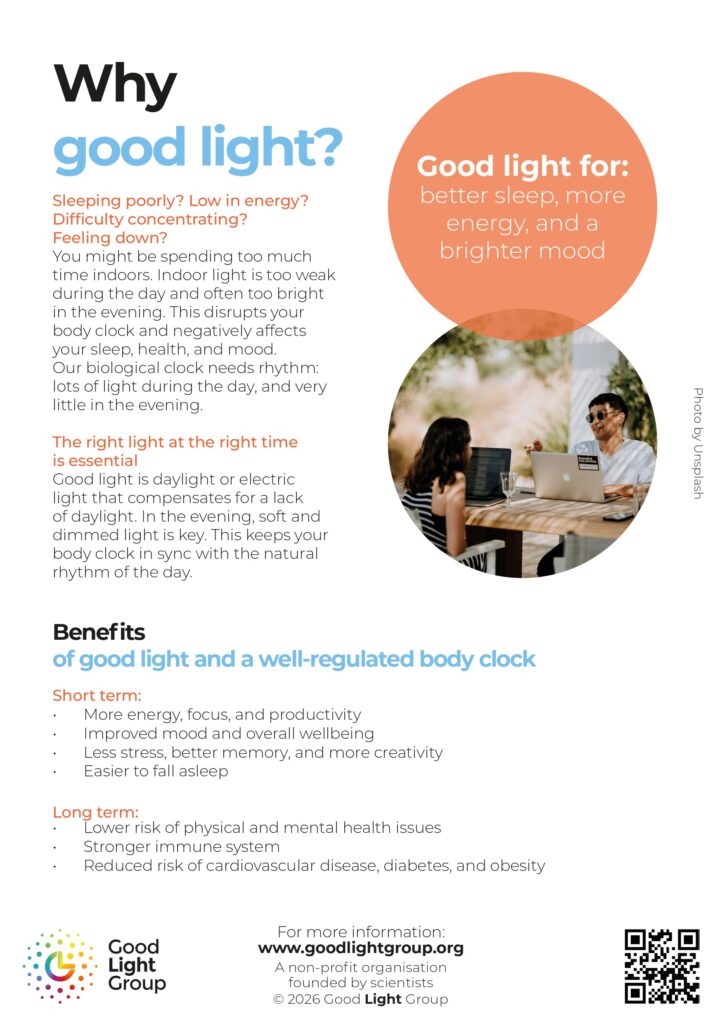
The second page of the document opens with a series of everyday questions:
Not sleeping well? Low on energy? Struggling to concentrate? Feeling down?
It then presents a crucial observation: we may be spending too much time indoors. Indoor light during the day is often too dim, while at night it is frequently too bright. This imbalance can disrupt the body’s internal clock and affect sleep, health, and mood.
The document goes on to explain that our circadian system depends on rhythm: we need abundant light during the day and very little light at night.
In many ways, this statement captures the central paradox of modern lighting.
For more than a century, electric lighting helped humanity conquer darkness. Today, however, we are beginning to realize that the real problem may not simply be a lack of light. Instead, it may be that when we need light, we do not get enough of it—and when we need darkness, we do not get enough of that either.
Many offices do not appear dark, yet from the perspective of the human circadian system, they may still function as low-light environments.
Many homes feel warm and inviting, but the television, smartphone, dining-room lighting, and bathroom lighting used before bedtime may all be sending the body the same message: it is not night yet.
Many hotels promote themselves as sleep-friendly environments, but from the lobby and corridors to the bathroom and bedside lighting, whether they truly create a coherent progression from evening to relaxation to sleep is rarely subjected to rigorous verification.
This is the deeper significance of the document.
It is not trying to sell a particular lamp or lighting product. Instead, it reminds us that light should be understood in a new way: as a daily environmental dose that influences human biology, health, and well-being.
3 | Good Light Is Entering a Measurable Phase
One small but noteworthy detail in this leaflet deserves attention.
It suggests that people can first measure light using a lux meter, with the sensor positioned at eye level. It also mentions that smartphone lux meter apps can be used for an approximate assessment, while cautioning that most apps are not particularly accurate and may even provide overly optimistic readings.
The passage is brief, but it is significant for the industry. It signals that Good Light’s language is beginning to shift from “perception” toward “measurement.”
In the past, we often said: this space feels comfortable, this light is soft, this lighting feels natural, this atmosphere feels premium. These perceptions are all important.
However, if they cannot be measured, verified, and delivered consistently, it becomes difficult to build professional consensus, and even harder for them to be incorporated into standards, design processes, construction, commissioning, and operations.
Using lux as an introductory language for the general public is a reasonable choice. Lux is easy to understand and relatively easy to measure with simple tools.
At the same time, however, the leaflet leaves us with a deeper question:
If lux is only the first step, what comes next?
4 | 500 lux, 10 lux, 1 lux: Why These Numbers Matter
What I find most compelling about this leaflet is that it translates the idea of “good light” into a set of numbers that are remarkably easy to remember.
Daytime: 500 lux.
Three hours before bedtime: below 10 lux.
At night: below 1 lux.
Outdoors: two hours per day, including at least thirty minutes in the morning.
Screen use: after every twenty minutes, stand up and look toward the sky for twenty seconds.
These numbers give the public something actionable. They transform an abstract concept into practical daily habits.
For professionals, however, these same numbers highlight a broader shift: the value of light is moving away from lighting power and toward human dose.
Just as nutrition science does not stop at asking whether food tastes good, but also considers calories, protein, fat, sugar, vitamins, and timing of intake, the future of healthy lighting should not stop at asking: How bright is the luminaire? What is its color temperature? What is its color rendering performance? How much power does it consume? What does it cost?
Instead, we should also ask: How much light does a person receive in the morning? How much biologically effective light exposure accumulates throughout the day? Is light stimulation gradually reduced in the evening? Is true darkness maintained during sleep? Do children, older adults, and night-shift workers require different light doses?
These questions extend well beyond the traditional boundaries of lighting design.
They are moving the conversation about light into a new framework:
Light Dose.
5 | Do We Need a “Good Light Nutrition Label”?
If this leaflet is viewed as a public education document, it is already highly successful.
It communicates a set of simple but important messages: go outside during the day; seek morning light exposure; stay near windows whenever possible; supplement with electric light when daylight is insufficient; dim the lights in the evening; and avoid exposing yourself to light that may disrupt sleep at night.
However, when viewed from the perspective of industry and standards, it raises a much larger question: should we think about light in the same way we think about nutrition?
Food has recommended daily intakes. Exercise has recommended weekly durations. Sleep has age-specific recommendations. What about light?
The light-dark rhythm required by an infant is clearly different from that of an adult. Adolescents often struggle with delayed circadian phase and nighttime screen exposure. Older adults generally require greater daytime light exposure while also needing sufficient nighttime illumination to reduce the risk of falls. Night-shift workers cannot simply follow the same light-dark schedule recommended for daytime workers. Likewise, a school, an office, a hotel, and a senior care facility should not be prescribed the same lighting regimen.
If light truly influences sleep, alertness, mood, concentration, and circadian physiology, then what we ultimately need may not be more descriptive adjectives, but a framework that can be understood, measured, designed, and verified:
A Good Light Dose Scale.
6 | This Is Also a New Turning Point for the Lighting Industry
Traditionally, the lighting industry’s value chain has revolved around light sources, luminaires, drivers, controls, design, and installation.
However, if light dose becomes the new core language, the entire value chain will need to be redefined.
LED light sources will no longer be evaluated solely by CCT, CRI, and luminous efficacy; they will also need to provide more comprehensive spectral and biologically effective lighting data.
Luminaires will no longer be concerned only with light distribution curves; they will need to account for the light actually reaching occupants’ eyes within a space.
Control systems will no longer focus merely on dimming and color tuning; they will need to understand time, activities, environmental context, and human physiological requirements.
Sensors will no longer be limited to detecting occupancy; they will need to monitor whether the lighting environment is achieving its intended design objectives.
Design software will no longer stop at calculating desktop illuminance; it will need to incorporate spatial models and human-factor models that predict how people experience light within a space.
Verification tools will no longer measure lux alone; they will need to quantify spectrum, flicker, m-EDI, DER, and cumulative light exposure over time.
At that point, good light will no longer be a slogan. It will become a new delivery framework—an integrated system through which lighting can be specified, designed, measured, verified, and managed.
7 | From “Six Steps” to a Single Dosage Scale
This leaflet from Good Light Group appears, on the surface, to be a friendly public education document.
However, I believe its deeper significance is that it helps articulate a long-overlooked issue: people do not simply need illumination. People need the right light at the right time, and they also need to return to darkness at the appropriate time.
This is precisely what distinguishes “good light” from traditional lighting.
The next question, however, is even more important. If we want to translate these lifestyle recommendations into design strategies, products, standards, and verification methods, how should we establish a truly practical Good Light Daily Dose Scale?
Should it be based on lux or m-EDI? How should it align with CIE, IES, and WELL standards? How should it differentiate among infants, children, adolescents, adults, older adults, and night-shift workers? And how can a single framework evolve into a new standard language that the lighting industry can actually deliver and implement?
These may well be the questions that deserve our attention in the next stage of development.

 English
  Chinese (China)
  Chinese (Taiwan)