
deLIGHTed talks Asia @ GILE 2026
Good Light Wake-up Call Series Report 03
Marijke Gordijn: Good Light, Rhythms, and Circadian Health
If Professor Robert Lucas’ presentation gave us a new ruler for measuring circadian-relevant light, Dr. Marijke Gordijn’s presentation placed that ruler back into life, work, sleep and public health.
Because healthy lighting ultimately needs to answer more than technical questions:
- Can we measure melanopic EDI?
- Can we calculate DER?
- Can we describe non-visual light responses through CIE S 026?
The deeper question is: Can the human body still hear time?
At deLIGHTed talks Asia @ GILE 2026, Dr. Marijke Gordijn, from Chrono@Work, Good Light Group and the University of Groningen, delivered an inspiring presentation: Good Light, Rhythms, and Circadian Health
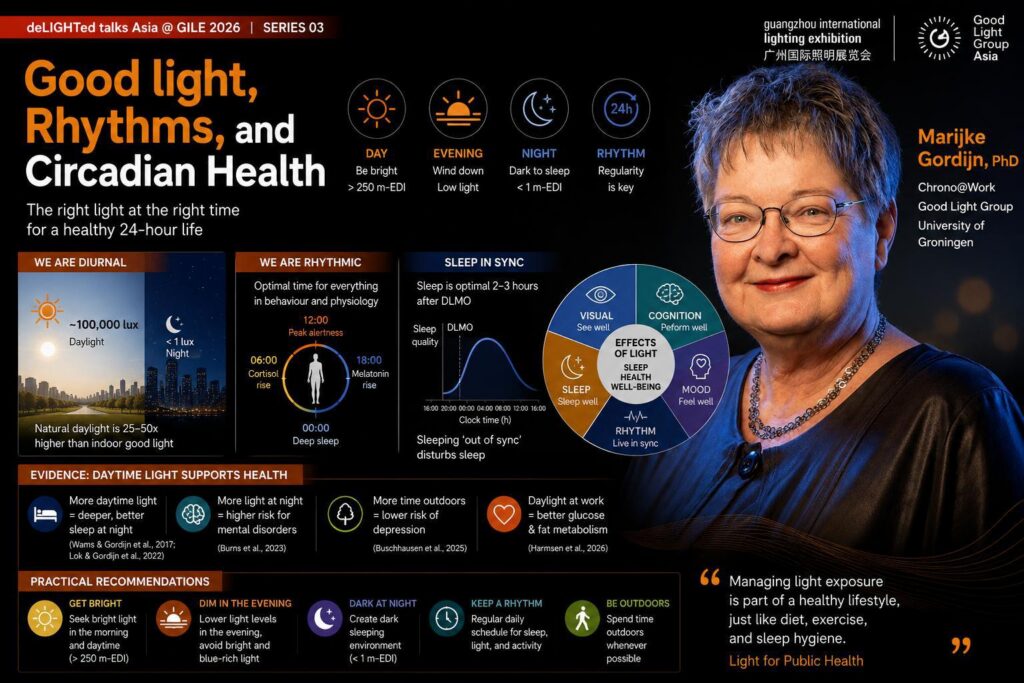
Her presentation began with a simple but powerful fact: We are a diurnal species. Human beings are not nocturnal animals.
Our bodies belong to daytime, to daylight, to morning activation, daytime alertness, evening winding down and nighttime quietness.
But modern buildings and modern lifestyles are blurring this rhythm. During the day, we spend long hours indoors under light levels that are often too low. At night, we are exposed to excessive electric light, screen light and urban light. As a result, the body’s once-clear time signals become weaker, more confusing and sometimes misaligned.
This is the central message of Marijke’s presentation: The right light at the right time.

1 | We are not the same person in the morning as we are in the evening
Marijke shared a striking example from swimming finals and semi-finals. In a significant number of cases, the difference between morning and evening performance could be larger than the difference between winning gold or silver. This was not simply a story about elite athletes.
It was a reminder: We are not the same person in the morning as we are in the evening.
This sentence matters deeply for the lighting industry.
Modern buildings, workplaces and urban systems often assume that humans are constant. A meeting at 9 a.m. Another meeting at 3 p.m. Work continuing at 9 p.m. Emails at midnight. Screens after midnight. Business travel across time zones. Shift work, night work, catch-up sleep, social jet lag and daylight saving time.
We are used to treating time as numbers on a clock. But the body does not only listen to clock time. The body has its own biological clocks. These clocks are not abstract concepts. They exist in the brain, and they also exist across cells and organs throughout the body.
Marijke reminded us that the function of biological clocks is to provide time structure to the body, helping it anticipate regular changes across the 24-hour day.
In the morning, the body prepares to wake. In the evening, the body prepares to slow down. At night, the body prepares to sleep. Before meals, the body prepares for digestion. Performance, body temperature, hormones, metabolism, cognition and mood all have their own temporal rhythms.
So the first task of Good Light is not to make every space brighter all the time. It is to respect this basic truth: Human beings are rhythmic organisms.
2 | The wrong light at the wrong time disrupts order
One of the clearest messages in Marijke’s presentation was: The wrong light at the wrong time.
This may be one of the most important problems in modern indoor lighting. During the day, we need enough light, especially daylight or light that provides strong circadian time signals. But modern indoor environments are often too dim. At night, we need low light, low stimulation, darkness, and ideally true darkness during sleep. But modern cities, indoor lighting and electronic screens make the night increasingly bright.
As a result, we create indoor light environments without rhythm: Too little light during the day. Too much light in the evening. The signals received by the body become contradictory. During the day, the body does not receive enough information that “it is daytime.” At night, the body is repeatedly told that “it is not yet time to rest.”
This has major implications for lighting.
Healthy lighting is not a synonym for “brighter light.” Nor is it simply “warmer” or “cooler” light. Nor is it completed by adding a few scene settings to a control panel.
Real healthy lighting must deal with time.
It must ask:
- What time is this light for?
- Who is receiving it?
- What activity is it supporting?
- Is it supporting alertness, focus, relaxation, care, recovery or sleep?
- Is it aligned with the body’s biological clock?
3 | DLMO: sleep is not only about bedtime. It is about when the body is ready to sleep
When we talk about sleep, we often ask:
- What time do you go to bed?
- How many hours do you sleep?
- How well do you sleep?
But Marijke reminded us that sleep has another crucial question: Is your sleep synchronized with your biological clock?
She introduced DLMO, or Dim Light Melatonin Onset, the time point at which melatonin begins to rise under dim light conditions. In simple terms, DLMO can be seen as an important marker of the body entering its biological night.
Optimal sleep timing is not arbitrary. For adults, sleep is often best positioned approximately 2–3 hours after DLMO. For children, this interval may be shorter.
If someone goes to bed before the body is biologically ready for sleep, or if the body is ready for sleep but work, screens, social activity or light exposure delay bedtime, sleep can become out of sync. Sleep becomes misaligned with the biological clock. This helps explain why some people may sleep for eight hours and still feel tired. It also explains why sleep regularity matters, not only sleep duration.
Marijke referenced research linking irregular sleep patterns with all-cause mortality risk in the following years.
This reminds us:
Healthy sleep is not only about how long we sleep. It is also about whether sleep is regular. And whether sleep is aligned with internal biological time.
So healthy lighting is not simply a “sleep mode” before bedtime.
It should help people maintain a healthy rhythm across the whole day:
- Daytime light to support wakefulness.
- Evening light to allow winding down.
- Nighttime darkness to support recovery.
4 | Light is a Zeitgeber for the master clock
One key word in Marijke’s presentation was: Zeitgeber. This German term means “time-giver.”
For the human body, light is one of the most important Zeitgebers. It tells the body what time it is.
In the human circadian system, the SCN, or suprachiasmatic nucleus, is often referred to as the master clock. Light enters through the eyes, influences the master clock, and then helps coordinate peripheral clocks, organ rhythms, cellular rhythms and behavioral rhythms.
So when we talk about light, we are not only talking about visual stimulation. We are talking about an environmental signal that synchronizes the body’s time system.
This is why Marijke emphasized: Recommendations for light levels depend on time of day.
Daytime and nighttime cannot be treated with the same logic. Work hours and pre-sleep hours cannot be governed only by the same static lighting criteria. Hospitals, offices, homes and schools cannot rely on one fixed illuminance value to solve all problems.
Based on recommendations such as those discussed by Brown et al. in 2022, daytime working hours may target > 250 m-EDI, while the nighttime sleep environment should be as low as possible, even below 1 m-EDI.
The point is not simply to memorize numbers. The point is to understand the direction:
- Daytime should tell the body that day has arrived.
- Nighttime should tell the body that night has truly arrived.
5 | The gap between natural daylight and ordinary indoor lighting is much larger than we think
Marijke showed a highly intuitive comparison.
Near a window in a workplace, natural light may reach around 34,720 lux, corresponding to approximately 29,970 m-EDI lux. By contrast, regular workplace lighting may be around 236.8 lux, corresponding to approximately 141.8 m-EDI lux.
These numbers are striking.
Many people assume that if office lighting feels bright enough, it is already close to daylight. But in reality, the gap between natural daylight and typical indoor lighting is enormous.
Marijke further noted that natural daylight can be 25–50 times higher than indoor “good light,” and regular workplace lighting can be hundreds of times lower than a sunny day. This does not mean every indoor space must replicate outdoor daylight. That is neither realistic nor necessary.
But it reminds us:
The modern indoor daytime is often not truly “daytime” for the body. This may be one reason why some people work indoors all day and still struggle with sleep at night. The issue may not only be stress. It may also be that the day was too dim, the evening too bright, and the body’s time signals were weakened.
Therefore, healthy lighting design cannot only focus on nighttime. Daytime light is equally important, and perhaps even more foundational.
More light during the day is related to deeper and less fragmented sleep at night
A good night may begin with the light we receive during the day.
6 | Light affects more than sleep. It may also relate to mood, cognition and metabolism.
Marijke did not limit light to sleep alone. She repeatedly emphasized that light is a powerful signal for the body, affecting circadian rhythms, sleep, mood and cognitive performance. She referenced UK Biobank data from more than 85,000 people: More light at night was associated with higher risk of depression, anxiety disorder, PTSD, psychosis, bipolar mood disorder and self-harm. Higher daytime light levels, independently of light at night, were associated with reduced risk of depression, PTSD, psychosis and self-harm.
This does not mean light alone explains mental health. Mental health is complex and involves genetics, society, lifestyle, stress, sleep, environment and many other factors.
But the evidence reminds us: The light environment may be an underestimated part of public health.
Marijke also discussed the relationship between time spent outdoors and future depression risk, particularly for late chronotypes, or evening-type people. In addition, she shared emerging work on light and metabolic health. In workplace comparisons between days behind a window and days under electric light only, natural daylight conditions were associated with glucose levels more in the normal range and increased fat oxidation.
Together, these ideas point to a larger proposition:
- Light is not only a lighting design issue.
- Light is also a lifestyle issue.
- Light can even become a public health issue.
7 | “Is electric light always safe?” A question we must ask again.
In the modern lighting industry, we often assume that electric light is safe.
- If it passes electrical safety.
- If it has no obvious glare.
- If it meets illuminance standards.
- If it does not visibly flicker.
- If the product is certified.
Then we assume it is safe.
But Marijke raised a question worth serious reflection: Electric light is always safe?
This question does not reject electric light. Nor does it oppose modern lighting. On the contrary, precisely because electric light is so important, so widespread and so deeply embedded in modern life, we must better understand its influence on the body’s time system.
- Insufficient electric light during the day may fail to provide enough circadian support.
- Too much electric light at night may disrupt sleep and recovery.
- Light at the wrong time may cause the body to miss natural rhythms.
- Long-term irregular light exposure may become part of the lifestyle challenges of modern society.
Therefore, the future lighting industry should not define safety only through electrical safety.
We also need to ask:
- Is this light safe in time?
- Is it appropriate for circadian rhythms?
- Is it friendly to different populations?
- Does it support long-term daily rhythms?
This is not an additional burden.
It is a necessary lesson as lighting moves from functional products toward health-supportive environments.
8 | Managing light exposure should become part of a healthy lifestyle
One of Marijke’s most important closing messages was: Managing light exposure is part of a healthy lifestyle, just like diet, exercise, and sleep hygiene.
This statement deserves serious attention from the lighting and building industries.
When we talk about a healthy lifestyle, we often think about:
- Eating well.
- Exercising regularly.
- Sleeping regularly.
- Managing stress.
- Not smoking.
- Drinking less alcohol.
But rarely do we say: Manage your light.
Yet light exposure runs through the whole day. It determines whether the morning truly starts. It influences daytime alertness. It affects evening winding down. It shapes whether the body can prepare for sleep.
So the value of healthy lighting is not simply to sell a product. It is to help people build a healthier light-dark rhythm. Better daytime. Better evening. Better night. Better sleep. Better mood and daily rhythm.
This is why Marijke placed light within the context of public health.
Good Light is not only personal comfort. It may also become a health-supportive infrastructure for schools, hospitals, offices, homes, senior living and public buildings.
9 | What this means for the international lighting and healthy building industries
For the international lighting and healthy building industries, Marijke’s presentation offers a clear direction:
- Healthy lighting cannot remain only at the level of visual comfort.
- It cannot remain only at the level of energy efficiency.
- And it cannot remain only a wellness story.
The next stage requires us to move toward: Rhythm-supportive lighting environments.
This means:
- During the day, light should sufficiently support wakefulness, activity and daytime performance.
- In the evening, light should decrease and avoid disrupting sleep preparation.
- At night, light should be minimal, and when necessary, low-stimulation and low-disruption.
- Different ages, schedules, cultures, work patterns and building types require different strategies.
This places new demands on the whole value chain:
- LED and luminaire manufacturers need to provide more complete spectral and circadian-relevant data.
- Control systems need to truly support time-based scenes, not just decorative presets.
- Designers need to integrate spectrum, illuminance, eye-level exposure, time, daylight and user behavior.
- Building consultants and WELL / healthy building teams need to include light exposure management in broader health strategies.
- Owners and operators need to understand that lighting is not only a design decision, but also an operation and user-experience issue.
- Researchers and standards bodies need to continue providing clear, responsible and actionable evidence boundaries.
Healthy lighting should not be a “healthy lamp.” Nor should it be a “healthy mode” on a control interface.
It should be an environmental strategy that supports a 24-hour life rhythm.
10 | The real formula for Good Light: Person × Time × Space × Purpose
If we translate Marijke’s presentation into design language, we might summarize it with one formula:
Good Light = Person × Time × Space × Purpose
- The same light can mean different things at different times.
- The same light may affect children, older adults, shift workers and late chronotypes differently.
- The same light has different purposes in classrooms, patient rooms, offices, bedrooms and transit spaces.
- The same light may support health during the day and become disruptive at night.
Therefore, Good Light cannot be defined by a single parameter.
We cannot say one spectrum is always Good Light. We cannot say one colour temperature is healthy. We cannot say one illuminance level is the universal answer.
Good Light must consider:
- Who the person is.
- What time it is.
- What the space is used for.
- Whether the goal is wakefulness, learning, relaxation, care, recovery or sleep.
This is the true meaning of the right light at the right time.
It is not a slogan. It is a design logic.

Closing: Good Light helps the body hear time again.
Marijke Gordijn’s presentation brought a gentle but firm reminder to the Good Light Wake-up Call:
Humans are not machines that should always be online. Humans are rhythmic beings.
- We need daytime. We also need nighttime.
- We need light. We also need darkness.
- We need wakefulness. We also need sleep.
- We need productivity. We also need recovery.
Modern society has given us the ability to illuminate the world at any time. But that does not mean we should illuminate the world at all times.
Good Light is not always brighter. It is not always smarter. It is not always more scenes.
Good Light gives the body the right signal at the right time. During the day, it tells the body to wake. In the evening, it tells the body to slow down. At night, it tells the body that rest is allowed. During sleep, it allows darkness to become part of health again.
This is what Marijke means by: The right light at the right time.
Good Light helps the body hear time again. From illuminating spaces to supporting rhythms. From visual comfort to circadian health. From a single product to a healthy lifestyle. From indoor lighting to public health.
This is the next step of the Good Light Wake-up Call.

 English
  Chinese (China)
  Chinese (Taiwan)