
At many project acceptance inspections, technicians place a light meter on the work plane.
For example: 500 lx. Pass.
The forms are signed, the equipment is handed over, and everyone breathes a sigh of relief.
But what, exactly, does that number prove?
It proves that, at a particular time, at a particular location, and on a particular plane, a certain amount of light was measured.
But it does not automatically prove what the person sitting there is actually experiencing visually; whether they feel comfortable; whether they can perform their tasks clearly; whether their light exposure over the course of a day is appropriate; or whether the space will continue to perform as intended months later.
Illuminance, of course, matters.
The problem is not that it is wrong. The problem is that we often ask a necessary metric to carry a responsibility that it cannot fulfill on its own.
1 | Luminaire output is not the same as what people actually receive
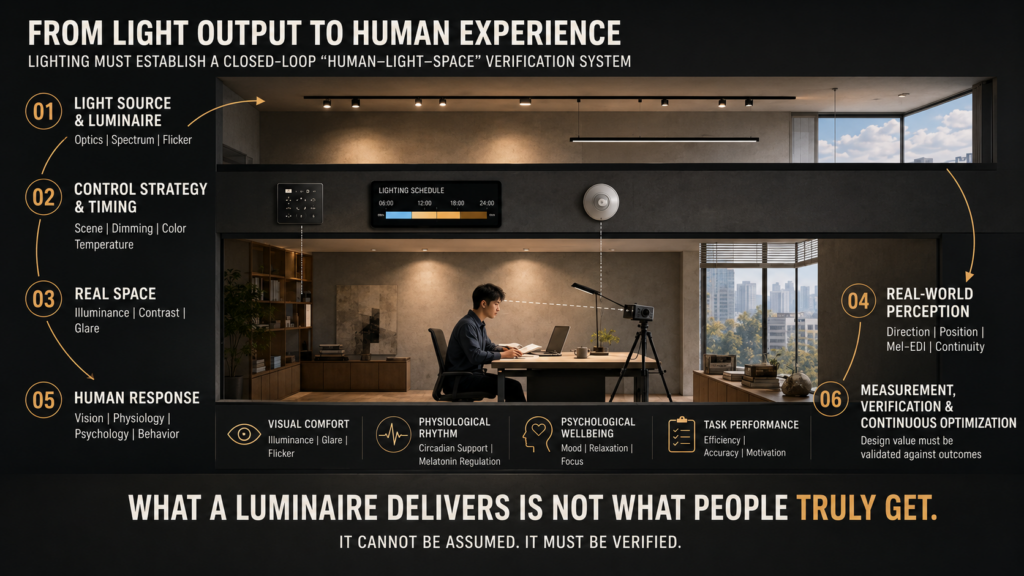
Light does not travel from the luminaire to the person in a straight line.
The light source’s spectrum, distribution, and flicker are shaped by the control strategy, mounting position, wall reflections, furniture obstructions, changes in daylight, and human activity before the light finally reaches the eye.
The same set of luminaires installed in two different spaces can produce different results. Even within the same space, a person’s actual light exposure can change when they move to a different seat, face a different direction, or experience the space at a different time.
What we really need to verify is not simply what a particular product produces in isolation, but:
What does a person actually receive under specific spatial, visual, temporal, and activity conditions?
2 | Verification can be divided into at least three layers
The first layer is product capability.
This includes spectrum, light distribution, dimming range, flicker, color quality, and control response—demonstrating that the product has the basic capabilities required to perform the intended task.
The second layer is spatial outcomes.
In addition to illuminance on the work plane, the project should assess, according to its objectives, illuminance at the eye, luminance distribution, visual contrast, actual glare, as well as SPD, mel-EDI, and flicker under different times and scenarios.
The third layer—and ultimately the most important—is human outcomes.
Is vision comfortable? Are tasks easier to perform? Are users willing to use the configured lighting scenes?
If a project makes claims about physiological or psychological benefits, it must also use research methods that are appropriate to those specific claims.
One point deserves particular emphasis: mel-EDI measured or calculated at the actual eye position and viewing direction can help characterize specific melanopic-weighted light exposure, but it is not itself a health outcome.
Metrics can help us build an evidence chain, but they cannot replace the evidence chain itself.
3 | Not every project needs a human-subject experiment
Requiring verification does not mean turning schools, offices, or homes into medical laboratories.
A more reasonable approach is to first clarify what the project is actually claiming, and then select a level of verification that matches those claims.
If the claim is energy savings, verify the energy baseline and actual consumption.
If the claim is visual comfort, assess luminance, glare, contrast, and user feedback.
If the claim is circadian support, the verification must consider eye position, timing, exposure duration, spectrum, and mel-EDI—not simply the correlated color temperature of the luminaires.
The broader the claim, the greater the evidentiary burden.
A value proposition without the ability to measure it is just advertising; measurement without a clearly defined value hypothesis is merely an accumulation of data.
4 | Verification should begin before design starts
Without a baseline, it is difficult to determine what the project has actually changed.
Before the renovation or implementation, document the real-world conditions of the space, including occupancy and usage patterns, daylight conditions, measurements at the eye position, and user needs. After implementation, repeat the measurements using the same methodology, while clearly stating the sources of error, the boundaries of the assessment, and what has not been demonstrated.
Only then can acceptance testing move beyond simply confirming that the equipment has been installed and begin to answer the more important question: Has the design intent actually been translated into what people experience and receive?
This is Question 9 of The Next Question About Light:
In the most recent project you were involved in, what did the existing acceptance testing actually prove? If you could add just one more on-site verification, what would it be—and why?
Please respond in the following format: Project context|Existing acceptance testing|Additional verification|Rationale
This is not a conclusion. It is Question 9.

 English
  Chinese (China)
  Chinese (Taiwan)