
deLIGHTed talks Asia @ GILE 2026
Good Light Wake-up Call Series Report 10
Amardeep Dugar:Lighting Design for Wellness — A Salutogenic Framework

In the previous reports of this series, we have gradually explored healthy lighting from multiple perspectives, including science, light sources, design, engineering implementation, and owner value.
Professor Robert Lucas explained that traditional lux measurements are no longer sufficient to describe how light influences the human circadian system. New metrics such as melanopic EDI and Daylight Efficacy Ratio (DER) are becoming essential.
Dr. Marijke Gordijn reminded us that good lighting is about delivering the right light at the right time.
Jan Denneman called on the lighting industry to shift its focus from illumination to human outcomes.
From the LED technology perspective, Kei Haraguchi / 原口圭 argued that after more than 30 years of white LED development, the industry’s goal should no longer be limited to improving luminous efficacy (LPW), but should instead create value for human circadian health.
Anne Berends expanded the discussion beyond visible light, introducing near-infrared light, dosage, and the scientific boundaries of health lighting.
Jeff Miller emphasized that lighting designers play the critical role of translating scientific knowledge into meaningful human experiences.
Kevan Shaw further pointed out that healthy lighting is not achieved simply by talking about it. It must be designed, calculated, measured, verified, and continuously managed throughout operation.
In the previous article, we explored how healthy lighting is evolving from a wellness narrative into measurable asset value—creating long-term investment value that building owners can understand.
Amardeep Dugar‘s presentation takes the discussion one step further, placing healthy lighting within a much broader context: Lighting Design for Wellness: A Salutogenic Framework
The purpose of this presentation was not to introduce another “healthy lighting” product, nor simply to place the word “wellness” in front of lighting design.
Instead, it asks a much more fundamental question: How can lighting design move beyond preventing problems and actively promote health and well-being?
That is the essence of the salutogenic framework.
Traditionally, architecture and lighting design have largely been problem-oriented. We focus on avoiding glare, minimizing flicker, preventing insufficient illumination, reducing safety risks, lowering energy consumption, and complying with standards. All of these remain essential.
However, Amardeep challenges us to think beyond simply avoiding harm.
The more important questions become:
- Can lighting help people better understand and navigate a space?
- Can it support people in managing their daily activities?
- Can it encourage meaningful social interaction?
- Can it strengthen people’s sense of safety, order, and purpose?
- Can it improve the experience of living and interacting within public spaces?
This represents a fundamental shift—from problem-based lighting to salutogenic lighting. It is a shift from avoiding ill health to actively creating health and well-being.
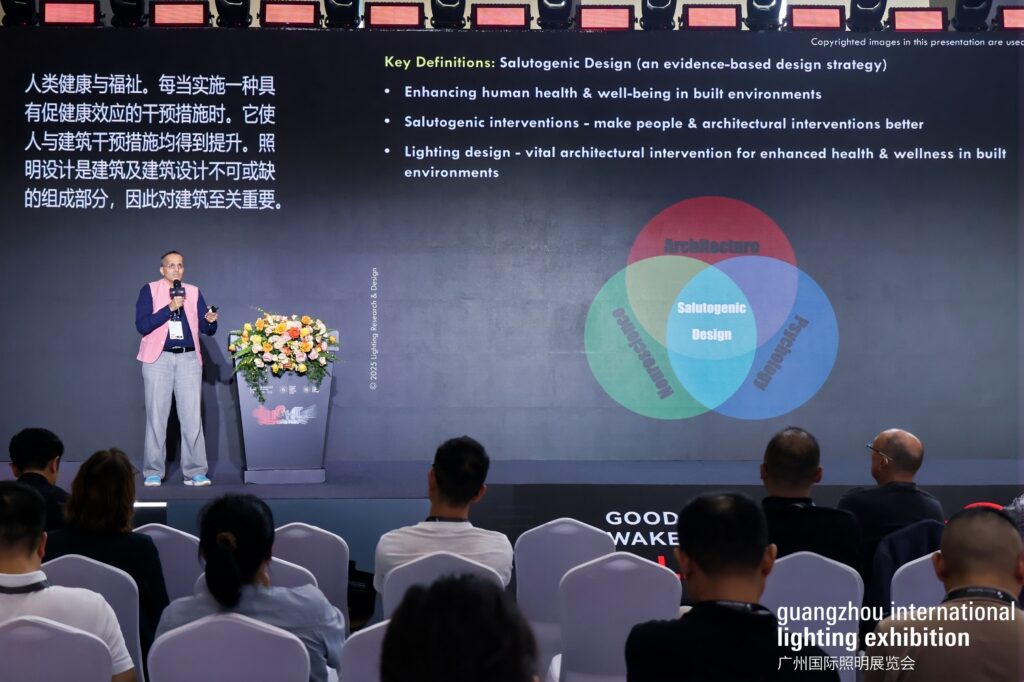
1 | Public Spaces Are Essential Settings for Human Well-Being
Amardeep begins his presentation by focusing on public realms—the spaces where community life unfolds.
Public spaces are neither our homes nor our workplaces or schools. They are often referred to as the third place.
These are the environments where people meet, pause, wait, socialize, observe, move, rest, and participate in everyday urban life.
Plazas, streets, libraries, community centers, transport hubs, parks, cultural venues, public lobbies, hospital waiting areas, and shared spaces within schools all form part of the public realm.
When these spaces are designed well, they can fundamentally improve people’s everyday experiences.
This is an especially important message for the lighting industry.
Too often, lighting in public spaces is viewed purely as functional lighting—providing sufficient brightness, ensuring safety, maximizing energy efficiency, and minimizing maintenance.
But public spaces are far more than circulation areas. They are where social interactions take place. They shape whether a city feels welcoming, whether public services are delivered with dignity, and whether health and well-being can be experienced and shared by everyone.
For this reason, public lighting should not be evaluated solely by asking: “Is this space bright enough?”
還應考慮:
- Do people want to stay here?
- Do they feel safe?
- Can they easily understand how to navigate the space?
- Do they feel welcomed?
- Can they interact naturally with others?
- Does the environment provide a sense of order, meaning, and belonging?
This is precisely why Amardeep begins his discussion of wellness through the lens of public spaces.
Healthy lighting should not be regarded merely as a premium feature for high-end interior projects. It should become an integral part of the quality of public life, helping create healthier, more inclusive, and more human-centered communities.
2 | Wellness Is Not a Single Health Metric—It Is an Active Pursuit
Amardeep begins by revisiting the meaning of wellness itself.
Although the term wellness is relatively modern, its roots can be traced back to much older concepts of holistic health.
Historically, wellness did not simply mean the absence of illness. Instead, it described a balanced way of living that integrated physical activity, hygiene, nutrition, social interaction, and everyday choices suited to an individual’s needs and circumstances.
The modern definition of wellness places even greater emphasis on intentional action.
As Amardeep highlights: “Wellness is the active pursuit of activities, choices, and lifestyles that lead to a state of holistic health.”
This perspective has profound implications for lighting design.
If wellness is an active pursuit, then the built environment is no longer just a passive backdrop—and neither is light.
Lighting can support people’s choices and daily activities. It can influence behavior, shape emotional responses, reinforce our perception of time, encourage social interaction, and determine whether a space feels understandable, manageable, and meaningful.
From this perspective, the relationship between lighting and wellness extends far beyond asking: “Is this lighting good for health?”
A more meaningful question is: “Does this lighting environment help people live better?”
This is what makes Amardeep‘s framework broader than the conventional discussion of healthy lighting.
Rather than focusing solely on physiological metrics, it also considers how lighting influences human behavior, perception, social relationships, the meaning people derive from places, and the overall quality of everyday life.
Ultimately, wellness-oriented lighting is not simply about improving biological outcomes—it is about creating environments that enable people to flourish physically, psychologically, and socially.
3 | Salutogenesis: From Preventing Disease to Creating Health
The central concept of Amardeep‘s presentation is Salutogenesis.
The term can be understood as “the creation of health” or “health promotion.” It stands in contrast to the traditional pathogenic model, which focuses primarily on disease and illness.
The pathogenic approach asks questions such as:
- What causes disease?
- How can we prevent harm?
- How can we reduce risk?
- How can we treat health problems?
The salutogenic model, however, asks a fundamentally different set of questions:
- How do people remain healthy in a world where stress is unavoidable?
- What environmental conditions help people cope with stress?
- What kinds of design support human resilience?
- How can spaces empower people to navigate everyday life more effectively?
This concept originates from the work of medical sociologist Aaron Antonovsky, whose research focused on a simple yet profound question: Why do some people remain healthy despite experiencing significant stress and adversity?
Rather than studying only the causes of disease, Antonovsky explored the factors that enable people to maintain health and well-being even under challenging circumstances.
This perspective offers powerful insights for architecture and lighting design.
In reality, stress is an unavoidable part of modern life.
Cities generate stress. Hospitals are inherently stressful environments. Schools, workplaces, transportation systems, senior living communities, and public service facilities all present physical, psychological, and social challenges.
If lighting design merely minimizes hazards, it has only accomplished part of its mission.
A salutogenic approach asks something more ambitious.
- Can lighting help people better understand their surroundings?
- Can it make environments easier to navigate and manage?
- Can it strengthen people’s sense of meaning, confidence, and control?
These questions define the starting point of salutogenic lighting design.
Instead of asking only, “Does this lighting avoid causing problems?”
it asks a far more meaningful question: “Does this lighting help people maintain and promote their health and well-being?”
This shift—from preventing illness to actively supporting human flourishing—represents one of the most significant changes in the future direction of lighting design.
4 | Sense of Coherence: Three Deeper Goals for Lighting Design
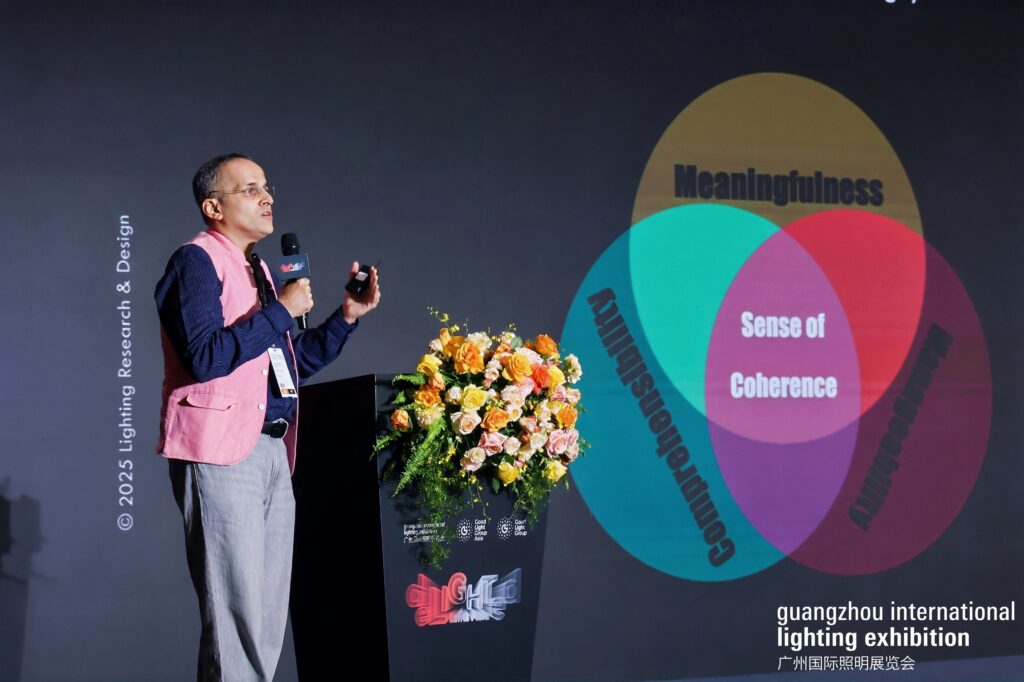
Another key concept introduced by Amardeep is the Sense of Coherence (SoC).
Originally developed by Aaron Antonovsky, the Sense of Coherence consists of three interconnected dimensions:
- Comprehensibility – “My world is understandable.”
- Manageability – “My world is manageable.”
- Meaningfulness – “My world is meaningful.”
When applied to lighting design, these three concepts become remarkably powerful.
Comprehensibility: Helping People Understand Their Environment
A good lighting environment does far more than enable people to see. It should help people understand the space around them.
Where is the entrance? Where is the exit? Where should people pause? What deserves attention? Where are potential hazards? Which areas are intended for quiet reflection, and which are designed for social interaction? Which direction should I go? Where am I within this environment?
Lighting that answers these questions contributes to a comprehensible environment—one that is intuitive, legible, and easy to navigate.
Manageability: Supporting People’s Ability to Act
A well-designed lighting environment should also empower people to manage their activities with confidence.
Can I move through the space safely? Can I clearly see the task I need to perform? Can I regulate my level of alertness and comfort? Can I easily find the services or destinations I need? Can I transition smoothly between different activities throughout the day? Do I feel in control within this environment?
Lighting that supports these capabilities creates a manageable environment, reducing stress while increasing confidence and independence.
Meaningfulness: Creating Places That Matter
Perhaps the most overlooked dimension of lighting design is its ability to create meaning.
Does the space make me feel welcome? Does it encourage me to stay? Does it preserve my dignity? Does it help me connect with other people? Does it express the memory, culture, and identity of a place? Does it reinforce the public value of the environment?
Lighting that strengthens these emotional and social connections contributes to a meaningful environment—one where people feel that they belong.
Beyond Visual Tasks
Through the Sense of Coherence framework, Amardeep elevates lighting design beyond the traditional goal of supporting visual tasks.
Instead, lighting becomes a tool that helps people understand, navigate, and find meaning within the environments they inhabit.
This represents an important evolution for the healthy lighting profession.
If healthy lighting is defined only by physiological metrics, its potential remains limited.
True health and well-being encompass far more than biology. They also include cognition, behavior, emotional well-being, social connection, and a sense of purpose.
A salutogenic approach reminds us that lighting should not only help people see better—it should help them live better.
5 | Why the Term “Human-Centric Lighting” Should Be Used with Caution
One of the most thought-provoking messages in Amardeep’s presentation is his observation that the term Human-Centric Lighting (HCL) is, in many contexts, inappropriate.
This is not because designing for people is unimportant.
Rather, it is because Human-Centric Lighting has become an overused—and in some cases, misused—marketing term.
Amardeep argues that HCL has increasingly become what he describes as a “hollow phrase.” It is often used to support exaggerated health claims, build social credibility, or provide reassurance to customers, even though the products or systems themselves may not necessarily deliver meaningful health outcomes.
This is a critical point for the lighting industry.
One of the most common challenges over the past several years has been the tendency to reduce complex scientific knowledge into simple product labels.
A luminaire is marketed as Human-Centric Lighting.
A control system is promoted as healthy lighting.
A preset scene becomes a circadian mode.
A tunable white schedule is presented as a complete wellness solution.
Yet without appropriate design, application context, measurement, validation, and evaluation of outcomes, these terms can easily become marketing language rather than evidence-based practice.
Amardeep‘s message closely aligns with one of the central themes of the Good Light Wake-up Call|好光覺醒行動 series: Healthy lighting is not defined by terminology—it is defined by methodology.
Simply calling a lighting solution human-centric does not mean it truly serves people.
Calling it wellness lighting does not guarantee that it improves health.
Labeling it circadian lighting does not automatically mean it supports healthy circadian rhythms.
Instead, we should ask more fundamental questions:
- Does the lighting have clearly defined objectives?
- Is it appropriate for the intended application and user group?
- Is it grounded in established scientific evidence and its known limitations?
- Has it been thoughtfully designed?
- Has its performance been objectively measured and verified?
- Does it produce meaningful visual, biological, and behavioral outcomes for the people using the space?
These are the questions that distinguish evidence-based lighting design from marketing claims.
For this reason, Amardeep expresses a preference for the term Integrative Lighting.
Unlike Human-Centric Lighting, Integrative Lighting emphasizes the integration of multiple dimensions of lighting performance—visual, biological, psychological, behavioral, social, architectural, and environmental—rather than suggesting that a single feature or product is inherently “human-centric.”
It is a broader, more holistic framework that recognizes lighting as part of an integrated system supporting human health, well-being, and everyday life, rather than simply another product category or marketing label.
6 | Integrative Lighting: A More Appropriate Professional Framework
Compared with Human-Centric Lighting (HCL), Amardeep argues that Integrative Lighting is a more appropriate and scientifically robust term.
Within the context of the International Commission on Illumination (CIE), integrative lighting refers to lighting that is designed to produce appropriate visual, biological, and behavioral responses in people.
Rather than focusing on a marketing label, the concept emphasizes three interconnected dimensions of human response:
- Visual responses
- Biological responses
- Behavioral responses
These outcomes are achieved through the thoughtful design of light’s spatial and temporal distribution, together with its intensity and spectral composition.
This makes Integrative Lighting a far more rigorous concept than simply describing a product or system as Human-Centric Lighting.
Instead of placing the word human into a slogan, it asks designers to consider a much deeper set of questions:
- How is the light perceived visually?
- How does it influence the body’s biological rhythms?
- How does it affect human behavior and activity?
- How should lighting change over the course of the day?
- How should light be distributed throughout a space?
- How should illuminance, spectrum, and timing be controlled?
- Are these lighting conditions appropriate for the specific users, the intended activities, and the characteristics of the space?
In other words, Integrative Lighting is not a product category—it is a design methodology.
It requires lighting designers to integrate visual performance, biological effects, and behavioral outcomes into a coherent design strategy rather than treating them as separate objectives.
This perspective points toward the future direction of healthy lighting.
The industry must move:
- From labels to methodologies.
- From marketing claims to evidence-based design.
- From individual products to integrated lighting systems.
- From optimizing isolated metrics to supporting the whole human experience.
Ultimately, Integrative Lighting recognizes that good lighting is not defined by a single metric or feature. It is defined by how effectively the entire lighting environment supports people—visually, biologically, behaviorally, and throughout the rhythms of everyday life.
7 | Three Human Responses to Light: Visual, Biological, and Behavioral
A key contribution of Amardeep‘s presentation is his framework for understanding how light influences people through three interconnected types of human responses:
- Visual Response
- Biological Response
- Behavioral Response
Together, these three dimensions form the foundation of Integrative Lighting.
Visual Response
Visual responses concern how people perceive and interpret their surroundings.
They are influenced by the quantity of light, its spectral composition, and its spatial and temporal distribution. This includes familiar lighting parameters such as illuminance, radiant energy, spectral power distribution (SPD), color quality, and the luminance distribution within a three-dimensional visual environment.
This is the aspect of lighting with which the industry has traditionally been most familiar.
People need light to see. They rely on it to recognize shapes, distinguish details and colors, understand spatial relationships, and navigate safely through their environment.
Biological Response
Biological responses relate primarily to the body’s circadian system—the internal 24-hour biological clock that regulates sleep, alertness, hormone production, and numerous physiological processes.
Light is the primary environmental signal that synchronizes this system.
Exposure to light can suppress melatonin, shift circadian timing, and influence neuroendocrine activity throughout the body.
In recent years, this has become one of the most actively researched areas of healthy lighting, leading to the development of metrics such as melanopic EDI (m-EDI), EML, and other circadian-related measurements.
Behavioral Response
Behavioral responses describe how light influences human behavior through the nervous system.
Lighting can affect alertness, mood, attention, decision-making, movement, and social interaction.
The autonomic nervous system plays an important role in these responses.
Activation of the sympathetic nervous system is associated with heightened alertness and the body’s “fight-or-flight” response, while activation of the parasympathetic nervous system supports relaxation, recovery, and the “rest-and-digest” state.
Although behavioral effects are often overlooked in conventional lighting practice, they are essential to understanding how lighting shapes human experience.
Light does far more than enable vision or regulate circadian rhythms. It also influences how people move, communicate, pause, relax, remain alert, or even avoid certain spaces.
A lighting environment can subtly shape behavior in ways that are immediately noticeable:
- In a public space, lighting may encourage people to move quickly through an area—or invite them to stay and engage with others.
- In a restaurant, lighting may either draw attention to the food or create an atmosphere that encourages conversation.
- In a hospital, lighting can increase anxiety—or promote a sense of calm and reassurance.
- In an office, lighting can help maintain alertness and concentration—or contribute to fatigue and reduced performance.
These examples illustrate why healthy lighting design cannot be evaluated by lux alone, nor even by m-EDI alone.
An integrative approach requires designers to understand how lighting simultaneously influences visual performance, biological function, and human behavior.
That is the true meaning of Integrative Lighting—a design philosophy that recognizes light as a powerful environmental factor shaping not only what people see, but also how they feel, behave, and ultimately experience the spaces in which they live and work.
8 | The Eight Dimensions of Wellness: Lighting Design Should Go Beyond Physical Health
Amardeep also draws upon the widely recognized framework of the Eight Dimensions of Wellness, reminding us that health and well-being extend far beyond physical condition alone.
These eight dimensions include:
- Physical Wellness
- Emotional Wellness
- Spiritual Wellness
- Intellectual Wellness
- Environmental Wellness
- Social Wellness
- Occupational Wellness
- Financial Wellness
This framework offers an important perspective for lighting designers. It reminds us that creating healthy environments is not simply about improving biological metrics or optimizing visual performance.
A truly healthy space is one where people feel safe, calm, oriented, connected, productive, and able to participate fully in everyday life.
Lighting can contribute to each of these dimensions in different ways.
Physical and Environmental Wellness
Lighting directly influences physical and environmental wellness through its effects on circadian rhythms, physiological responses, day-night lighting patterns, spectral composition, and overall environmental quality.
Well-designed lighting supports healthy biological function while creating environments that are comfortable, safe, and sustainable.
Emotional and Social Wellness
Lighting also shapes emotional experiences and social interaction.
The atmosphere of a space, the balance between light and shadow, interpersonal distances, visual comfort, and the way lighting encourages or discourages conversation all influence how people feel and relate to one another.
A thoughtfully illuminated environment can promote calmness, trust, belonging, and meaningful social engagement.
Spiritual and Occupational Wellness
Lighting can also contribute to a deeper sense of purpose and identity.
Through spatial hierarchy, visual order, architectural expression, and symbolic use of light, lighting helps people understand where they are and what a place represents.
In workplaces, lighting can reinforce organizational identity, support focus, and create environments where people feel motivated and valued.
Intellectual and Financial Wellness
Lighting plays an important role in supporting cognitive performance.
Visual clarity, appropriate contrast, and well-designed lighting controls can improve concentration, reduce fatigue, and enhance productivity.
At the same time, intelligent lighting systems, automation, performance verification, and evidence-based design contribute to long-term operational efficiency and asset value, supporting the financial dimension of wellness.
Expanding the Meaning of Healthy Lighting
This broader wellness framework transforms the discussion of healthy lighting.
Rather than focusing solely on physiological health, it recognizes that lighting influences multiple dimensions of human life simultaneously.
It acknowledges that lighting can shape not only biological responses, but also emotions, cognition, social relationships, environmental quality, workplace experience, and even the long-term value of buildings.
In doing so, Amardeep‘s framework restores a richer human and architectural perspective to lighting design.
Healthy lighting is no longer simply about helping people see better or supporting circadian rhythms.
It is about creating environments that enable people to live better, connect better, work better, and flourish across every dimension of wellness.
9 | Physical and Environmental Wellness: How Lighting Supports Circadian Rhythms and Natural Cycles
Within the Physical–Environmental dimension of wellness, Amardeep emphasizes that lighting should do more than provide visibility—it should support appropriate biological responses, particularly those governed by the circadian system.
Our daily exposure to light influences a wide range of physiological functions, including activity levels, mood, sleep, digestion, hormone regulation, and the synchronization of our internal biological clock.
Environmental wellness, in turn, can be enhanced through the thoughtful design of light’s timing, intensity, and spectral composition.
Put simply, the lighting environment should respect the body’s natural biological rhythms.
During the day, lighting should promote alertness, activity, and cognitive performance. As evening approaches, light should gradually become less stimulating, helping prepare the body for rest and sleep.
Rather than remaining static throughout the day, lighting should evolve in ways that reflect natural temporal patterns.
This does not mean that every project requires a sophisticated dynamic lighting system.
Instead, it serves as an important reminder that light has a temporal dimension.
Healthy lighting should never be defined by a single lighting scene intended to serve every hour of the day.
Instead, designers should consider how lighting responds to the rhythms of human activity, the way spaces are used throughout the day, and the changing characteristics of natural daylight.
Recognizing time as a fundamental design parameter represents one of the most significant shifts from traditional lighting practice toward Integrative Lighting.
Rather than treating lighting as a fixed environmental condition, Integrative Lighting views it as a dynamic component of the built environment—one that adapts to support human physiology while responding to both natural cycles and the evolving needs of occupants throughout the day.
10 | Emotional and Social Wellness: How Lighting Shapes Human Interaction and Relationships
Within the Emotional–Social dimension of wellness, Amardeep explains that emotional well-being depends on lighting that evokes appropriate behavioral responses, while social well-being can be supported through the thoughtful design of light’s spatial distribution, intensity, and spectral composition.
This perspective is especially relevant for public spaces, restaurants, cultural venues, hotels, offices, and community environments.
Lighting can influence whether people focus primarily on their surroundings—or on one another.
Brighter, more open lighting environments may encourage people to explore a space and engage with their surroundings.
Lower illuminance, combined with a greater sense of enclosure, may create conditions that encourage conversation and interpersonal connection.
Of course, these are not universal rules.
Human behavior is influenced by many factors, including culture, context, architecture, and the purpose of the space.
Nevertheless, the principle remains important:
Lighting has the power to shape social behavior.
If a public space is too dark, people may feel uncertain or unsafe. If it is excessively bright, they may be less inclined to linger. If the lighting lacks hierarchy and visual interest, the environment may feel monotonous and uninspiring. If important destinations, boundaries, or circulation paths are poorly defined, people can become disoriented.
Conversely, when lighting is carefully designed to organize circulation, define gathering areas, highlight seating, establish visual focal points, and reinforce spatial hierarchy, it becomes easier for people to navigate, interact, and connect with one another.
In this way, lighting becomes more than a tool for visibility. It becomes an instrument for shaping the social experience of a place.
This is why healthy lighting should not be viewed solely as a matter of physical health.
It is equally a matter of social well-being.
A thoughtfully designed lighting environment can encourage people to feel comfortable sharing space, engaging with others, and participating more fully in community life.
Ultimately, good lighting does not simply illuminate places—it helps create places where people genuinely want to be together.
11 | Spiritual and Occupational Wellness: How Lighting Creates Orientation, Order, and Meaning
Within the Spiritual–Occupational dimension of wellness, Amardeep explores the relationship between the human perceptual system and our sense of spatial orientation.
In the natural world, the position of the sun establishes the fundamental order of light and shadow.
Through this interplay of light and darkness, we understand space, perceive direction, recognize depth and materiality, sense the passage of time, and locate ourselves within our surroundings.
This natural order is far more than a visual phenomenon.
It also shapes how people feel, how they experience a place, and how effectively they work within it.
When the distribution of light and shadow is confusing or chaotic, people often experience discomfort and uncertainty.
When a space lacks clear orientation, people become disoriented. When lighting is completely uniform and devoid of hierarchy, a space can feel flat, monotonous, and lacking in identity.
Conversely, when lighting establishes a clear visual structure, people are better able to understand the environment, navigate it confidently, and develop a meaningful relationship with the place.
In workplaces, lighting contributes not only to visibility but also to productivity, organization, identity, task performance, and the overall quality of the working environment.
A well-designed workplace lighting system does more than illuminate a desk. It helps people understand the purpose of the space, recognize priorities, maintain focus, and work within a clear spatial and temporal rhythm.
This perspective reminds us that lighting design should never be reduced to meeting minimum illuminance requirements alone.
Light is one of the fundamental languages through which architecture communicates order.
It reveals hierarchy, defines movement, expresses identity, and creates places that people can intuitively understand and meaningfully inhabit.
Viewed through the lens of salutogenic and integrative lighting, lighting is not merely a technical layer added to architecture—it is an essential component of how people orient themselves, perform their work, and experience purpose within the built environment.
12 | Intellectual and Financial Wellness: How Lighting Supports Visual Clarity and Long-Term Value
Within the Intellectual–Financial dimension of wellness, Amardeep connects the visual system, visual acuity, and patterns of light and shadow.
Intellectual wellness depends on lighting that supports appropriate visual responses.
The human visual system requires sufficient and appropriate stimulation to recognize shapes, patterns, textures, and fine details. This underpins many of our everyday activities—including reading, learning, working, decision-making, and safe movement.
Although these principles may seem familiar, they remain fundamental.
If people cannot see clearly, it is impossible to achieve genuine health and well-being. If visual fatigue is excessive, a space cannot truly be considered high quality. If the relationships between brightness and contrast are confusing, cognitive load increases. If the lighting environment fails to support the intended task, both performance and safety are compromised.
Visual comfort, therefore, is not merely a technical requirement—it is the foundation upon which cognitive performance is built.
Amardeep also expands the discussion to Financial Wellness, highlighting the importance of appropriate automation, lighting controls, and long-term operational performance.
A successful lighting environment should not only be visually appealing and effective for its users; it must also remain practical and sustainable throughout the life of the building.
This includes managing energy consumption, simplifying maintenance, reducing operational costs, and ensuring that lighting systems continue to deliver their intended performance over time.
This perspective reminds us that wellness is not achieved simply by adding more features or specifying increasingly sophisticated technology.
True healthy lighting is about finding the right balance between human experience, operational efficiency, economic performance, and long-term value.
Only when these dimensions are considered together can healthy lighting become a solution that building owners are willing to invest in, operate, and sustain over the long term.
This idea also reinforces one of the recurring themes throughout the Good Light Wake-up Call|好光覺醒行動 series:
Healthy lighting is not simply about creating better light—it is about creating better-performing environments that deliver lasting value for both people and buildings.
13 | Salutogenic Lighting: Creating Spaces That Are Understandable, Manageable, and Meaningful
In the concluding part of his presentation, Amardeep brings together the concepts of Salutogenesis and Sense of Coherence (SoC) to form a practical framework for lighting design.
At its core, salutogenic lighting can be understood through three complementary qualities of light:
Comprehensible Lighting
Lighting should help people understand the space they are in and the activities taking place within it.
A comprehensible lighting environment reveals spatial hierarchy, clarifies circulation, identifies destinations, highlights important features, and helps people intuitively understand where they are and where they need to go.
Manageable Lighting
Lighting should enable people to manage both themselves and their surroundings.
A manageable lighting environment supports safe movement, appropriate task performance, daily routines, and the ability to adapt comfortably to different activities throughout the day.
It gives people a greater sense of confidence, control, and independence within their environment.
Meaningful Lighting
Lighting should help create spaces that are engaging, satisfying, and valuable.
A meaningful lighting environment contributes to emotional connection, reinforces the identity of a place, supports cultural expression, and creates environments where people genuinely want to spend time.
It transforms lighting from a purely technical necessity into an essential part of human experience.
These three principles deserve wider attention throughout the lighting profession because they translate healthy lighting from a collection of scientific metrics into a language that designers, building owners, and the general public can all understand.
Consider how these ideas apply across different environments:
- A well-designed public space should help people understand where they are and how to navigate confidently.
- A well-designed hospital should help both patients and healthcare professionals manage daily activities and maintain healthy day–night rhythms.
- A well-designed school should support students in understanding tasks, schedules, and learning environments.
- A well-designed senior living facility should help older adults live more safely, maintain healthy daily routines, and preserve their dignity.
- A well-designed office should enhance concentration while creating an environment where people enjoy working and collaborating.
- A well-designed urban public realm should foster a sense of order, warmth, identity, and belonging within the city.
This is the real strength of salutogenic lighting.
It does not claim that lighting can solve every health problem. Rather, it recognizes that lighting is one of the environmental conditions that can help people understand their surroundings, manage their daily lives, and find meaning in the places they inhabit.
In this way, lighting becomes more than an engineering discipline or a design element. It becomes an integral part of creating environments that support human health, well-being, and quality of life.
14 | Implementation Framework: Distinguishing Market Trends, Engineering Reality, and Clinical Science
In the latter part of his presentation, Amardeep offers a critical governance-level reflection on the implementation of healthy lighting frameworks.
He emphasizes that any credible approach to healthy lighting must carefully manage interdisciplinary boundaries. Market trends, engineering realities, clinical science, design methodologies, standards systems, industry initiatives, and certification frameworks all operate in different domains. They cannot be conflated.
Each carries a distinct role, and confusion between them creates systemic risk.
If market trends evolve too quickly without restraint, they can lead to exaggerated claims and overpromising.
If engineering constraints are ignored, proposed solutions may fail to be implemented in real-world projects.
If clinical science is misinterpreted, healthy lighting risks drifting into pseudo-scientific narratives.
If standards boundaries are unclear, overlapping roles between organizations can create confusion and fragmentation within the industry.
If regional differences are not acknowledged, global frameworks become difficult to scale or apply consistently.
For these reasons, the implementation of healthy lighting must be grounded in clearly defined responsibilities and boundaries.
- Technical committees are responsible for developing, revising, and interpreting consensus-based standards.
- Industry alliances can analyze how these standards are applied at a strategic and high-level context.
- Design communities translate principles into practical methodologies.
- Manufacturers contribute product capabilities and measurable data.
- Certification systems provide structured language for project validation.
- Research institutions continue to investigate mechanisms and generate evidence.
- Market communication must remain accurate, transparent, and responsible.
This multi-layered structure is particularly important for cross-sector platforms such as GLGA. The role of such platforms is not to replace standards organizations or to create competing certification authorities.
Rather, their value lies in facilitating collaboration across disciplines—helping different stakeholders develop a shared language while respecting the boundaries of their respective domains.
In this way, the industry can move forward in a coordinated manner, balancing innovation with scientific integrity and practical feasibility.
15 | Global Ideal vs Regional Reality: Healthy Lighting Must Be Adaptable
Amardeep concludes his presentation by emphasizing a crucial concept: scalability.
For any global framework of healthy lighting to be truly implemented in practice, it must recognize and accommodate regional differences.
Different regions operate under different building codes. Markets vary in product availability. Projects differ in commissioning and tuning capabilities. Cities experience different daylight conditions. Clients have different budget constraints. Facility management teams have different levels of expertise. Cultural expectations around light, privacy, social interaction, and nighttime behavior also vary significantly.
For this reason, a healthy lighting framework cannot be overly rigid.
It must maintain high-level universality, while preserving local adaptability.
Core principles can be shared globally. Performance indicators can gradually align. Methodologies can be exchanged and learned across regions. However, actual implementation must always respect local realities.
This is also why initiatives such as Good Light Wake-up Call|好光覺醒行動 are particularly important in Asia.
Asia is not simply a market that adopts European or North American healthy lighting frameworks. It is a region with its own distinct conditions:
- High urban density
- Complex and fast-moving supply chains
- Distinct engineering practices
- Strong demand for public and infrastructure buildings
- Accelerating aging population challenges
- Unique educational environments
- Significant healthcare and wellness pressures
- Intensely active urban lifestyles
Because of these factors, implementing healthy lighting in Asia requires both global scientific foundations and regional design methodologies.
The future of healthy lighting is not about exporting a single model worldwide. It is about building a framework that is scientifically consistent, yet operationally flexible—capable of adapting to diverse contexts while preserving shared principles of human health and well-being.
16 | Implications for the Chinese Lighting Industry: Beyond “Healthy Lighting Products” Toward Salutogenic Design Capability
Amardeep’s salutogenic framework carries very direct implications for the Chinese lighting industry.
The Chinese market is not short of healthy lighting products. There are full-spectrum luminaires, eye-care lighting systems, classroom lighting solutions, senior care lighting, hospital lighting, circadian lighting systems, intelligent dimming platforms, and “simulated daylight” solutions.
What is genuinely missing is something different: the ability to translate these products into salutogenic, health-supportive spatial design capabilities.
Without a design framework, healthy lighting remains a feature or a selling point.
Without scenario-based methodologies, it becomes a set of generic templates.
Without scientific boundaries, it risks exaggerated or unsupported claims.
Without engineering capability, it cannot be reliably delivered in real projects.
Without operational strategies, it cannot sustain performance over time.
Without a shared public language, it becomes difficult for clients, developers, and government stakeholders to understand its value.
The salutogenic framework reminds us that healthy lighting is not simply about producing better luminaires.
It is about creating lighting environments that are more comprehensible, more manageable, and more meaningful for people.
This perspective is particularly important for China’s public buildings, schools, hospitals, senior care facilities, offices, and urban regeneration projects.
The future competitiveness of the Chinese lighting industry should not be defined by questions such as:
- Who offers the most complete spectral solution?
- Who achieves the highest technical specifications?
- Who provides the lowest cost?
- Who has the most product configurations?
Instead, the more important questions are:
- Who can design light as a human-supportive environment?
- Who can translate scientific knowledge into spatial scenarios?
- Who can transform products into lived experience?
- Who can convert systems into long-term value?
- Who can move healthy lighting from marketing language to public well-being?
This is the real transformation.
It is not an incremental improvement in products.
It is a shift in capability—from lighting products to lighting as a design discipline for human health and societal value.
Conclusion: Good Light Is Not a Product Label, but a Salutogenic Environmental Capability
Amardeep Dugar’s keynote delivers a pivotal framework for the Good Light Wake-up Call|好光覺醒行動 series.
Healthy lighting should not be confined to circadian metrics. It should not be reduced to full-spectrum products. It should not be limited to the label of Human-Centric Lighting. And it should not remain at the level of marketing narratives.
Instead, it must be understood within a more complete context of wellness thinking and salutogenic design.
Light should not only enable people to see—it should help them understand space.
It should support how people manage activities, regulate biological rhythms, experience safety, engage socially, perform work, recover physically and mentally, and ultimately perceive meaning in their environments.
This is where lighting design and human well-being genuinely intersect.
From visual response to biological response.
From behavioral response to social response.
From a wellness story to a salutogenic framework.
From the hollow labeling of Human-Centric Lighting to the methodological rigor of Integrative Lighting.
From product claims to environments that are comprehensible, manageable, and meaningful.
Amardeep’s message is clear: Healthy lighting is not a label. It is a design capability—and more fundamentally, a salutogenic environmental capability.
Good Light should be comprehensible.
Good Light should be manageable.
Good Light should be meaningful.
Good lighting makes spaces easier to understand, life easier to manage, and experiences more meaningful.
This is the direction forward for the Good Light Wake-up Call|好光覺醒行動.

 English
  Chinese (China)
  Chinese (Taiwan)