
deLIGHTed talks Asia @ GILE 2026
Good Light Wake-up Call Series Report 17
Tori Hui Ren: From Product Parameters to Real-World Human-Centred Evidence

Across the Good Light Wake-up Call|好光覺醒行動 series, we have explored healthy lighting from many different angles.
Robert Lucas 教授告訴我們,傳統 lux 不足以描述光如何告訴身體時間。
Dr. Marijke Gordijn emphasized that Good Light must respect human rhythms.
Jan Denneman 呼吁照明产业从 illumination 走向 human outcomes。
Kei Haraguchi 以 Nichia 的光譜創新提醒我們,LED 30 年後的價值不能只停留在光效。
Dr. Anne Berends expanded the conversation toward near-infrared light, dose and scientific boundaries.
趙弘軼事主任 brought healthy lighting into healthcare, reminding us that hospital lighting must move from compliance lighting to clinical environment design.
Professor Yandan Lin brought the topic back to homes, showing why the next upgrade is not a smarter lamp, but a healthier home.
林偉傑博士 explained how light may act on the brain through visual circuits and brain-state pathways.
鄭紅成 used EEG to remind the industry that without verification, there is no true healthy light.
Zoe Xia / IWBI showed how healthy light must move from storytelling to value evaluation.
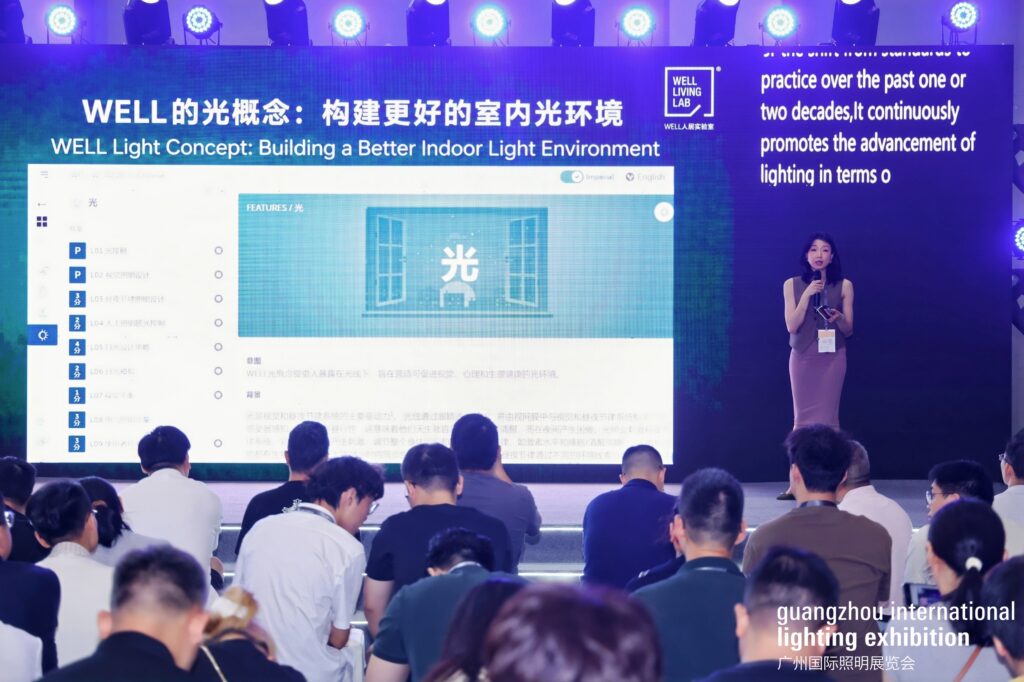
Tori Hui Ren’s presentation adds another essential layer: Healthy light must move from product parameters into real environments, real human experience and co-created evidence.
Her topic was: Light as Therapy: From Light Environment to Health Value Communication
The word “therapy” here should not be interpreted as a medical treatment claim. It is a reminder that light environments are deeply involved in daily life.
Light shapes how people see, feel, work, rest, recover and orient themselves in time. Good light can support healthier, more comfortable and more rhythm-aligned indoor living.
But this value cannot be built only on product specifications. It must be placed in real spaces. Used by real people. Observed in real scenarios. Measured with appropriate methods. Translated into language that designers, owners, manufacturers and users can understand.
This is why Tori’s contribution is so important. She does not simply ask whether a product has good parameters. She asks whether those parameters can become meaningful health value in real human environments.
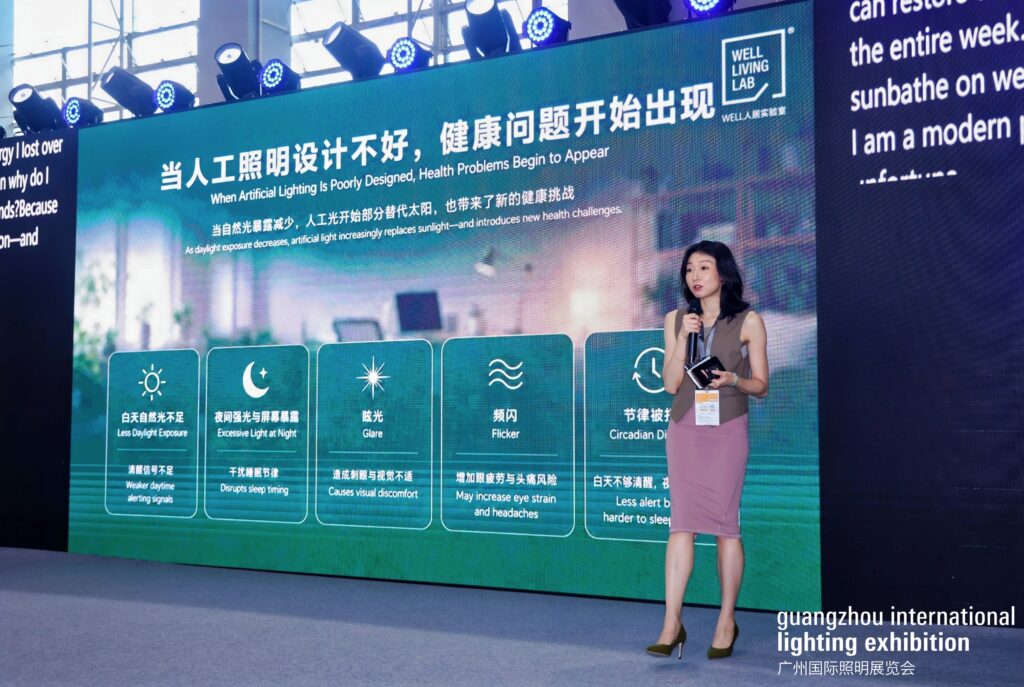
1 | Tori Hui Ren’s role: a translator of healthy living value
Tori Hui Ren’s professional position is especially relevant to the next stage of healthy lighting.
She sits at the intersection of several worlds: Health-oriented built environments. Human-centred research. Product interpretation. Scenario-based communication. Healthy building value translation. Market education. Industry collaboration.
This makes her more than a presenter of WELL language or product attributes. Her role is closer to a translator of healthy living value.
Healthy lighting today involves many different languages. Scientists speak about mechanisms and evidence. Standards bodies speak about requirements and verification. Manufacturers speak about parameters and product performance. Designers speak about space, experience and delivery. Owners speak about investment, risk and asset value. Users speak about comfort, sleep, brightness and daily life.
The healthy lighting industry often fails not because it has no technology, but because these languages are not yet connected.
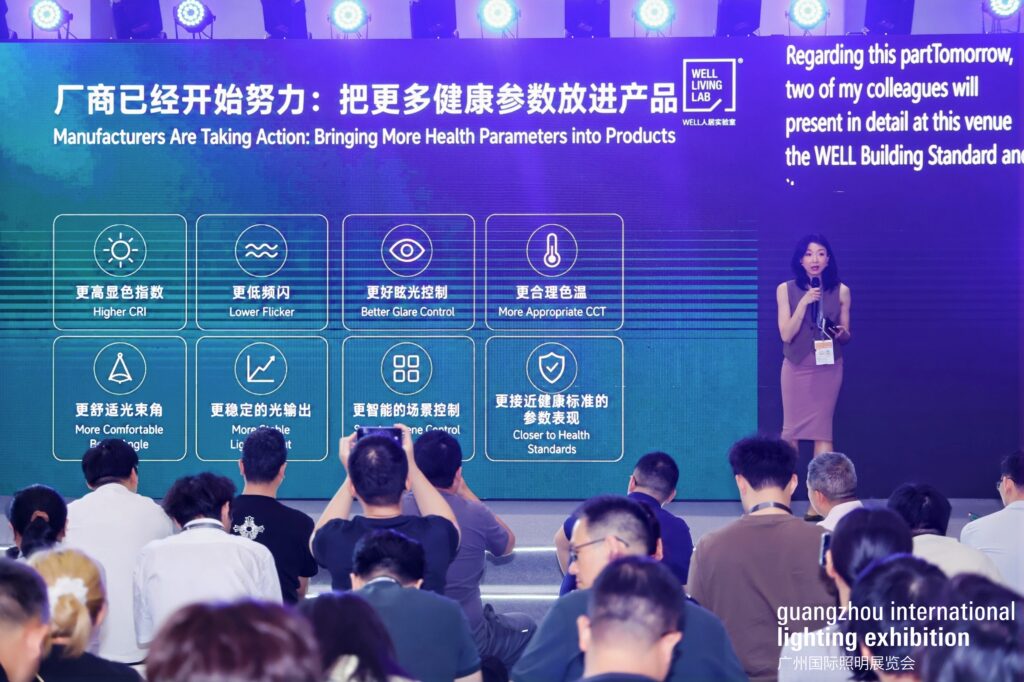
Many companies already offer strong product capabilities: High colour quality. Low flicker. Better glare control. More stable output. Tunable spectrum. Smart controls. Scene presets. More complete test reports.
But these capabilities often remain trapped in specification sheets. They have not yet been fully translated into: Owner value. Design intent. User experience. Healthy building strategy. Field verification. Scenario-based evidence. Market trust.
This is where Tori’s perspective becomes valuable.
- She pushes the industry to ask:
- How do these parameters enter a real space?
- How are they perceived by users?
- How can designers use them?
- How can owners understand their value?
- How can they be observed and evaluated?
- How do we avoid overclaiming?
- How do we move from single-product performance to co-created healthy environments?
This is the shift from product competition to value co-creation.
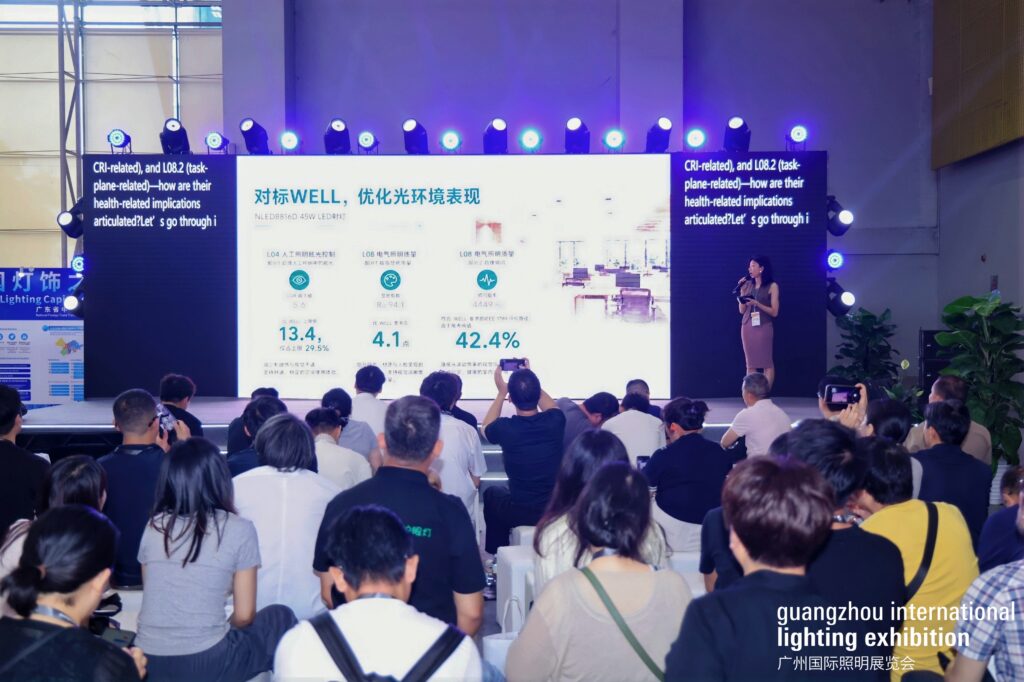
2 | Natural light is the original reference point for healthy lighting
Tori’s presentation begins with natural light.
This is the right starting point.
Natural light does much more than illuminate. It supports vision. It helps people see form, colour, texture, distance and expression. It synchronizes circadian rhythms. It tells the body when it is day. It supports alertness. It helps the human system stay oriented, active and awake during daytime. It shapes behaviour. It encourages outdoor activity, social interaction, recovery and daily structure. It also connects with metabolic processes, including vitamin D-related pathways.
These are not abstract ideas.
They remind us that human beings did not evolve under purely indoor electric light.
Our visual system, circadian system and physiological timing structure developed in relationship with natural day-night cycles.
This is why modern indoor life creates new risks. People often spend long hours indoors. Daytime light exposure may be too weak. Night-time light exposure may be too strong. Screens and artificial lighting may blur the boundary between day and night.
The first lesson of healthy lighting is therefore not to romanticize sunlight or simply “copy the sun.”
It is to understand what natural light teaches us: Time. Direction. Intensity. Spectrum. Variation. Daily rhythm. Connection with life.
Healthy lighting begins when artificial environments learn again from these natural patterns.
3 | When artificial lighting is poorly designed, health-related problems begin
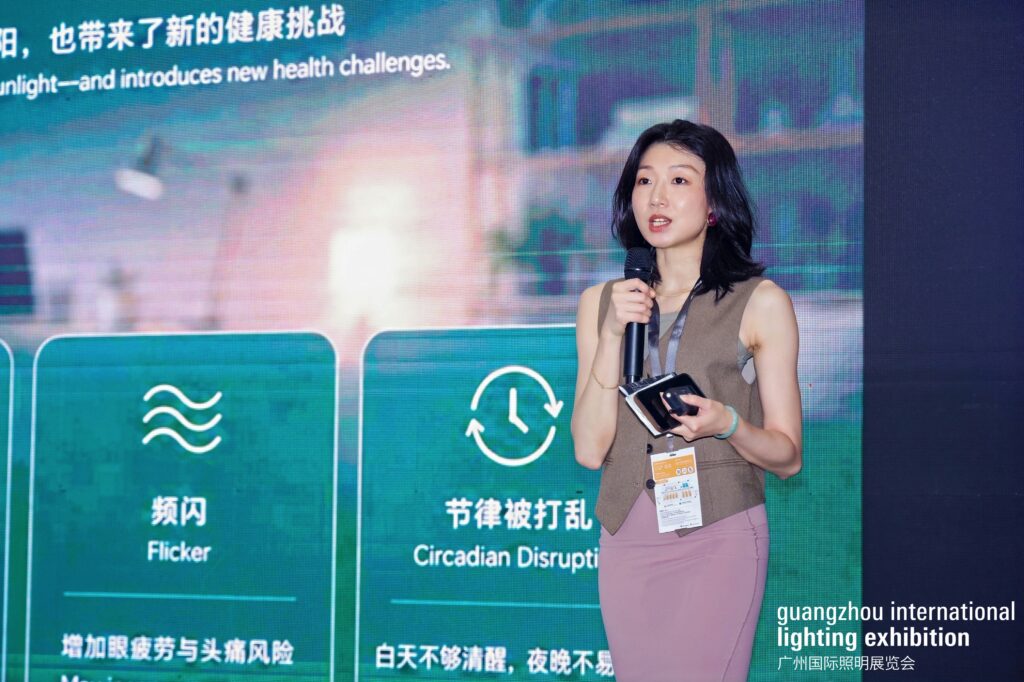
One of the most direct messages in Tori’s presentation is: When artificial lighting is not well designed, health-related problems begin to appear.
Artificial lighting itself is not the problem.
The problem is whether it is designed responsibly.
- If daylight is insufficient during the day, and indoor lighting does not provide a clear daytime signal, people may live in spaces where “day is not day enough.”
- If night-time lighting is too bright, especially before sleep, people may live in spaces where “night is not night enough.”
- If glare is poorly controlled, visual discomfort increases.
- If flicker is not managed, some users may experience eye strain, headaches or sensitivity-related discomfort.
- If colour temperature, brightness, direction and control logic do not match daily routines, the light environment may become disruptive rather than supportive.
This means artificial lighting can no longer be judged only by whether it is bright enough. Nor only by whether it is energy efficient. Nor only by whether it is smart.
Artificial lighting must learn to respect human time, vision, physiology and daily behaviour.
Healthy light is not simply an additional product feature. It is a correction of the modern indoor environment.
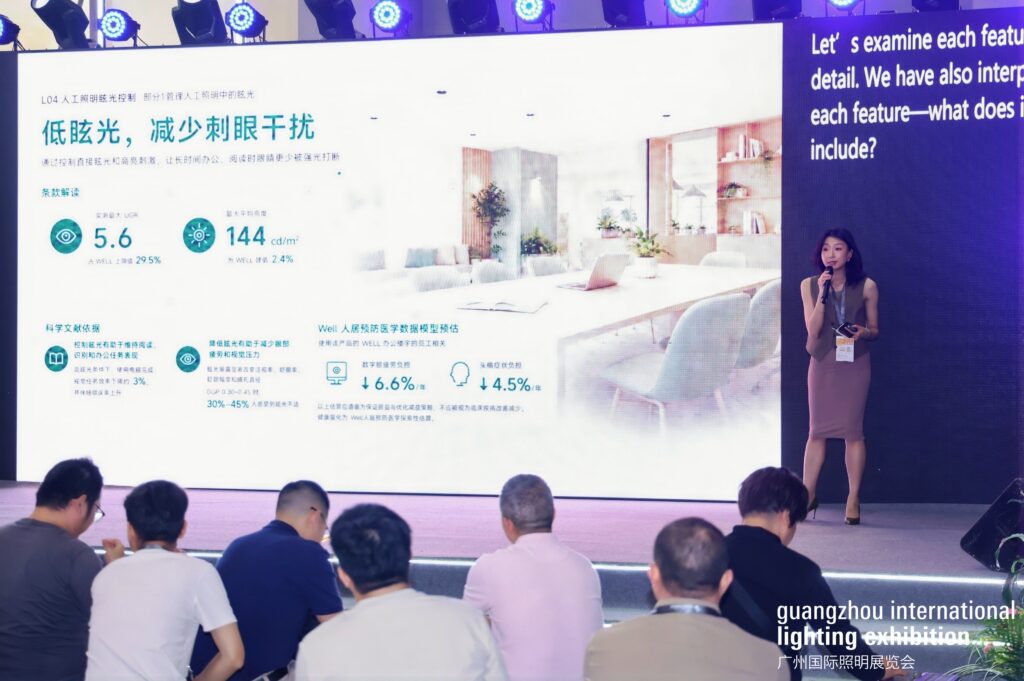
4 | Good parameters do not automatically become good value
One of the strongest ideas in Tori’s presentation is: Good parameters do not equal good communication.
This can be expanded further: Good parameters do not automatically become good value.
Today, many lighting companies have a long list of technical indicators: CRI. TM-30. Rf. Rg. SDCM. Pst LM. SVM. CCT. Duv. Illuminance. EML. Melanopic EDI. Blue light hazard classification. Beam angle. Dimming curves. Flicker data. Spectral power distribution.
All of these matter.
But the real questions are: Who understands them? Who cares about them? Who can connect them to spatial value? Who can translate them into design language? Who can turn them into a reason for owners to invest? Who can explain what they mean for everyday life?
Without this translation, good parameters remain numbers.
For consumers, they may look like technical clutter. For owners, they may look like extra cost. For designers, they may lack project context. For the market, they may become another layer of terminology.
Healthy lighting therefore needs translation. From parameters to value. From technology to scenarios. From standards to user language. From product performance to meaningful contribution in homes, offices, hotels, hospitals and care environments.
This is the real meaning of moving from light environment to health value.
5 | Delos and Well Living Lab: bringing healthy buildings into experimental environments
To understand Tori’s perspective, we need to understand the broader contribution of Delos and the Well Living Lab.
Delos is not a traditional lighting company. Its contribution has been to connect human health and wellbeing with the indoor built environment.
Its fundamental question is: People spend most of their lives indoors. So how do indoor environments affect health, sleep, behaviour, mood, performance and quality of life?
This is exactly the question the healthy lighting industry is now facing.
The Well Living Lab adds another important dimension. Instead of discussing healthy buildings only as a concept, it brings human-environment interaction into reconfigurable, sensor-rich, real-world-like experimental settings.
This matters for three reasons.
First, it moves healthy buildings from belief to evidence.
Healthy buildings cannot rely only on statements such as “this should be healthier.”
They need research. Measurement. Human-centred experiments. Realistic spatial simulation. Observable human and behavioural responses.
Second, it places individual environmental factors inside a whole living system.
People are not affected by light alone.
They are also affected by air, temperature, sound, materials, furniture, visual background, behaviour, work patterns, sleep routines and operating conditions.
Therefore, healthy lighting cannot be isolated. Light must be studied together with other dimensions of the indoor environment.
Third, it builds a more rigorous bridge between products, design and scenarios.
A product with good parameters does not automatically create health value when placed in a room. A design idea that sounds persuasive does not automatically generate the expected user experience.
Experimental platforms such as the Well Living Lab remind the industry that: Product capability needs scenario translation. Scenario strategy needs human-centred validation. Health value needs data, research and user experience to build trust.
This is why Tori’s perspective is especially relevant to lighting.
She does not simply ask manufacturers to create “healthier products.” She reminds the industry that healthy products must enter healthy living contexts. Healthy parameters must enter real environments. Healthy value must be communicated responsibly. Healthy claims must have boundaries. Healthy light must move from isolated luminaires toward real spaces and lived experience.
6 | Healthy lighting needs experimental co-creation, not one-way product promotion
A major risk in the healthy lighting industry is that companies treat healthy light as a marketing campaign. Create a new spectrum. Create a new lighting scene. Create a new mode. Prepare a test report. Develop a health story. Launch it into the market.
This approach is not enough.
The real value of healthy lighting cannot be established only through one-way promotion. It requires experimental co-creation. Manufacturers bring product capability. Designers bring spatial strategy. Research teams bring experimental design. Healthy building platforms bring value language. Owners provide real sites. Users provide lived experience. Measurement tools provide objective data. Standards organizations provide common language.
Only then can healthy light move from: “We say it is good.”
to: “We understand where, for whom, under what conditions, and with what evidence it creates value.”
This is where Delos / Well Living Lab / WELL Living Lab and GLGA could explore meaningful future collaboration.
Healthy light needs to move from product displays to scenario experiments. From sales presentations to human-centred research. From isolated parameters to multi-factor environments. From market slogans to observable, measurable, comparable and translatable value.
7 | Co-creation opportunity 1: healthy light for homes
Homes are one of the most important settings for healthy lighting. People spend long hours at home. Home behaviours are complex. Individual differences are large. Night-time sensitivity is high. A home includes work, study, rest, family interaction, sleep, caregiving, night waking and recovery.
Future collaboration between GLGA, Delos / Well Living Lab and related research partners could explore residential healthy lighting scenarios such as:
- Insufficient daytime light exposure for home workers.
- Children’s study lighting and pre-sleep transition.
- Older adults’ night-time path lighting and fall-risk reduction.
- Low-stimulation bedroom lighting before sleep.
- Evening family lighting in living rooms.
- Different spectra and control strategies before bedtime.
How whole-home intelligence can move from convenient control to rhythm support.
The question should not simply be: Which lamp is healthier?
The real questions are: What light does this person need across the day? What supports daytime activity? What supports evening transition? What disrupts night-time recovery? Do users understand the lighting modes? Do they actually use them? Does long-term use change satisfaction or behaviour?
Healthy home lighting does not need more decorative scenes. It needs a deeper understanding of family rhythms.
8 | Co-creation opportunity 2: healthy light for work experience
Workplaces are another major setting for healthy lighting.
They are also one of the easiest to overclaim. Many people say healthy lighting improves productivity.
A more responsible statement would be: Healthy lighting can help create environmental conditions that support visual comfort, alertness, circadian alignment, satisfaction and work experience.
Future co-creation could explore:
- How daylight and electric lighting jointly support daytime alertness.
- Eye-level vertical light exposure and user perception.
- Glare control and screen-based work comfort.
- Low flicker and long-duration visual fatigue.
- Different light strategies for meeting rooms, open offices, focus zones and recovery spaces.
- Whether employees actually use lighting controls.
- How different lighting conditions affect workplace preference, satisfaction and perceived wellbeing.
Workplace healthy lighting should not stop at higher illuminance or tunable colour temperature. It should enter real work behaviour and spatial experience. This is where a scenario-based experimental platform can make a difference.
9 | Co-creation opportunity 3: hotels and sleep recovery
Hotels have strong potential for healthy lighting.
Guests often need recovery. They need to sleep well. Wake up comfortably. Relax in an unfamiliar room. Adjust to travel fatigue or time-zone changes. Reduce night-time disruption. Rebuild a sense of order within a short stay.
However, much hotel lighting still focuses mainly on aesthetics and ambience. The room looks beautiful. The lighting layers are sophisticated. The control panel may be complex. But the environment may not actually be sleep-supportive.
Future co-creation could explore:
- How evening room lighting can reduce stimulation after check-in.
- How bedside reading lights can support use without disturbing pre-sleep transition.
- How night-time path lighting can support safety without strong disruption.
- How bathroom night lighting can avoid abrupt awakening.
- How morning wake-up light can coordinate with curtains and daylight.
- How travellers from different time zones respond to different room light environments.
The value of hotel healthy lighting is not only luxury appearance.
It is the feeling that: This room understands night. This room understands recovery. This room uses light to help the body return to rhythm.
10 | Co-creation opportunity 4: healthcare and senior living low-disruption lighting
Healthcare and senior living settings require the highest caution. There are patients. Older adults. Night-time care routines. Fall risks. Sleep disruption. Clinical tasks. Vulnerable users.
This is where healthy lighting must be most responsible.
Future co-creation could explore:
- Low-stimulation night lighting in wards.
- Path lighting for older adults.
- Daytime rhythm support in senior living environments.
- Lighting for nursing stations and night-shift staff.
- Light environments in sleep centres.
- Different needs of patients, staff and family members.
- How lighting can support safety, care and sleep at the same time.
This type of work must avoid medical overclaims. The goal should not be to claim that a lighting solution treats disease.
A more responsible research question is:
- What kind of light environment reduces night-time disruption?
- What kind of path lighting supports safer movement?
- What day-night strategy better fits care environments?
- What control strategy can be accepted by staff?
This is the right path for healthy lighting in healthcare and senior care.
11 | Co-creation opportunity 5: responsible communication language for healthy light
Tori’s statement that good parameters do not equal good communication is especially important for the future of the industry.
Healthy lighting needs a new communication language. Not exaggerated. Not oversimplified. Not overloaded with technical jargon. But accurate, clear, scenario-based and boundary-conscious.
- For scientists, the language should explain mechanisms and evidence.
- For designers, it should explain scenarios and metrics.
- For manufacturers, it should explain product capability and testing.
- For owners, it should explain value and verification.
- For users, it should explain experience and choices.
- For the market, it should explain responsibility and boundaries.
A future collaboration could develop responsible communication guidance for healthy lighting:
- What can be said?
- What needs qualification?
- What should not be said?
- How should we distinguish health support, environmental improvement and medical claims?
- How can metrics such as melanopic EDI, EML, flicker, glare and colour quality be translated into user language?
- How can owners understand the investment value of healthy lighting?
- How can consumers understand the life value of better light?
This is especially important for Asia and China.
Without responsible communication, healthy lighting can easily be overmarketed, misunderstood and eventually lose trust.
12 | Why the Good Light Wake-up Call needs Tori Ren’s perspective
The Good Light Wake-up Call|好光覺醒行動 is not only about scientists explaining science. It is not only about designers explaining design. It is not only about manufacturers showing products.
It is about building a full chain: Science. Standards. Products. Design. Verification. Scenarios. Owner value. User understanding. Market communication. Long-term operation.
Tori Ren 將代表 Delos 參與’s contribution sits at the intersection of scenario experimentation and value translation.
She reminds us:
- If healthy light cannot be understood, it will not be adopted.
- If it cannot be communicated responsibly, it will be misused.
- If it has only parameters, it may not become market value.
- If it has only stories, it may not build scientific trust.
- If it stays only at the product level, it may never become real healthy living value.
Healthy lighting therefore needs a new capability: Co-creation.
Not one company saying its product is good. But multiple disciplines and stakeholders asking together:
- How does Good Light enter homes?
- How does it enter offices?
- How does it enter hotels?
- How does it enter healthcare?
- 如何測量?
- How is it experienced by users?
- How is it adopted by owners?
- How is it delivered by designers?
- How is it maintained in operation?
This is the most promising opportunity for collaboration between GLGA and Delos / Well Living Lab / WELL Living Lab.
Closing: Good Light must be made, lived and verified
Tori Hui Ren’s presentation brings an essential reminder to deLIGHTed talks Asia @ GILE 2026 and the Good Light Wake-up Call|好光覺醒行動:
Healthy lighting is not only a scientific issue. Not only a product issue. Not only a design issue.
It is also a scenario issue. An experimental issue. A communication issue.
Natural light reminds us that people need light for vision, rhythm, alertness, behaviour and metabolism.
Poorly designed artificial lighting can create insufficient daytime signals, excessive night-time stimulation, glare, flicker and circadian disruption.
Manufacturers are putting more health-related parameters into products.
But good parameters do not equal good value. Good products do not automatically create good scenarios. Good stories do not automatically create real health outcomes.
The value of Delos / Well Living Lab / WELL Living Lab is that they remind us: Healthy light must enter real spaces. Real days. Real user experience. Measurable and comparable scenario research.
Only then can it be translated into design guidance, product improvement, owner value and industry consensus.
The most important message of this article is:
Good Light should not only be made. It must also be lived, observed and verified.
From light environment to health value.
From good parameters to good communication.
From product capability to scenario co-creation.
From health storytelling to human-centred experimentation.
From single products to shared industry evidence.
This is the message Tori Hui Ren brings to the Good Light Wake-up Call|好光覺醒行動.
And it is one of the most important open collaboration opportunities for the future of healthy lighting.
Good Light Wake-up Call. 好光覺醒。

 English
  Chinese (China)
  Chinese (Taiwan)