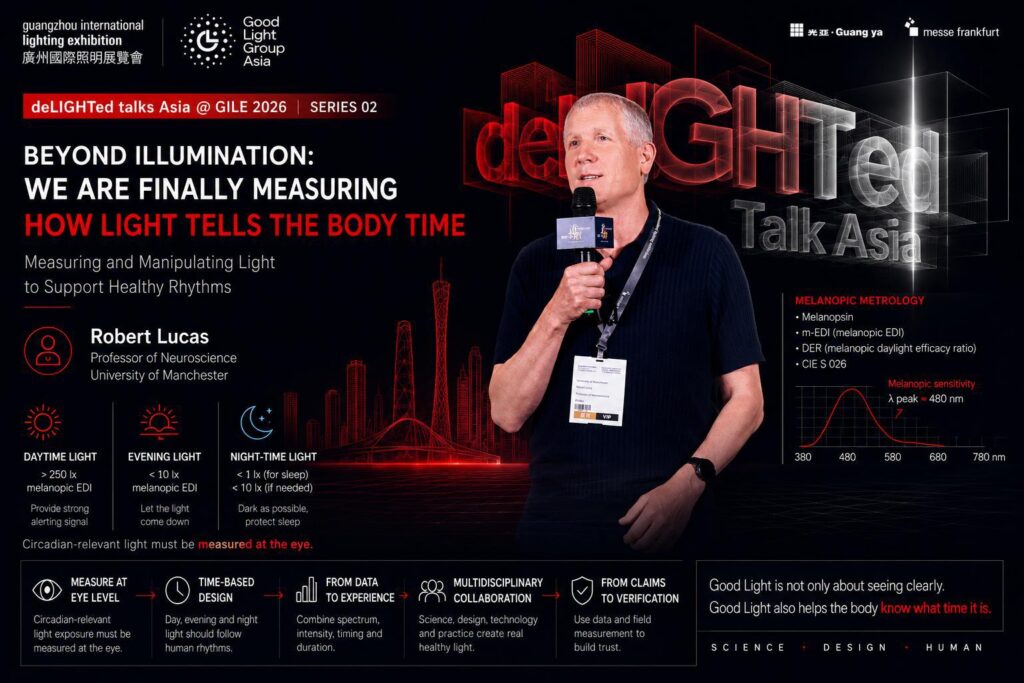
Beyond Illumination: We Are Finally Learning How to Measure “How Light Tells the Body Time”

deLIGHTed talks Asia @ GILE 2026

Good Light Wake-up Call Series Report 02

Robert Lucas: Measuring and Manipulating Light to Support Healthy Rhythms

For a long time, the lighting industry has been very good at asking one familiar question: Is this space bright enough?

So we measure illuminance in lux.

We describe luminous flux in lumens.

We use candela for luminous intensity.

We use CCT to describe colour temperature.

We use CRI and TM-30 to describe colour quality.

We use UGR to manage glare.

We use power, efficacy and lifetime to define product performance.

All of these are important.

But once lighting begins to speak about health, rhythms, sleep, alertness and human biological responses, a more fundamental question emerges: Are we measuring the light that the body actually uses to tell time?

At deLIGHTed talks Asia @ GILE 2026, Professor Robert Lucas from the University of Manchester gave a clear, rigorous and foundational presentation that helped establish the scientific basis for the entire discussion on healthy light.

His topic was: Measuring and Manipulating Light to Support Healthy Rhythms

The significance of this presentation was not merely the introduction of another metric.

Its real message was this:

If healthy lighting is to move from concept to science, from products to projects, and from claims to verification, the first step is to understand what we should actually measure.


The natural light-dark cycle is the body’s language of time.

Human beings are not organisms isolated from light.

From the earliest days of life on Earth, our bodies have lived within the natural cycle of light and darkness.

Sunrise.

Daytime.

Twilight.

Night.

This is not just environmental background. It is a daily time signal received by the body.

At the beginning of his presentation, Professor Lucas reminded us that the natural light-dark cycle drives 24-hour biology. It affects far more than sleep and wakefulness.

It also affects:

  • Body temperature.
  • Blood pressure.
  • Hormones.
  • Hunger.
  • Glucose and fat metabolism.
  • Urination and bowel movements.
  • Physical and mental performance.
  • Growth and regeneration.

In other words, light does not only serve the eyes. Light also serves the body’s time system.

Light is not only visual information. Light is also biological time information.

This is the real starting point of circadian-supportive lighting.

When the body receives sufficient light during the day, it understands: now is the time to wake, move, work and learn. When the body enters darkness at night, it understands: now is the time to rest, recover and sleep.

But modern life has disrupted this natural order.

During the day, we spend too much time indoors, often under light that is too dim. At night, we are surrounded by electric lighting, screens and urban light, often making the night too bright.

Modern people are increasingly living in a reversed light environment: Days are dim. Nights are bright.

This may be the most basic, and most overlooked, problem in modern healthy lighting. The real task of circadian-supportive lighting is not to make spaces brighter all the time, nor to make lighting systems more complicated.

It is to: Make daytime more like daytime, and nighttime more like nighttime.


Why traditional lux is not enough

Lux is an extremely important visual lighting metric.

It helps us understand whether a space has enough light. It supports lighting design for offices, classrooms, hospitals, roads, retail spaces and homes. It helps us meet requirements for visual tasks, safety and codes.

But Professor Lucas reminded us that traditional photometry is built on a core assumption:

It is mainly based on the visual responses of cone photoreceptors in the human eye.

In other words, conventional illuminance mainly answers this question:

How bright does the light appear to the visual system?

But the body does not tell time only through the traditional visual system.

Professor Lucas’ research, together with later work in biological light measurement, shows that the retina contains light-sensitive systems closely associated with non-visual responses. One of the most important among them is melanopsin.

Melanopsin is a photopigment found in a specific class of retinal ganglion cells. It is closely related to circadian regulation, melatonin control, alertness and the biological clock. Its spectral sensitivity peaks around 480 nm, in the cyan-blue region of the spectrum.

This point must be handled carefully.

This does not mean “blue light is good” or “blue light is bad”.

One of the biggest mistakes in healthy lighting discussions is to reduce complex physiological light responses into simple marketing language:

  • Blue light is harmful.
  • Blue light is energizing.
  • Warm light helps sleep.
  • Cool light is healthy.

These statements are far too simplistic.

What truly matters is that the effect of light on the circadian system depends on spectrum, intensity, timing, duration, eye-level exposure and context.

The same lux does not mean the same biological effect.

A space may have the same conventional illuminance, but because the spectral power distribution is different, its stimulation of the melanopsin system may be very different.

So the industry must recognize: Same lux does not mean same biological effect.

This sentence is crucial for the healthy lighting industry.

If we continue to discuss healthy light only through traditional lux, it is like describing the nutrition of a meal only by its weight. It is useful, but far from sufficient.


Melanopic metrology: a new measurement language for healthy light

Once we understand that traditional lux is not enough to describe circadian-relevant responses, we need a new measurement language.

This is the meaning of melanopic metrology.

In his presentation, Professor Lucas reviewed the Manchester Workshops and the international collaboration that helped establish new biological light measurement approaches. These efforts became part of the foundation for CIE S 026 and related international standardization work.

One of the most important concepts is: Melanopic Equivalent Daylight Illuminance, often abbreviated as melanopic EDI。 or m-EDI.

It can be understood as the amount of standard daylight illuminance that would produce an equivalent stimulation of the melanopsin system.

Its unit is still lux. But it is not conventional visual lux.

It does not ask:

How bright does this light look?

It asks:

For the circadian-relevant melanopsin system, how much daylight-equivalent stimulation does this light provide?

This is the value of m-EDI.

It helps us move from “how bright it appears” to “whether the body is receiving enough, or too much, biological time information.”

Another related metric is:

Melanopic DER, or melanopic daylight efficacy ratio.

It describes the melanopic efficacy of a light source relative to standard daylight D65.

In simple terms, DER helps us understand whether a light source provides stronger or weaker melanopic stimulation relative to daylight under the same visual illuminance.

When metrics such as m-EDI and DER enter lighting design and product data, circadian-supportive lighting is no longer just a story of warm-to-cool tuning. It begins to have a shared language that can be compared, designed and verified.

In the past, we often said:

  • This lamp is cooler.
  • This lamp is warmer.
  • This scene is brighter.
  • This scene is dimmer.

Now we should ask:

  • What is the melanopic EDI of this scene?
  • Is it sufficient during the day?
  • Does it reduce in the evening?
  • Is it low enough at night?
  • What is measured at eye level?
  • How does DER change under different dimming states?
  • Does the control system actually operate according to time?

This is where healthy lighting begins to move from feeling to measurement.


Circadian-supportive lighting cannot rely only on colour temperature tuning.

In the market, many “circadian lighting” solutions are simplified into one pattern:

  • Cool white light in the morning.
  • Higher brightness at noon.
  • Warm white light in the evening.
  • Low light before sleep.

This direction is not entirely wrong, but it is far from enough.

Human circadian response is not determined only by CCT.

  • The same 4000K can produce different melanopic EDI values depending on the spectrum.
  • The same 2700K light, if it is intense, late at night and close to the eyes, may still affect nighttime circadian regulation.
  • The same 6500K light, if it is weak and short in duration, may not provide enough biological effect.

So circadian-supportive lighting cannot only ask about colour temperature.

It must also answer:

  • What spectrum?
  • What intensity?
  • At what time?
  • 持续多久?
  • Where does the light reach?
  • How much reaches the eye?
  • In what context?
  • 什么人群?

True circadian-supportive lighting is multidimensional:

Spectrum × Intensity × Timing × Duration × Eye-level Exposure × Context

Without these dimensions, healthy lighting can easily be reduced to a button:

  • Day mode.
  • Reading mode.
  • Sleep mode.
  • Healthy mode.

But a button does not equal health.

A scene name does not equal biological effect.

Healthy lighting must be designed. And it must be verified.


Daytime, evening and night: three basic directions for healthy rhythms

Professor Lucas presented a clear and practical application framework. It is not complicated, but it is very important.

  • First, daytime light should be sufficient.
  • Second, evening light should be reduced.
  • Third, nighttime should be as dark as possible.

According to the recommendations presented:

  • Daytime light: > 250 lx melanopic EDI
  • Evening light: < 10 lx melanopic EDI
  • Night-time sleep environment: dark as possible

During nighttime rest, melanopic EDI at the eye should ideally be below 1 lx. For unavoidable nighttime activities, it should remain below 10 lx melanopic EDI.

Even more importantly, these values should be measured in the vertical plane, close to eye level.

This is a major shift for the lighting industry.

Traditional lighting projects often measure horizontal illuminance on the workplane or desktop. But circadian-relevant light exposure must focus more on what actually reaches the eye.

The body’s time system does not receive light through the desk. It receives light through the eyes.

Circadian-relevant light must be measured at the eye.

This sentence marks the boundary between product claims and project verification.

  • Lumens in a product catalogue are not the same as eye-level exposure.
  • A luminaire’s nominal spectrum is not the same as the actual spectrum in a real space.
  • A scene defined in a design document is not the same as what happens during operation.

So the next step for healthy lighting is not only to make better luminaires. It is also to build better measurement, commissioning and verification processes.


These recommendations are not magic formulas. They are responsible starting points.

It is important to emphasize that Professor Lucas did not present these recommendations as absolute truths.

On the contrary, he clearly noted that:

  • The recommendations may be revised as research progresses.
  • They are mainly applicable to adults with regular daytime schedules.
  • Special considerations may apply to children, older adults, shift workers and other populations.
  • They should also be considered alongside existing guidance for visual function, comfort and safety.

This is very important.

Circadian-supportive lighting does not replace conventional lighting design.

Nor should it blindly maximize a single metric.

  • Higher daytime m-EDI is not always better.
  • Night lighting should not become so dark that it compromises safety.
  • Warm light does not automatically mean healthy.
  • High DER does not automatically mean a good project.
  • Low m-EDI does not automatically guarantee good sleep.

Healthy lighting design is always a balance.

It must consider:

  • Visual tasks.
  • Circadian biology.
  • Glare control.
  • Visual comfort.
  • Spatial aesthetics.
  • Safety needs.
  • User age.
  • Daylight availability.
  • Control strategy.
  • Operation and maintenance.
  • And real human behavior.

This is the true meaning of integrative lighting.

It is not lighting driven by one single metric. It is lighting that integrates visual, biological, behavioral and spatial needs.


What this means for the Asian healthy lighting industry: stop selling only “concepts”

This presentation is especially important for the Asian lighting industry.

Asia, especially China, has one of the most complete lighting manufacturing ecosystems in the world. It is also one of the most active markets for healthy lighting products.

From eye-care desk lamps and full-spectrum lighting to classroom lighting, healthy offices, healthy homes and senior-care lighting, the market already has many products and solutions claiming to support health.

This is a positive sign.

It shows that the industry is beginning to return to people.

But if healthy lighting is to build real trust, it cannot remain at the level of concepts.

We need to ask:

  • Does the product provide complete spectral data?
  • Does it provide melanopic EDI or DER information?
  • Are the data consistent across different dimming states?
  • Can the control system operate according to time?
  • Has the scene been verified at eye level?
  • Has the actual project measured m-EDI during daytime, evening and night?
  • Has real operational performance been recorded after occupancy?

Without these questions, healthy lighting can easily become a market package that only appears advanced.

Professor Lucas’ presentation provides a very clear pathway for the industry:

First, move from lux-only to melanopic-aware.

Do not only look at conventional illuminance; understand melanopic EDI.

Second, move from product data to eye-level exposure.

Do not only look at product data; measure what people actually receive in the space.

Third, move from static lighting to time-based lighting.

Do not only look at light at one moment; understand how light changes throughout the day.

Fourth, move from claims to verification.

Do not only claim health benefits; build trust through field data.

Fifth, move from product competition to system capability.

Circadian-supportive lighting requires light sources, luminaires, controls, sensors, design, commissioning and operation to work together.

This is exactly the direction that the Good Light Wake-up Call|好光觉醒行动 aims to support.


Make daytime daytime again, and nighttime nighttime again.

If Professor Lucas’ presentation could be summarized in one sentence, it might be this:

Make daytime daytime again, and nighttime nighttime again.

It sounds simple.

But for modern people, it has become increasingly difficult.

During the day, we spend too much time indoors. At night, we are surrounded by too much artificial light. Our bodies are receiving weaker and less consistent time signals from the environment.

Circadian-supportive lighting is not about creating a world that is always bright. Nor is it about building a smart system so complicated that no one can use it.

Its real purpose is:

  • During the day, provide the body with enough wakefulness signal.
  • In the evening, allow light to decline.
  • At night, protect darkness and sleep.
  • Across different spaces, different people and different tasks, provide a more appropriate time-based light environment.

This cannot be delivered by a single product alone.

It requires collaboration across the full chain: from light source to luminaire, from controls to sensors, from design to measurement, from standards to operation.

Healthy light is not a lamp. Healthy light is an environment coordinated with the human time system.


From “illuminating space” to “calibrating biological time”

Professor Lucas’ presentation provides one of the most important foundations for healthy lighting.

Traditional lighting asks:

Is the space bright enough?

Circadian-supportive lighting asks further:

Is the body receiving the right time signal?

This is an upgrade in the language of lighting measurement. It is also an upgrade in the value logic of the lighting industry.

  • From photopic lux to melanopic EDI.
  • From horizontal illuminance to eye-level exposure.
  • From static lighting to time-based lighting.
  • From product claims to project verification.
  • From illuminating space to supporting human circadian rhythms.

This does not reject traditional lighting.

On the contrary, it adds a more human-centered dimension on top of traditional lighting.

Future healthy lighting should not only ask:

  • Is it bright enough?
  • Is it energy efficient?
  • Is the colour rendering good?
  • Is the colour temperature comfortable?

It should also ask:

  • Does this light provide the right signal to the body at the right time?
  • Is daytime exposure sufficient?
  • Is nighttime exposure low enough?
  • How much actually reaches the eye?
  • Can it be measured, designed, verified and operated?

This is where healthy lighting truly begins to mature.


Closing: Good Light should also help the body know what time it is.

Good Light is not only about seeing the world clearly.

Good Light should also help the body know what time it is.

  • In the daytime, it reminds us to wake, move, work and learn.
  • In the evening, it helps us slow down.
  • At night, it respects darkness and allows the body to rest and recover.

This is the simplest and deepest meaning of circadian-supportive lighting.

It is not a complicated concept.

It is not a marketing label.

It is not a warm-to-cool colour temperature transition.

It is not a set of unverified health claims.

It is the lighting industry’s renewed understanding of people.

From illumination to biological timing.

From lux to melanopic EDI.

From claims to verification.

Professor Robert Lucas’ presentation gives us a new ruler.

With this ruler, we can begin to ask more seriously:

Is the light we give people truly aligned with the time their body needs?

Only when lighting begins to respect human time again can we truly move toward the next stage of Good Light.

Good Light Wake-up Call.


发表回复

您的邮箱地址不会被公开。 必填项已用 * 标注