
Have you ever encountered this scenario?
A project invests heavily in “human-centric lighting / healthy lighting.” At handover, everyone seems satisfied—“looks good.” But months later, users are still fatigued, sleep hasn’t improved, hotel guests find it glaring, and facilities complain about maintenance. Designers feel frustrated, owners are confused, and brands can’t explain—where did it go wrong?
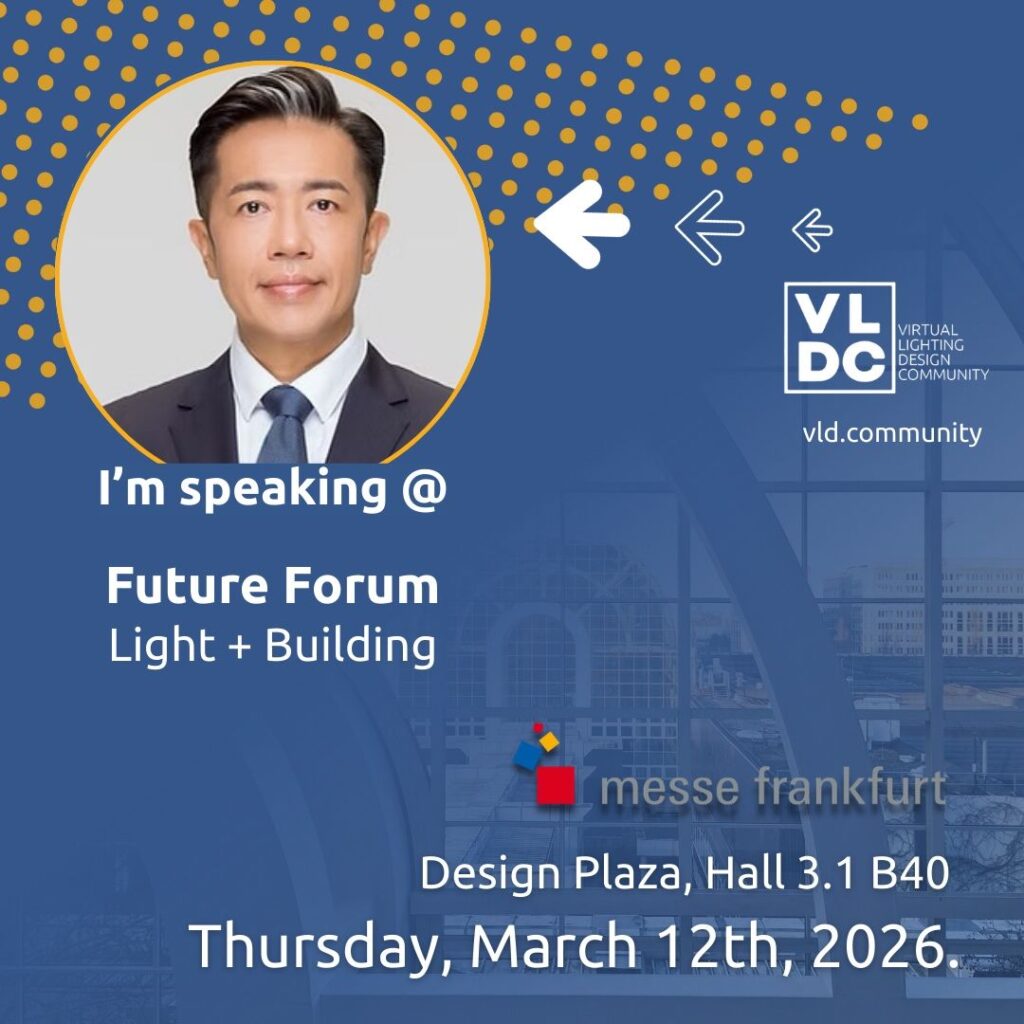
In March 2026, GLGA Founder and GLG Asia Director Lawrence Lin will give a 20-minute talk at Light + Building 2026 (Frankfurt) during the VLDC Future Forum / Design Plaza (Hall 3.1, B40). The topic: clarifying “human-centric lighting”—don’t just discuss concepts, start talking about verifiable deliverables.
1. What we really lack is not buzzwords, but the “last mile”
In recent years, discussions around HCL (Human-Centric Lighting) / healthy lighting have grown: circadian rhythm, mood, cognition, comfort… everyone can say something.
But on the engineering site, problems appear:
- How do we turn “healthy” into deliverable design criteria?
- How to verify it? What to check?
- How to operate it? Will it still work after three years?
In short: if it cannot be validated on site, it shouldn’t be responsibly claimed. This is not harsh—it’s basic respect for designers, owners, and users.
2. Why does HCL often “fail to land”?
We often unconsciously treat product specifications as human experience.
Specifications describe:
- CCT, CRI, illuminance, power density, distribution curves…
But what people actually experience is:
- Light reaching the eyes in the space—not the light leaving the factory.
In real spaces, light is “rewritten”:
- Different wall/ceiling reflectances feel different
- Geometry, obstructions, furniture affect brightness patterns
- Daylight and control strategies fluctuate exposure throughout the day
- People move, sit, stand, and look in different directions
A common phenomenon: the same fixture in different spaces or times delivers very different retinal stimuli.
Yet we often only measure desktop horizontal illuminance, ignoring critical factors:
- Vertical illuminance at eye level
- Time-based exposure profiles
- Activity and line-of-sight (what people do, where they look)
Result: you think you implemented HCL, but in reality, you just “adjusted some numbers.”
3. Lawrence Lin in Frankfurt: making light verifiable
He will present an engineering-oriented and honest framework to translate “healthy lighting” into deliverable language:
Light × People × Space × Time × Activity
- Light: spectrum, intensity, distribution
- People: age, sensitivity, differing needs
- Space: materials, geometry, daylight conditions
- Time: periods, seasons, historical exposure
- Activity: tasks, postures, attention, line-of-sight
This is what he calls making light REAL—not “conceptually healthy,” but credibly deliverable.
4. Method: Field-based Evaluation
Lawrence defines it as:
Evaluate the actual light stimulation received by people in representative eye positions, scenes, and time periods.
It does not replace standards, but bridges them—turning metrics into on-site actionable evidence.
He breaks evaluation into three layers:
Layer 1 | Visual integrity
- Proper balance of horizontal + vertical illuminance
- Brightness hierarchy, not just average values
- Verify glare risk on site, not just theoretically
- Color rendering from slogan → measurable data
Layer 2 | Circadian support
- Go beyond CCT—focus on eye-level circadian stimulation
- Evaluate morning/midday/evening exposure profiles
- Consider age and individual differences in target settings
Layer 3 | Emotional and experiential consistency
- Smooth transitions across spaces and times
- Link metrics to experience with structured feedback
- Make the spatial experience discussable, reviewable, not subjective
5. From evaluation to deliverable: a reusable workflow
Plan → Measure → Diagnose → Design → Verify → Monitor
Outputs:
- Auditable evidence pack
- Contractual acceptance criteria
- Operational monitoring and re-commissioning paths
With verifiable criteria, healthy lighting truly enters the engineering world.
6. On-site info (come say hi!)
- VLDC Future Forum @ Design Plaza (Hall 3.1, B40)
- Thursday, March 12, 2026
- Light + Building 2026 | Frankfurt
7. Closed-door roundtable (by invitation)
During the exhibition, GLGA will host a closed roundtable to align key members on moving healthy lighting from claims → measurable, verifiable, deliverable, operable standards.
If you are a designer, standards organization, brand, control platform, or in measurement/verification, leave a comment or DM to participate.

 English
  Chinese (China)
  Chinese (Taiwan)