
Human-Centric Lighting: Essential or Marketing Hype?
From GLA’s 2018/2019 “roadmap” to implementation challenges, and now the new opportunities AI brings
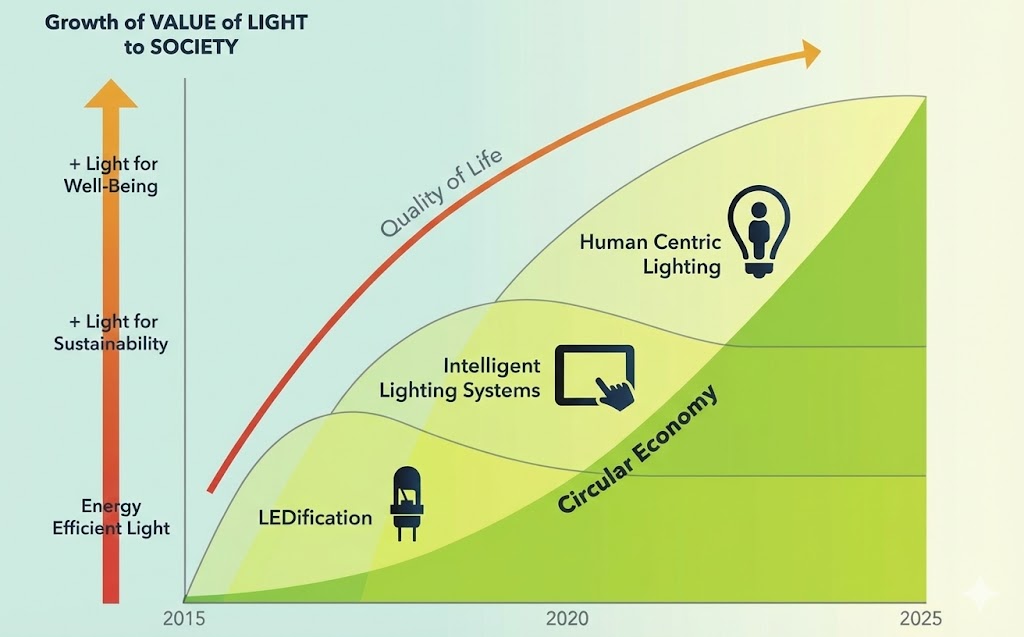
Over the past decade, the clearest trend in the lighting industry has been LEDification: higher efficacy, lower energy consumption, and rapid replacement of traditional light sources.
But once “energy savings” became a baseline expectation, the industry faced a new question: what additional value can lighting bring to society?
It was in this context that the Global Lighting Association (GLA) released the Strategic Roadmap of the Global Lighting Industry around 2018. One of its key narratives was bringing digitalisation and health & wellbeing into the spotlight. In a 2019 public event, the roadmap was summarized in three main themes: digitalization of buildings and infrastructure, circular economy, and health & wellbeing lighting.
Earlier, Jan Denneman, as GLA President, publicly introduced the roadmap as one of the industry’s consensus directions for the next stage.
A question immediately arose:
Why, after being promoted as the “next step after LEDification” in 2018/2019, has HCL (Human-Centric Lighting) struggled to scale in the following years?
1. Let’s be clear: HCL can be both essential and marketing
The controversy stems from two interpretations of HCL in the industry:
As real demand (essential): Light affects not only vision but also alertness, sleep rhythms, mood, and health risk management—long studied in science.
As marketing hype: Many products equate “tunable CCT / variable spectrum / morning & evening scenes” with “better sleep, higher performance,” while ignoring glare, luminance distribution, contrast, flicker, energy, and verifiable delivery. HCL then becomes a nice-sounding but non-verifiable slogan.
The CIE stated plainly in its 2024 position: the industry indeed treats HCL / circadian lighting / biodynamic lighting as marketing terms. The preferred term is “Integrative Lighting”, emphasizing that visual and non-visual (ipRGC-related) effects must be considered together with scientific evidence.
In other words: it’s not HCL that’s inherently vague, but HCL without a technical foundation and verification loop that easily becomes empty rhetoric.
2. Why did GLA promote HCL in the roadmap?
GLA’s roadmap addressed two industry realities:
- After LEDification, competing purely on efficacy and cost became saturated
- Digital & smart systems were transforming lighting into a “gateway infrastructure” (sensing, control, data, and services)
Articles in 2018 clearly noted that the roadmap looked toward 2040, emphasizing smart lighting as a key pillar. The 2019 public event placed “Lighting for health and wellbeing” alongside digitalization and circular economy as the three main themes.
So the so-called “next step after LEDification” is more accurately: the industry was seeking a second growth curve beyond efficiency, with health & wellbeing and smart systems seen as the most likely to deliver added value.
(In Europe, this logic was expressed early by LightingEurope: “LEDification + smart systems + HCL + circular economy” as value-growth drivers.)
3. Why It’s Difficult to Implement: The Five Gaps from “Lacking a Technical Foundation” to “Lacking Space × Human-Centric Models”
Key: Lacking a technical foundation (α-opic model starting from LED components) → Lacking standard regulations for space × human-centric models → Lacking verification systems and operational models for devices and spaces.
Breaking this down into five “gaps” makes it clear why large-scale implementation has been so difficult over the years.
Gap 1: Inconsistent Terminology and Boundaries — Same Name, Different Meaning, Preventing Clear Procurement and Responsibility
When HCL can refer to “tunable color temperature,” “circadian strategy,” or “system engineering of integrative lighting,” tender documents, design specifications, and acceptance criteria naturally misalign.
The CIE explicitly states that “integrative lighting” should be used as a more rigorous official conceptual framework to avoid marketing terms replacing scientific definitions.
Gap 2: Technical Foundation Gap — The Gap from “Calculable” to “Scalable Manufacturing” for α-opic (Five Receptors)
To turn “non-visual effects” from a slogan into engineering practice, it is necessary to quantify the stimulation of light on the five photoreceptor classes, i.e., α-opic metrology.
The CIE S 026:2018 framework defines the relevant spectral sensitivity functions and equivalent daylight illuminances (α-opic EDI, with melanopic EDI being the most commonly used) and emphasizes that traditional V(λ) photopic illuminance is insufficient.
The real industrial pain points are:
- Can spectral consistency, batch drift, and thermal/aging variations of components/modules be traceably managed?
- Do specifications transparently provide SPD and α-opic derived metrics, rather than only CCT, CRI, and luminous flux?
These engineering details determine whether HCL is a “system capability” or merely a “demonstration capability.”
Gap 3: Space × Human-Centric Model Gap — From “Luminaire Parameters” to “Human Exposure in Space”
The true human factor is not the luminaire itself but the light exposure of people in the space: line of sight, eye-level vertical plane, dwell time, daylight contribution, activity type, and individual differences.
CIE recommends that light exposure be evaluated or predicted using the observer’s eye plane (usually vertical and facing the line of sight), not just the horizontal plane.
This explains the most common “implementation failures”: designs or acceptance check only horizontal illuminance, whereas HCL/circadian lighting requires eye-level, time, spectral, and spatial luminance distribution integration, leading to situations where illuminance is adequate but people feel uncomfortable or sleep poorly.
Gap 4: Verification System Gap — Lack of “Device + Method + Auditable Delivery”
Without a verification system, HCL can only rely on claims. CIE warns of two imbalances:
- Traditional regulations only focus on vision and energy efficiency.
- Market products focus solely on ipRGC stimulation while neglecting overall lighting quality.
Both extremes can harm well-being and function.
Truly deliverable HCL must at minimum ensure:
- On-site measurable: eye-level melanopic EDI/α-opic EDI, luminance/glare risk, contrast and uniformity, color quality, flicker, etc.
- Dynamic validation: strategies remain valid for day/night, different scenarios, and changing daylight.
- Auditable process: dimming curves, control logic, and operational records are traceable.
Gap 5: Operational Model Gap — “Install and Forget” vs. “Long-Term Operation”
HCL is inherently “system engineering + long-term operation”: it can be overridden by humans, vary with space usage, and change with seasonal daylight.
CIE notes that due to individual differences and prior light exposure history, using fixed values for standardization is difficult; a more reasonable approach is to provide ranges and strategies achievable by the control system.
This highlights a long-standing commercial reality in the industry: a one-time luminaire sale cannot support the cost structure of continuous optimization and closed-loop responsibility.
4. External factors slowing adoption
Recent macro conditions (pandemic, supply chain issues, energy/cost pressures) push owners toward short ROI, verifiable, low-risk solutions. HCL without KPI + verifiable system is often cut first from shrinking budgets, explaining why it’s hot at showcases but cold in procurement contracts.
5. AI and Intelligent Control: Making HCL Easier to Implement, or Just Making the Messaging More Polished?
The answer is the same: both possibilities exist.
The real opportunity brought by AI/intelligent control is to turn “HCL” from a slogan into a closed-loop system.
The GLA roadmap already emphasizes that smart lighting is a key pillar, and intelligence can specifically address HCL’s most difficult challenges: spatiotemporal dynamics + individual differences.
Closed-loop control: Using sensors and computation to make light exposure a controllable variable.
Multi-objective optimization: Simultaneously optimize energy consumption, glare/contrast risk, visual task performance, and melanopic EDI.
Personalization and zoning: Replace “one-size-fits-all fixed values” with “strategy ranges + user choices”, which aligns closely with the CIE’s emphasis on “controllable implementation ranges.”
Where AI can amplify risks:
If the focus is only on non-visual stimulation at the expense of glare, visibility, and comfort, it falls into the “imbalance” trap warned by CIE.
If not auditable, HCL can become more like a “black-box health claim.”
If algorithmic “recommendations” are not explainable or auditable, it becomes harder for owners and regulators to verify.
6. Where the Opportunity Lies: The Three-Layer Foundation for Re-Engineering Human-Centric Lighting (From Components to Space to Operations)
To make HCL truly a “must-have deliverable”, the key is not just better storytelling, but transforming it into a three-layer engineering system:
Layer A: Traceability of Components and Spectra (α-opic established from the source)
Based on the CIE S 026 framework, embed SPD and α-opic metrics down to component/module/luminaire specifications and consistency management.
Layer B: Space × Human-Centric Model (incorporating “where people are, where they look, and how long they stay” into design and acceptance)
Include eye-level plane, orientation, and temporal dosage (day/evening/night patterns) in evaluation and acceptance logic.
Layer C: Verification and Operations (making results auditable, maintainable, and continuously optimizable)
Use sensors, controls, and data logging to turn HCL from a “snapshot on the day of delivery” into a long-term, operationally sustainable strategy.
Conclusion: The Endgame of HCL Is Not “Better Marketing,” but “Better Deliverability”
Therefore, the question “Is human-centric lighting a must-have or just marketing?” can be answered more accurately as:
- For human well-being, it is becoming a must-have.
- For industry delivery, it only upgrades from marketing rhetoric to an infrastructure capability when it incorporates α-opic technical foundation + space × human-centric model + verification and operational closed loop.
This is also the “implementation engineering” the industry truly needs to complete, following the GLA’s inclusion of “healthy and well-being lighting” on the roadmap in 2018/2019.
References:
- CIE. Position Statement on Integrative Lighting – Recommending Proper Light at the Proper Time (3rd Edition), CIE PS 001:2024
- CIE. CIE S 026:2018 Tools: α-opic Toolbox & User Guide
- Schlangen, L.J.M. et al. The Lighting Environment, Its Metrology, and Non-visual Responses to Light (2021)
- IESANZ & LCNZ, Strategic Roadmap of the Global Lighting Industry (2019)
- Lighting Magazine (Australia, 2018), LpS 2017, Euractiv/LightingEurope
- LpS 2017 conference materials: Jan W. Denneman delivered a presentation as “GLA President” on the Strategic Roadmap of the Global Lighting Industry (2017 agenda record).
- Euractiv / LightingEurope press release: The strategic roadmap’s value-driving approach includes LEDification, smart systems, and HCL (2016).

 English
  Chinese (China)
  Chinese (Taiwan)