
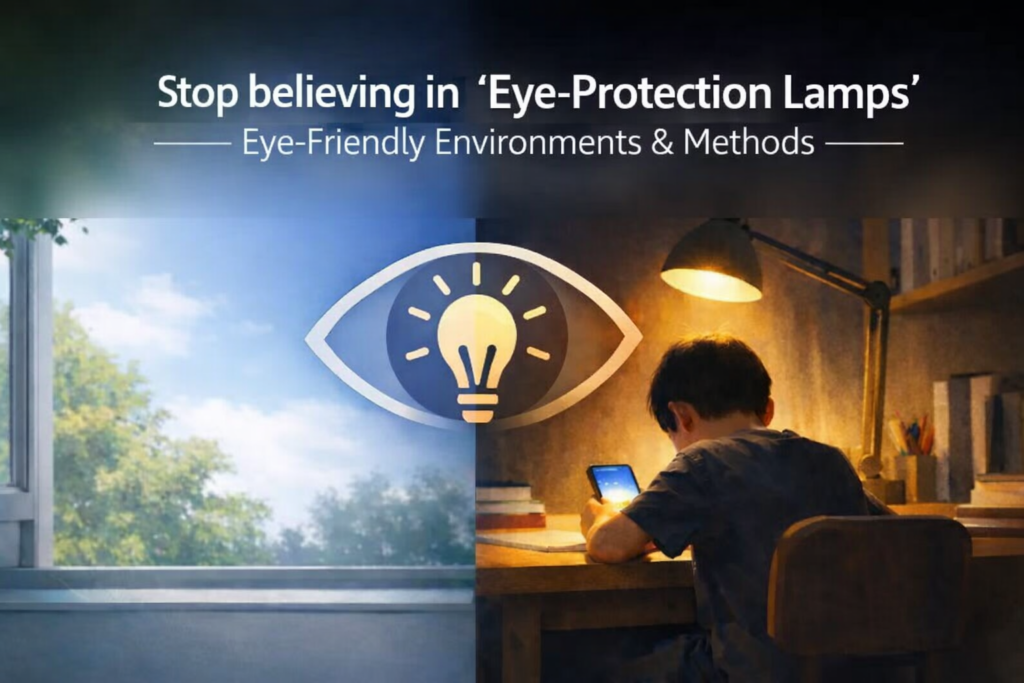
You’ve probably seen this scene before:
A child hunched over a desk doing homework. The room isn’t exactly dark, but not truly bright either. A phone or tablet glows nearby. A familiar anxiety kicks in for adults—“Should we switch to a better eye-protection lamp?”
Recently, a research press release from the State University of New York College of Optometry (SUNY Optometry) pushed the question one step further: myopia may not be driven primarily by screens themselves, but rather by a very common indoor habit—prolonged near work in relatively dim environments.
This sounds like an old refrain. But the study offers a more specific—and testable—explanation:
when doing near work, the pupil (like a camera aperture) constricts; if the surrounding environment is also dim, the amount of light reaching the retina may be further reduced. One sentence in the press release puts it plainly:
In dim lighting, this combination may significantly reduce retinal illumination.
Next, I want to translate this into everyday language—and extend it into a sentence the lighting industry should seriously reflect on:
Instead of continuing to place blind faith in a single device (floor lamps, eye-care lamps), we should build a complete system of eye-friendly environments and practices.
1. What is this study really reminding us of?
The SUNY team proposes a “unifying hypothesis”:
Why do seemingly different factors—near work, indoor dim light, outdoor time, atropine, certain optical lenses—all relate to myopia progression?
There may be a common “key” behind them: how much light stimulation the retina actually receives during near-task activities.
They also emphasize that this is not a final conclusion, but a testable hypothesis:
This is not a final answer.
That restraint matters. The study does not ask us to simply blame “lamps” or “screens.” Instead, it shifts attention away from single devices and back to real-world combinations of visual behavior and environments.
2. Why do I say the industry is too obsessed with “floor lamps / eye-protection lamps”?
Because myopia risk is never determined by which lamp you buy, but by a system-level outcome:
Space × Human × Time × Activity
- Space: How is light distributed in the room? Is brightness even? Is there glare? Along the child’s line of sight, is the environment comfortable—or patchy with bright and dark zones?
- Human: The same lighting feels and burdens different people differently—by age, refractive status, and sensitivity.
- Time: Daytime, evening, and night all have very different needs. “Bright enough” and “don’t disturb sleep” often need to be balanced.
- Activity: Reading, writing, screen use, crafts, relaxing, getting up at night—each activity should not be lit the same way.
Focusing only on “buying a more expensive lamp” often compresses a complex problem into a single product answer.
It may improve something, but it can also obscure the real variables:
What lighting are you in? How are you using your eyes? For how long? At what distance?
3. Four “eye-friendly use” principles for ordinary families
(No lighting expertise required)
First, a disclaimer: the following is not medical advice. If a child’s myopia is progressing rapidly, follow ophthalmologic or optometric guidance. The SUNY study also states clearly that it will not immediately change clinical guidelines.
Principle 1: Don’t push through near work in dim environments
You don’t need extreme brightness, but avoid “making do.”
The core warning of this research is that dim light + prolonged near work may be a risky combination.
Principle 2: Treat outdoor time as a necessity, not a reward
Across international myopia research, increased outdoor time remains one of the most consistent protective factors. Many regions recommend about two hours outdoors per day as a public-health guideline.
Principle 3: Break continuous near-work into segments
Instead of obsessing over “how long is too long,” remember this:
Don’t let near-distance tasks run seamlessly without breaks.
Giving the eyes chances to look far, move, blink, and refocus is more important than “pushing through to finish”—especially for children.
Principle 4: Evening light should be gentler, zoned, and only as much as needed
This is less about myopia and more about sleep and circadian rhythm.
The IMI also notes that sleep and circadian rhythms may relate to eye development. While the relationship between screens, nighttime light exposure, and myopia still needs more research, “don’t turn night into day” remains a safe strategy.
4. A deeper takeaway for lighting professionals: stop fixating on desk illuminance
If you work in lighting design, products, or engineering, the value of this research is not “making another eye-care lamp,” but upgrading evaluation frameworks.
4.1 From “how bright is the desk” to “what light does the eye actually receive”
The SUNY hypothesis centers on retinal illumination.
That means judging “good lighting” by horizontal illuminance alone is insufficient. Greater attention is needed on:
- Luminance distribution along the line of sight
- Glare and high-contrast zones
- Proportions between task areas and background areas
- The to-the-eye environment under different postures (upright, head-down, leaning)
4.2 What we really need is scene-based lighting: Time × Activity strategies
Reading and writing, screen use, relaxation, nighttime movement—these should each have different lighting “recipes.”
Selling “one lamp for the whole house” as a feature is, in essence, manufacturing risk.
4.3 Add human-factor models: the same lamp is not the same for everyone
Children’s viewing behavior, working distance control, and retinal stimulation needs differ from adults’.
People sensitive to light or intolerant of glare differ again.
If “eye protection” ignores individual differences, it inevitably collapses into a slogan.
5. GLGA’s position: build a deliverable eye-friendly environment and method system
I see this study as a signal:
The myopia discussion is shifting from “multi-factor correlations” toward more quantifiable mechanism hypotheses.
So what the industry should truly pursue is not further single-device worship, but a deliverable system:
- Spatial models: design light distribution by scenes and sightlines, not just by chasing a lux number
- Human-factor models: integrate age, sensitivity, habits, and sleep needs
- Time & activity strategies: different formulas for day vs. night, study vs. relaxation, screens vs. paper
- Methods & habits: treat continuous near-work duration, outdoor time, and rest rhythms as system components
- Verification loops: upgrade from “eye-care claims” to measurable, assessable, operable outcomes
In one sentence:
Myopia prevention is not about buying the right lamp—it’s about getting light, space, and behavior right together.
Closing: Don’t rush to take sides—return the problem from “products” to “systems”
The SUNY study does not say “light is the answer.”
It suggests that we should view the eye as a system that adapts to its environment—and view the environment as a variable that can be designed and managed.
When we step out of the tug-of-war between “screens are guilty” and “lighting fixtures are omnipotent,” only then can we truly move toward a path that is more stable, more scientific, and more humane:
Eye-friendly environments + eye-friendly practices.
References (please copy links into your browser)
- SUNY Optometry Press Release (2026/02/17)
https://www.sunyopt.edu/new-research-suggests-myopia-could-be-caused-by-how-we-use-our-eyes-indoors/ - PubMed Abstract (2026/02/17)
https://pubmed.ncbi.nlm.nih.gov/41709454/ - IMI (International Myopia Institute) clinical summary on light and myopia (2025)
https://myopiainstitute.org/imi-whitepaper/imi-the-role-of-light-in-refractive-error-development-and-myopia/

 English
  Chinese (China)
  Chinese (Taiwan)