
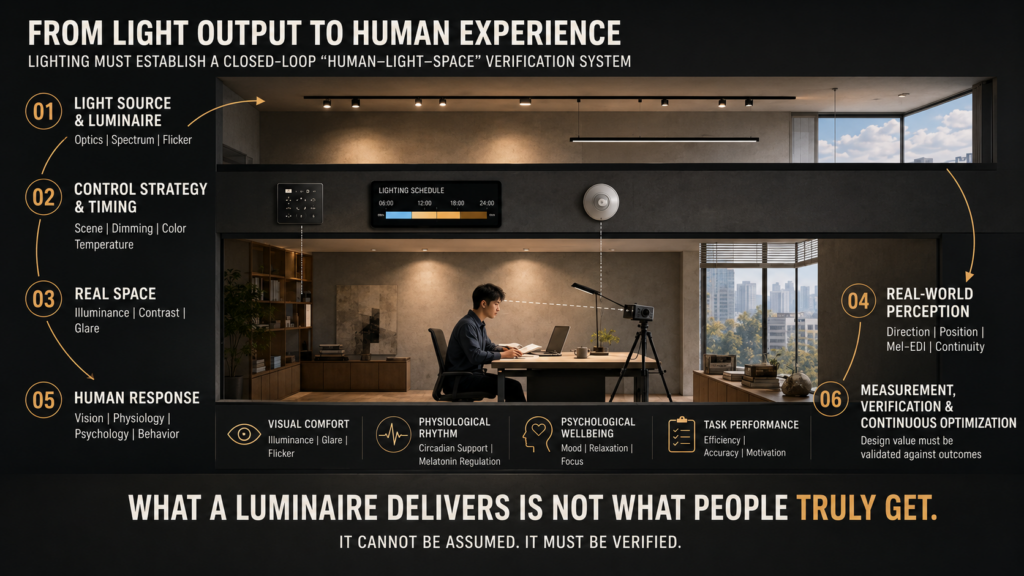
Two luminaires with exactly the same model and identical test reports can be installed in two different spaces—and the light people actually experience can be completely different.
One space may feel comfortable and visually clear. The other may feel dim, glaring, or even provide the wrong kind of light at the wrong time.
This does not mean luminaire testing has no value.
Quite the opposite: a compliant product is the foundation of a good lighting environment.
The issue is that: A compliant luminaire can demonstrate what the product delivers under specified test conditions; it cannot automatically demonstrate what people experience in a real space.
1 | From Laboratory Output to What People Actually Receive: There Is a Long Chain in Between
Once a luminaire enters a real space, its output passes through at least five layers of transformation.
The first layer is the light source and luminaire.
Luminous flux, light distribution, SPD, CCT, color rendering, flicker, and dimming performance determine what the system is capable of producing.
The second layer is control and time.
The same luminaire can produce different illuminance, spectral, and flicker characteristics depending on dimming level, driver behavior, and control settings. A setting that works well during the day may not be appropriate at night.
The third layer is the real space.
Wall reflectance, material colors, furniture placement, ceiling height, windows, daylight, and shading strategies all redistribute the light.
The fourth layer is eye position and direction.
A workplane reaching 500 lx does not mean a person’s eyes receive the same amount of light.
Where a person sits, which direction they face, what they are looking at, and whether they are moving can all change vertical illuminance at the eye, SPD, mel-EDI, luminance contrast, and perceived glare.
The fifth layer is the human response.
Differences in age, visual ability, activity, and duration of occupancy can lead to different outcomes in the same space.
The product can produce the same output without people receiving the same light. And even when people receive similar light, their responses will not necessarily be identical.
2 | If Illuminance Meets the Target, Why Can a Space Still Be “Difficult to Use”?
An illuminance calculation for a horizontal workplane can answer an important question, but it cannot represent the complete experience of a space.
In a space with dark walls, the same workplane illuminance may be accompanied by strong luminance contrasts. In an environment with highly reflective materials, it may instead create uncomfortable luminance relationships.
Older adults, children, night-shift workers, and typical office workers also have different visual tasks, schedules, and lighting-exposure requirements.
Therefore, “the design value meets the target” and “the lighting works effectively in the real-world setting” cannot be treated as equivalent.
3 | This Is Not About Replacing Standards. It Is About Completing the Delivery Chain.
Existing lighting standards establish important baselines for safety, energy efficiency, and basic visual performance.
The issue is not that the standards are wrong. It is that product testing and design calculations alone cannot fully account for all the variables introduced during installation, commissioning, use, and long-term operation.
The next step is not to abandon compliance, but to build on it by adding verification at the spatial and human levels.
4 | A Project Needs at Least Four Checkpoints
Before renovation: establish a real-world baseline.
During design: define the spatial, eye-position, temporal, and activity conditions.
After commissioning: measure at actual user positions—not simply verify luminaire output.
After occupancy: review the results and continue adjusting as conditions change.
Not every project requires complex human-subject experiments.
But whenever we claim to put people at the center, we should at least be able to explain what people actually receive under the intended conditions, at the intended location, and at the intended time.
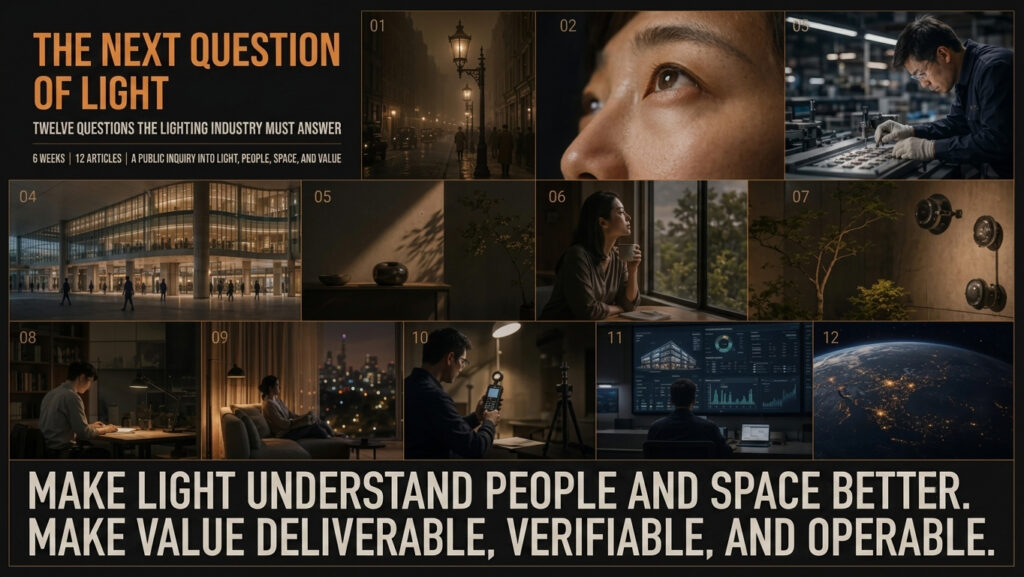
This is the seventh question of The Next Question About Light: Have you experienced a project where all the luminaires were compliant, yet the space still didn’t work well? Where did the problem ultimately come from—the product, controls, materials, eye position, or operation?
Please respond in the following format: Application context|Compliant metric|Actual problem|Cause assessment
This is not a conclusion. It is the seventh question.

 English
  Chinese (China)
  Chinese (Taiwan)