
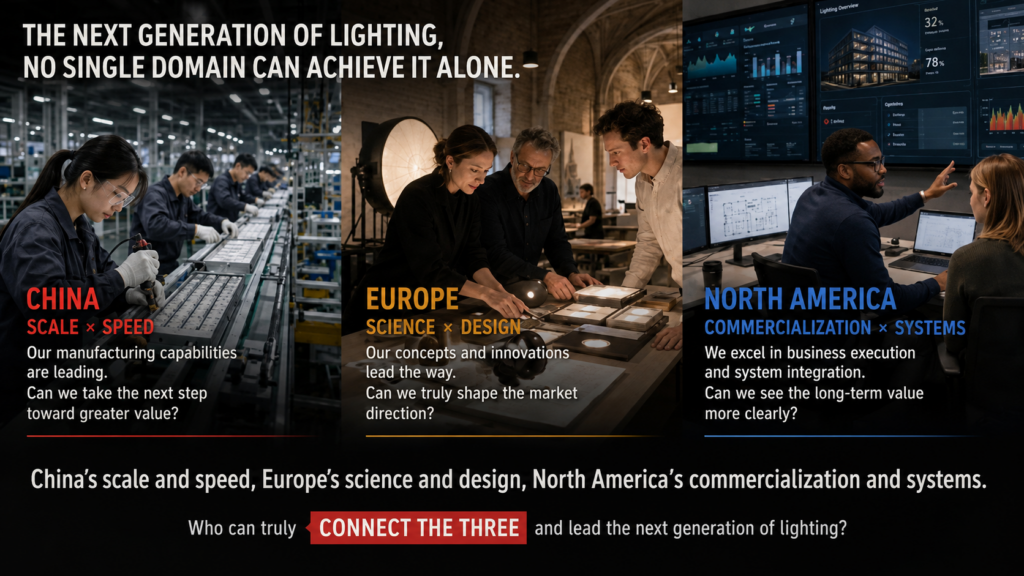
When it comes to the next generation of lighting, people often rush to ask: Will China, Europe, or North America lead the way?
My judgment is: No single region can accomplish it alone.
Because the next generation of lighting requires more than better light sources, more advanced standards, or stronger digital platforms.
It must possess three capabilities at the same time:
Build the technology;
Clearly define and communicate its value;
Then deliver the results at scale.
Today, these three capabilities are distributed across different regions, each with its own obvious gaps.
1 | China: Scale and Speed Are Already Leading; Value Definition Still Needs to Catch Up
China has one of the most complete lighting supply chains in the world.
From chips, packaging, drivers, luminaires, and controls to project implementation, new technologies can be brought to market quickly and then reduced in cost, iterated, and replicated across a huge market.
This is an irreplaceable industrial foundation for the next generation of lighting.
But scale does not automatically translate into leadership.
When companies still compete primarily on specifications, price, and delivery time, even advanced multi-channel spectra, sensing, and control can quickly become another round of feature stacking.
What the Chinese lighting industry needs to strengthen is the ability to move from manufacturing capability to value-definition capability: Not only answering “Can we produce it?”, but also “Why should we do it this way, what outcomes are we creating, for whom, and how can we prove them?”
2 | Europe: Deep Expertise in Science, Standards, and Design; Scaling into the Market Remains to Be Proven
Europe has accumulated long-standing capabilities in optics, architectural lighting, human factors research, sustainable design, and standards development.
It is strong at defining boundaries and establishing methodologies, and is more willing to discuss how light becomes part of architectural culture, people’s lives, and environmental responsibility.
Take Zumtobel as an example. Its professional lighting expertise and architectural design tradition, together with Tridonic‘s foundation in components and controls, have enabled it to maintain a relatively clear lighting identity.
But this is an asset, not an automatically realized outcome.
When market scale is limited, costs are relatively high, and decision-making cycles are longer, whether scientific and design advantages can be transformed into replicable and affordable solutions still needs to be demonstrated through business performance and real-world projects.
If an idea cannot be scaled, its influence may remain limited to demonstration projects and professional circles.
3 | North America: Strong in Commercialization and Systems Capabilities, but It May Also Move Beyond Lighting the Fastest
North America excels at turning technology into channels, contracts, return on investment, and system platforms.
Mature specification-driven markets, distribution channels, building controls, software ecosystems, and M&A capabilities make it easier for new solutions to form a complete commercial loop.
Acuity Inc. has clearly organized its business around two major segments, Acuity Brands Lighting and Acuity Intelligent Spaces, addressing the challenges of “space, light, and beyond.”
This reflects a clear path: Lighting is no longer just a product. It can also become an entry point into building data and operational systems.
But this path also raises another question: If the industry cannot demonstrate the long-term value of light itself to people, lighting may become the gateway to the system while ultimately ceasing to be the center of value.
4 | Three Companies, Three Unfinished Answers
Signify has an extensive global foundation of brands, channels, products, and connected lighting. Its 2026 Capital Markets Day strategy focuses on greater focus, performance improvement, and investment in Build businesses such as connected lighting.
These efforts are necessary in practical terms.
But from an industry perspective, it still needs to answer: beyond running the business more efficiently, how does Signify intend to define the role that light will continue to play in the next generation of buildings and people’s lives?
Zumtobel has the clearest professional lighting identity, but it must prove that expertise, science, and design can support scale and profitability.
Acuity Inc. has the clearest commercial path and is actively moving beyond lighting. Its question is: Is light merely a hardware entry point into the system, or does it still possess an irreplaceable human value?
These are not final judgments on these companies, but questions raised based on their publicly disclosed strategies as of July 2026.
5 | The True Leader Is the One Who Can Connect Three Capabilities
The next generation of lighting needs China’s scale and speed, Europe’s science and design, and North America’s commercialization and systems capabilities.
But connection is not simply about procurement. It means jointly building capabilities that can be used across regions:
Product data;
Application methodologies;
Eye-level verification;
Control logic;
Operational evidence.
Whoever can truly connect manufacturing, science, space, human factors, and business into a closed loop will have the opportunity to define the next generation of lighting.
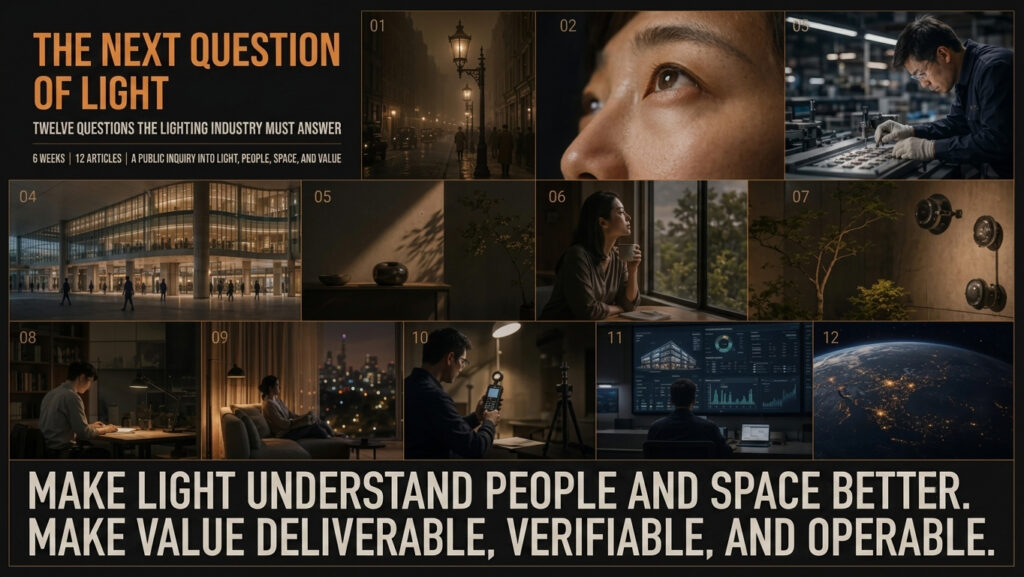
This is Question 11 of “The Next Question of Light”: What capability is your company or region best at, and which capability is it missing? What are you willing to open up in exchange for genuine cross-regional collaboration?
Please respond in the following format: Region|Core strength|Key gap|Resources you can open
This is not a conclusion.
It is Question 11.

 English
  Chinese (China)
  Chinese (Taiwan)