
If a light is highly energy-efficient, has excellent color rendering, and makes a space visually striking, does that automatically make it good lighting?
Not necessarily.
It may save energy while making it difficult for users to distinguish details. It may create a powerful emotional atmosphere while being unsuitable for prolonged occupancy. It may provide sufficient stimulation during the day while delivering inappropriate light at night.
The problem is not that any of these metrics or design approaches are wrong.
The problem is that no single dimension is sufficient to represent the full value of light.
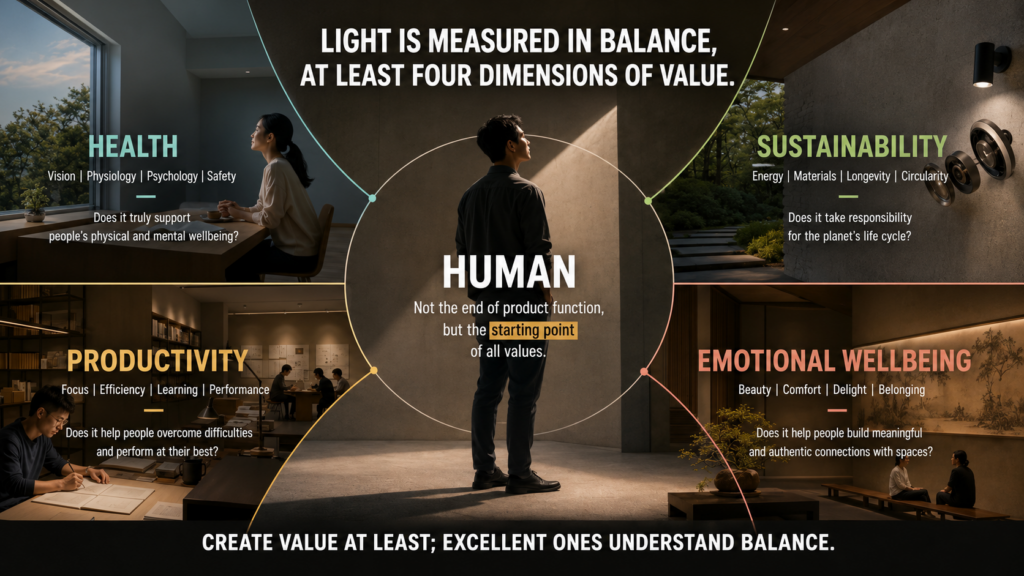
My view is this: To evaluate a light properly, we need to consider at least four value dimensions: health, sustainability, productivity, and emotion.
This does not mean every project needs to maximize all four.
Rather, we should first identify which value the lighting is primarily intended to create, and then examine whether that value comes at the expense of the others.
1 | Health: Does the Light Truly Support Human Well-Being?
Health is about more than simply asking, “Is it bright enough?”
At a minimum, it involves visual clarity, glare and flicker risks, circadian rhythms, psychological comfort, and safety in use.
Depending on the project objectives, these factors should be evaluated together with illuminance, luminance distribution, visual contrast, SPD, mel-EDI, flicker, as well as viewing position, direction, timing, and duration of exposure.
But we must be careful with our claims:
Meeting the recommended value for a single metric does not prove a particular health outcome. Light is also only one of many variables that influence health.
Responsible communication should distinguish between the performance of a lighting environment, hypotheses about physiological effects, and health outcomes that have been empirically validated.
2 | Sustainability: After Saving Energy, Have We Actually Reduced the Lifecycle Burden?
High luminous efficacy is certainly important, but sustainability cannot be measured by lumens per watt alone.
Materials, service life, repairability, control strategies, actual operating hours, spare parts, packaging, transportation, and end-of-life recycling all contribute to the true environmental cost of a lighting system.
A highly energy-efficient luminaire that is quickly removed and replaced because the user experience is poor may not, in the end, be truly sustainable.
Sustainability is not a laboratory specification sheet. It is the outcome of a product’s entire lifecycle.
3 | Productivity: Does the Light Help People Do Their Work Better?
In schools, offices, hospitals, and industrial environments, productivity is not simply about “working faster.”
It also includes accuracy, error rates, alertness, learning performance, safety, fatigue, and the ability to sustain a task over time.
If we claim that lighting improves productivity, we should first define the specific task, user population, other influencing variables, and observation period—and establish a baseline before the intervention.
Otherwise, “improved efficiency” can easily become a marketing claim that cannot be verified.
4 | Emotion: Is It a Momentary Spectacle—or an Experience People Want to Live With?
Light-and-shadow aesthetics and emotional value certainly matter.
Spaces need beauty, comfort, pleasure, and a sense of belonging.
But a moment of visual wonder does not necessarily translate into a good experience over a day, several months, or even years.
Emotional value should not be defined solely by designers on behalf of users. It needs to be understood through interviews, rating scales, behavioral observation, and long-term feedback from different user groups in real-world settings.
5 | From Four Value Dimensions to Verifiable Value
Every project can begin by answering four questions:
What primary value is this environment intended to create?
Who are the users, what activities are taking place, and over what timeframe?
What metrics and methods will be used to verify the value?
Does achieving this value impose an unacceptable cost on any of the other three dimensions?
We do not need every light to solve every problem simultaneously.
Every product or service should create at least one value that can be clearly articulated. Mature solutions address several dimensions, while truly outstanding solutions know how to make evidence-based trade-offs for different contexts.
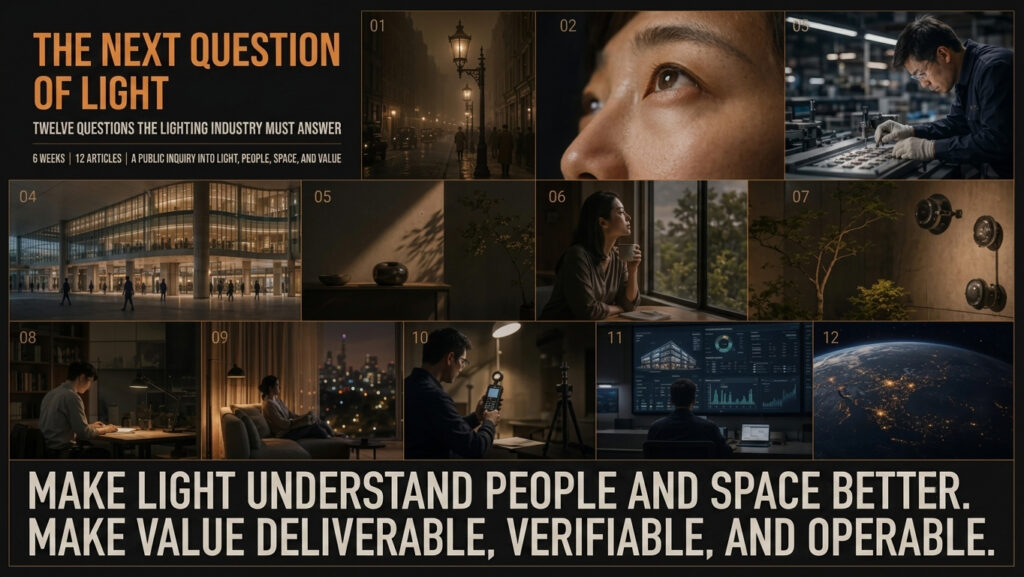
This is the sixth question of The Next Question About Light: In a project you have recently worked on, what value did you claim to create? What did you actually verify? And what did you have to give up to achieve it?
Please respond in the following format: Application context|Primary value|Verification method|Necessary trade-offs
This is not a conclusion. It is the sixth question.

 English
  Chinese (China)
  Chinese (Taiwan)