
deLIGHTed talks Asia @ GILE 2026
Good Light Wake-up Call Series Report 15
Zheng Hongcheng: No Verification, No True Healthy Light — A Scientific Interpretation Based on EEG

In the previous reports of the Good Light Wake-up Call|好光覺醒行動 series, we explored healthy lighting from many different perspectives.
Robert Lucas 教授告訴我們,傳統 lux 不足以描述光如何告訴身體時間。
Marijke Gordijn 博士提醒我們,好光,是在正確時間給身體正確的光。
Jan Denneman 呼吁照明产业从 illumination 走向 human outcomes。
Kei Haraguchi / 原口圭 of Nichia showed how LED spectral innovation can support circadian-oriented lighting applications.
Anne Berends 則把健康光帶到近紅外線、劑量與科學邊界的新討論。
趙弘軼事主任 brought healthy lighting into healthcare, reminding us that hospital lighting must move from compliance lighting to clinical environment design.
Professor Yandan Lin brought the conversation back to homes, explaining why the next upgrade in residential lighting is not only smarter or more beautiful lighting, but healthier, more verifiable lighting environments.
鄭紅成’s presentation pushes the series toward a sharper and more fundamental question: How do we prove that a light truly has an effect on people?
Not by feeling. Not by marketing. Not by product labels. Not by attractive terminology. Not by “it looks healthy.”
But by asking: Is there objective evidence? Is there a measurable physiological response? Can the effect be quantified? Can it be repeated? Is there a plausible mechanism? Are the safety boundaries clear?
His topic was direct and powerful: No Verification, No True Healthy Light
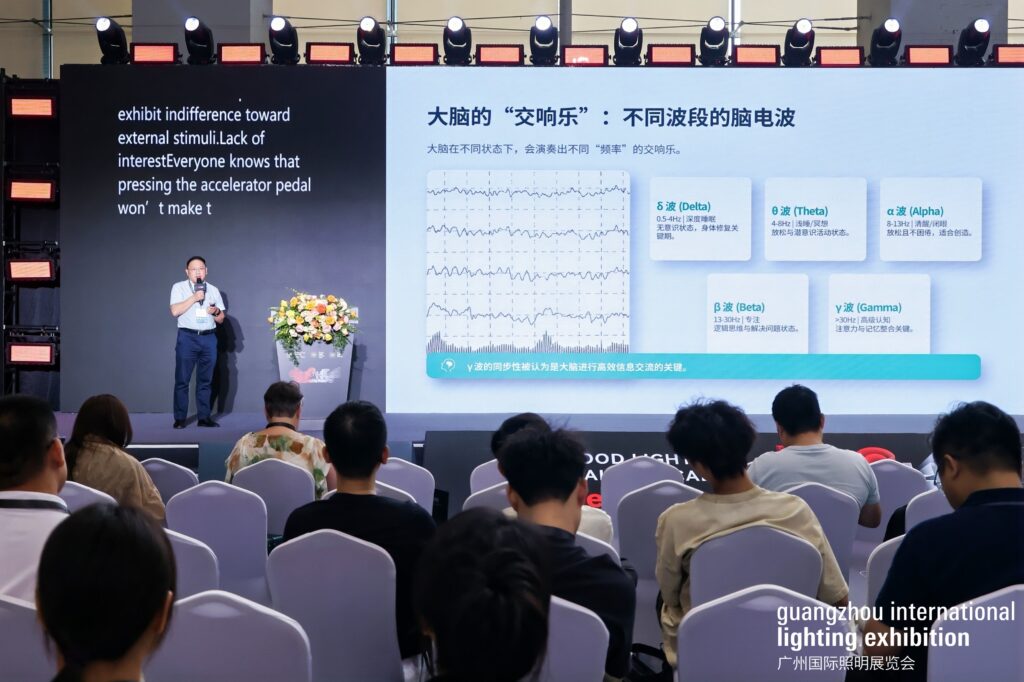
1 | A Scientific Interpretation Based on EEG
This is a principle the healthy lighting industry must take seriously.
As “healthy light” becomes a popular term, more products and systems claim to: Improve sleep. Increase focus. Reduce fatigue. Improve mood. Enhance cognition. Support brain health. Promote recovery.
These claims sound attractive.
But the real question is: How do we know they are true?
This is the value of 鄭紅成’s presentation.
By focusing on EEG — electroencephalography, or brainwave measurement — he reminds the industry that if light truly affects the brain, the brain should leave a trace. If the brain responds, that response should be measurable. If it can be measured, it can be analyzed, compared and verified.
Healthy lighting cannot remain at the level of “it feels good.” It must become traceable, measurable and evidence-based.
2 | When “healthy light” becomes a buzzword, the greatest danger is confusing feeling with fact
Healthy lighting has become one of the most popular topics in the lighting industry. Full spectrum. Eye-care lighting. Low blue light. Circadian lighting. Sleep lighting. Emotion lighting. Light therapy. Brain-science lighting. Human-centric lighting. Good Light.
These directions are not wrong.
The problem is that market communication often moves faster than scientific verification. When a consumer hears that a lamp is “healthier,” it is easy to believe. When an owner hears that a lighting system “supports sleep,” it sounds appealing. When a designer sees a product described as “circadian-friendly,” it may become attractive for a project.
But without evidence, such claims can easily become marketing language.
鄭紅成 reminds us that subjective feelings have limits.
“I feel more comfortable.”
“I seem more focused.”
“I think I slept better.”
“This light makes me feel good.”
These experiences matter. But they are not sufficient evidence.
Subjective feelings can be influenced by many factors: The space looks better. The product feels more premium. The design is more refined. The user expects improvement. The brand story is persuasive. The user is influenced by context or placebo effects.
This is why healthy lighting cannot only ask: How do you feel?
It must also ask: Did the body respond? Did the brain respond? Did sleep change? Did rhythm change? Did behaviour change? Can the data support the claim?
Moving from feeling to fact is one of the most important thresholds for healthy lighting.
3 | Healthy light has at least two levels: general healthy lighting and functional phototherapy
鄭紅成 first redefines “healthy light” by distinguishing two levels.
The first level is general healthy lighting.
This includes the everyday lighting qualities that help create better living, working and healing environments:
- Low or no visible flicker.
- Appropriate illuminance.
- Comfortable colour temperature.
- Good colour rendering.
- Reduced glare.
- Balanced spectral quality.
- Lighting that respects day and night.
This level is essential for homes, offices, schools, hospitals, hotels, senior living environments and many other daily spaces.
Its purpose is not to treat disease. Its purpose is to reduce harmful stimulation, improve visual comfort, support daily rhythms and create better long-term environmental exposure.
The second level is functional phototherapy.
This is more specific and requires much stricter boundaries.
Functional phototherapy may use specific wavelengths, intensities, frequencies, timing or doses to actively influence physiological functions.
Examples include:
- Blue light treatment for neonatal jaundice.
- Bright light therapy for seasonal affective disorder.
- Timed light exposure for circadian rhythm sleep disorders.
- And, more recently, specific frequency light stimulation in brain activity research.
These two levels should not be confused. General healthy lighting should not casually claim clinical therapeutic effects. Functional phototherapy should not be packaged as ordinary consumer lighting without professional guidance.
This distinction is crucial.
One of the greatest mistakes in the healthy lighting market is turning “environmental improvement” into “medical treatment claims.”
A mature industry must distinguish between: Environmental optimization. Health support. Functional intervention. Clinical treatment.
Each level requires different evidence, different boundaries and different responsibility.
4 | Light is not only illumination. It works through both visual and non-visual pathways.
鄭紅成’s presentation reminds us that light does more than allow us to see.
The most familiar pathway is the visual pathway. Light enters the eye and is processed by cones and rods, allowing us to perceive brightness, colour, contrast, movement and spatial form.
This is the foundation of lighting.
But modern photobiology tells us that light also has non-visual effects. Intrinsically photosensitive retinal ganglion cells, or ipRGCs, can transmit light signals to deeper brain regions related to circadian rhythm, mood and neural regulation.
This helps explain why light may influence: Sleep. Circadian rhythm. Melatonin secretion. Alertness. Mood. Cognition. Wakefulness. Physiological timing.
Light is therefore not only visual information. It is also biological information.
Under certain conditions, it may even become a form of neural modulation. But the more powerful the claim, the more careful the evidence must be.
If we say light affects the brain, we must show how.
If we say light affects sleep, we must define for whom, at what time, at what dose and under what conditions.
If we say light improves human state, we must define the evidence boundary.
The value of healthy lighting comes from science. The risk of healthy lighting comes from misusing science.
5 | Why EEG matters: it allows brain responses to be observed
EEG stands for electroencephalogram. It records the electrical activity generated by populations of neurons in the cerebral cortex through electrodes placed on the scalp.
In simple terms, EEG is a window into brain activity.
It offers several advantages.
First, real-time sensitivity.
EEG can record rapid changes in brain activity with high temporal precision, making it useful for observing immediate responses to light stimulation.
Second, physiological sensitivity.
Changes from relaxation to attention, from wakefulness to drowsiness, or from stable to abnormal brain activity can be reflected in changes in brainwave frequency and amplitude.
Third, objectivity.
EEG records physiological electrical signals rather than subjective descriptions.
Fourth, quantifiability.
Different frequency bands can be analyzed, compared and statistically tested.
Therefore, when light acts as an external stimulus, EEG can help us ask:
- Did the brain respond?
- Which frequency band changed?
- Which brain region responded?
- Was the response related to the stimulation frequency?
- Was it linked with subjective state changes?
- Can the response be repeated?
- Does it have clinical or practical meaning?
This is why 鄭紅成 emphasizes: Without objective physiological verification such as EEG, we should be cautious about calling something true healthy light.
Of course, EEG is not the only evidence.
Healthy lighting research may also involve sleep monitoring, eye tracking, circadian markers, hormonal indicators, HRV, cognitive tests, behavioural data, subjective questionnaires and long-term follow-up.
But EEG has a special meaning. It makes the relationship between light and brain response less speculative. It gives the industry a way to observe whether light leaves a physiological trace.
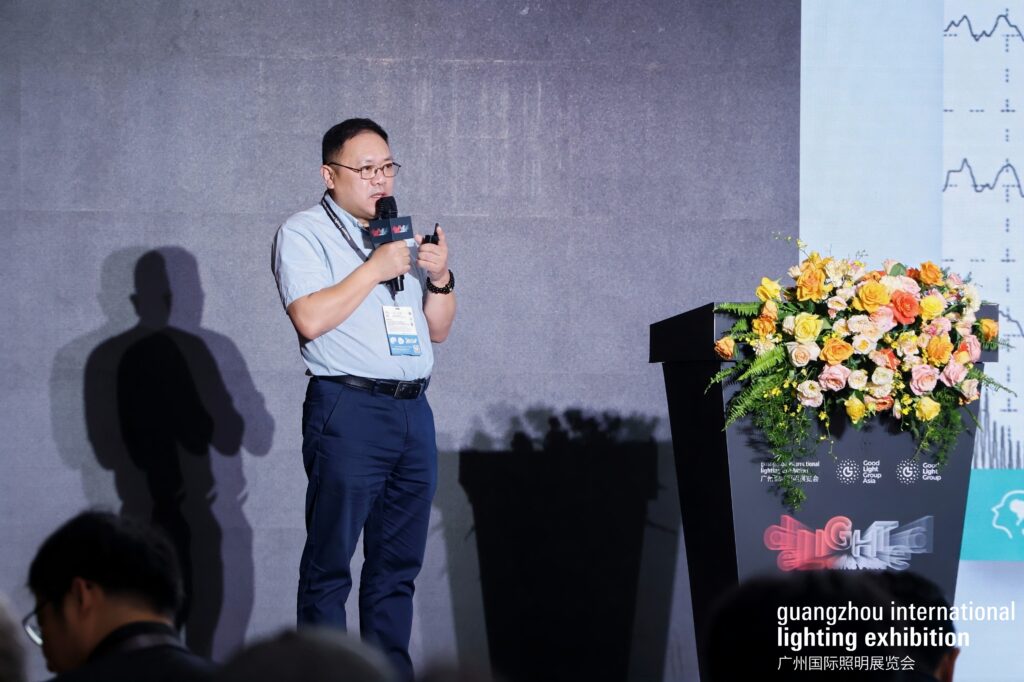
6 | The frequency language of the brain: different brainwaves reflect different states
EEG is powerful because brain activity has frequency characteristics.
Zheng Hongcheng’s presentation introduces several common brainwave bands.
- Delta waves, around 0.5 to 4 Hz, are often associated with deep sleep.
- Theta waves, around 4 to 8 Hz, are often associated with light sleep, meditation and relaxed subconscious states.
- Alpha waves, around 8 to 13 Hz, are often associated with relaxed wakefulness and closed-eye rest.
- Beta waves, around 13 to 30 Hz, are often associated with attention, logical thinking and task engagement.
- Gamma waves, above 30 Hz, are often associated with higher cognitive processing, attention and information integration.
The brain can be imagined as an orchestra playing different frequency patterns under different states.
When we are sleepy, focused, anxious, relaxed or deeply asleep, brain activity is not the same.
Therefore, if a light truly affects brain state, it may leave a pattern in EEG.
This is a key path for healthy lighting verification.
It is not enough to ask users:
- Do you feel more alert?
- 還要問:
- Are there measurable changes associated with alertness?
- Are there changes associated with reduced drowsiness?
- Are there changes associated with relaxation, attention or sleep stages?
- Are those changes stable, repeatable and interpretable?
If healthy lighting wants to move from storytelling to evidence, EEG is one important pathway.
7 | 40 Hz light stimulation: a frontier research direction and a mechanism worth studying
One core case in 鄭紅成’s presentation is 40 Hz flickering light and gamma-band activity.
This has become a highly discussed topic in neuroscience and light stimulation research.
The basic concept is that external light stimulation at 40 Hz may entrain or enhance neural activity at a similar frequency through the visual pathway. This kind of frequency entrainment has been studied in relation to brain networks, cognition and neurodegenerative disease models.
In animal studies, 40 Hz flicker stimulation has been associated with changes in amyloid-related pathology in Alzheimer’s disease mouse models. Later studies have explored combined auditory and visual stimulation, brain network response, cognitive outcomes and biomarkers.
This is an important and inspiring case. It tells us that light is not merely illumination.
Under specific frequency conditions, light may become a neural rhythm stimulus. The brain may respond to external rhythmic light signals in ways that can be measured. Such responses may be observed through EEG or more advanced electrophysiological methods.
However, this topic must be handled with caution. 40 Hz stimulation remains an emerging research direction. Results vary across studies. Animal findings cannot be directly translated into human clinical efficacy. Short-term brainwave response is not the same as long-term clinical outcome. Consumer products should not casually claim to treat neurodegenerative diseases.
The real message for the healthy lighting industry is not: Let us immediately commercialize 40 Hz health lamps.
The real message is: Health-related light effects must be verified through rigorous experiments. The closer light moves toward brain modulation, the clearer the scientific boundaries must be.The closer it moves toward clinical disease, the more it requires ethics, medical oversight and long-term evidence.
Without an evidence chain, frontier science should not be turned into product promises.
8 | From full spectrum to specific spectrum: different light types require different evidence levels
鄭紅成 also distinguishes different ways light may influence the brain.
Full-spectrum light may support a more natural and comfortable visual environment. Its value may include: Visual comfort. Colour quality. Reduced visual fatigue. A more natural spatial experience. Better daily environmental quality.
But full spectrum does not automatically mean brain health. It does not automatically mean direct modification of a specific brainwave. It cannot simply be claimed to treat sleep or cognitive problems. By contrast, specific spectra, specific frequencies and specific timing may produce more targeted physiological or neural responses under certain experimental conditions. But the more targeted the function, the more rigorous the evidence must be.
This distinction is important for the industry.
Not all healthy lighting claims belong to the same category. Full-spectrum lighting has its own evidence logic. Circadian lighting has its own evidence logic. Phototherapy has its own evidence logic. Neural stimulation has its own evidence logic. Healthcare applications have their own evidence requirements. Consumer applications have their own boundaries.
A mature healthy lighting industry should not mix all these concepts into one attractive label. It should clearly define the effect, evidence and limits of each type of light.
9 | EEG data can show whether light leaves a measurable trace
鄭紅成 emphasizes that theory needs data.
If light truly affects the brain, EEG should be able to show a trace. For example, in some 40 Hz light stimulation studies, brain activity in visual regions shows increased power around the 40 Hz frequency. Some audiovisual stimulation studies have also recorded broader brain responses. Other research attempts to connect gamma activity with drowsiness, attention or disease-related markers.
These studies are important because they move the statement “light affects the brain” from abstract concept toward observable data.
However, the boundary remains important. An EEG change means the brain has responded. But an EEG change does not automatically mean health improvement. A short-term response does not necessarily mean long-term benefit. A laboratory effect does not always translate to real-world environments. Group-level results do not always apply to every individual. Results from healthy participants do not necessarily apply to patients. Clinical claims require clinical pathways.
Therefore, healthy lighting verification should not only ask: Did something change?
It should also ask: What does this change mean? Is it stable? Is there a dose-response relationship? Is it linked with behavioural or clinical outcomes? Is it safe? Can it be reproduced in real environments? Who is the target population?
This is real scientific verification.
It is not simply about proving a product works. It is about understanding under what conditions it works, for whom it works and where the boundaries are.
10 | Light therapy and insomnia: clinical application must return to professional guidance
The final part of 鄭紅成’s presentation discusses light therapy for insomnia and sleep rhythm problems.
This is a highly relevant clinical field.
The core principle is that timed light exposure can influence the retinal-hypothalamic pathway and affect the suprachiasmatic nucleus, the body’s master clock. In some circadian rhythm sleep disorders, timed light exposure may be used as a non-pharmacological intervention.
For example: People with delayed sleep timing may use morning light to help advance their rhythm. People with advanced sleep timing may require carefully timed evening light to delay their rhythm. Shift work, jet lag and non-24-hour sleep-wake rhythm disorders may also involve individualized light intervention strategies.
But this does not mean everyone should casually use light therapy. The wrong timing may worsen the problem. The wrong intensity may overstimulate. The wrong user group may face risk. Bright light before sleep may worsen sleep onset difficulty. People with certain eye conditions, photosensitive diseases, psychiatric conditions or medication use may require special caution.
Therefore, light therapy is not the same as everyday lighting. It must be used under professional guidance.
This is also a warning for the lighting industry: It is appropriate to study light therapy. It is appropriate to support sleep medicine. It is appropriate to collaborate with hospitals and sleep centres. It is appropriate to develop safer and more controllable devices.
But light therapy should not be consumerized, overmarketed or medicalized without evidence. The closer we come to clinical application, the more we must respect clinical responsibility.
11 | Verification is not only about proving efficacy. It is also about defining safety boundaries
Many companies think verification is only about proving that a product works.
But scientific verification has another critical role: Defining safety boundaries. Healthy light is not always stronger light. Not always more full spectrum. Not always brighter. Not always more stimulating. Not always more “brain-active.”
The effect of light depends on: Wavelength. Intensity. Exposure time. Frequency. Duration. Direction. Eye-level exposure. Timing. Individual differences. Use scenario. Health status. Medication. Long-term exposure.
Therefore, verification must answer not only: Does it work?
It must also answer: At what dose is it safe? When should it be used? Who should avoid it? Are there side effects? Is long-term use reliable? How does it interact with other environmental factors? Does it require medical, design or technical supervision?
This is critical for healthy lighting. A mature industry does not simply make bigger claims. It defines clearer boundaries.
12 | What EEG means for the lighting industry: from product metrics to human responses
The traditional lighting industry is familiar with product metrics: Luminous flux. Power. Efficacy. CCT. CRI. Colour consistency. Lifetime. Flicker. Distribution. UGR. Control protocols.
These remain important. But healthy lighting requires a further transition: From product and space metrics to human response metrics.
These may include: Circadian response. Eye-level exposure. Sleep change. Brain state. Mood. Cognitive performance. Fatigue. HRV. Behavioural feedback. Long-term adaptation.
The significance of EEG is that it pushes the lighting industry from luminaire performance toward human physiological response.
This does not mean every project must use EEG. Homes, schools, offices and hotels cannot all conduct brainwave testing.
But EEG can serve as a research and validation tool that helps establish a more reliable evidence base.
Those research findings can then be translated into:
- Design guidelines.
- Product boundaries.
- Measurement methods.
- Scenario strategies.
- Verification approaches.
- Standards language.
- User education.
This is the right path from laboratory to industry. Not directly turning laboratory results into marketing claims. But building mechanisms through research, then translating them into design, measurement and real-world validation.
13 | A warning for the healthy lighting industry: do not let “health” become another competition label
The lighting industry is very good at turning new concepts into products quickly.
When eye-care becomes popular, the market produces eye-care lamps. When full spectrum becomes popular, full-spectrum products appear everywhere. When low blue light becomes popular, the term spreads rapidly. When circadian lighting becomes popular, many systems become “circadian.” When brain science becomes popular, brain-related lighting concepts may also appear quickly.
This speed shows the strength of the industry. But it also creates risk.
If every scientific direction is quickly turned into a consumer label, the market will lose trust.
鄭紅成’s message is clear: Healthy light should not become another competition label.
The winner should not be whoever says “health” first. Nor whoever sounds more mysterious. Nor whoever adds words such as EEG, brainwave, neuroscience or cognition to marketing language.
Frontier research should not become unverified product promises.
The truly competitive healthy lighting companies will not be those that tell the loudest stories.
They will be those that are willing to verify. Willing to test. Measure. Compare. Accept control groups. Admit boundaries. Distinguish scenarios. Collaborate with doctors, scientists, designers and standards bodies.
Explain what can be supported — and what cannot be guaranteed.
That is how healthy lighting can move from excitement to maturity.
14 | Verification does not block innovation. It gives innovation a responsible path.
Emphasizing verification does not mean stopping innovation. It means giving innovation a responsible path.
Healthy lighting is developing rapidly.
Many directions deserve exploration:
- Daytime circadian support.
- Low-stimulation night lighting.
- Sleep-friendly homes.
- Healthcare ward lighting.
- Senior living night safety.
- Children’s study and bedtime transition.
- Neurodiversity-friendly lighting.
- Light therapy devices.
- EEG-based human response testing.
- Personalized light environments.
These are valuable directions.
But each direction requires an evidence pathway. From mechanism hypothesis. To experimental validation. To small-scale pilots. To scenario design. To field measurement. To long-term feedback. To standardized methods. To responsible communication.
This is the innovation pathway healthy lighting needs. No verification does not mean “do not innovate.” No verification means “do not overclaim.”
Explore.
Test.
Prototype.
Demonstrate.
Build hypotheses.
But do not package a hypothesis as a conclusion. Do not package possibility as efficacy. Do not package laboratory phenomena as universal product promises.
That is scientific responsibility. It is also the foundation for trust.
15 | From EEG to Good Light: verification is the foundation of trust
Good Light Wake-up Call|好光覺醒行動 has always emphasized that healthy lighting must move from concept to designable, measurable, verifiable and deliverable industrial action.
鄭紅成’s EEG perspective adds one of the most important elements: Verification.
Without verification, Good Light may become sentiment.
Without verification, healthy lighting may become marketing.
Without verification, designers cannot build trust.
Without verification, owners cannot invest confidently.
Without verification, doctors cannot recognize claims.
Without verification, consumers cannot judge.
Without verification, standards cannot progress.
Without verification, the industry cannot upgrade.
Verification is not only for scientists. It is also an industry responsibility.
LED companies must provide reliable spectral and flicker data. Luminaire companies must provide traceable performance. Control systems must record actual operation. Designers must define targets and measurement points. Testing bodies must develop methods. Hospitals and research teams must validate human responses. Owners must understand the value of data. Industry platforms must help build shared language.
The future of healthy lighting will not be won by a single metric. It will be built through evidence chains.
Closing: let every ray of light become traceable and evidence-based.
鄭紅成’s presentation brings a crucial reminder to deLIGHTed talks Asia @ GILE 2026.
Healthy lighting cannot rely only on feelings. Not only on stories. Not only on product labels. Not only on beautiful spaces. Not only on scientific-sounding words.
True healthy lighting must withstand verification.
Professor Robert Lucas helped us understand how light tells the body time through melanopic metrics.
Dr. Marijke Gordijn helped us understand that Good Light must respect human rhythms.
Jan Denneman called on the industry to move from lighting to human outcomes.
Professor Yandan Lin reminded us that residential light is long-term health exposure.
鄭紅成 now reminds us:
When healthy lighting enters the fields of brain activity, sleep, emotion, cognition and clinical application, verification must come first.
EEG is not the only answer to healthy lighting. But it is an important signal.
It tells us: If light affects the brain, there should be an observable response. If health benefits are claimed, objective evidence should support them. If the industry wants to mature, it must move from concept competition to evidence competition.
The future of healthy lighting should not be about who tells the better story.
It should be about: Who has stronger data. Clearer boundaries. More rigorous verification. More realistic scenarios. More responsible applications.
And a stronger pathway from light as a product to light as measurable human value.
No verification, no true healthy light.
Let every ray of light become traceable. Let every health claim become evidence-based.
This is the message 鄭紅成 brings to the Good Light Wake-up Call|好光覺醒行動.
Good Light Wake-up Call. 好光覺醒。

 English
  Chinese (China)
  Chinese (Taiwan)