
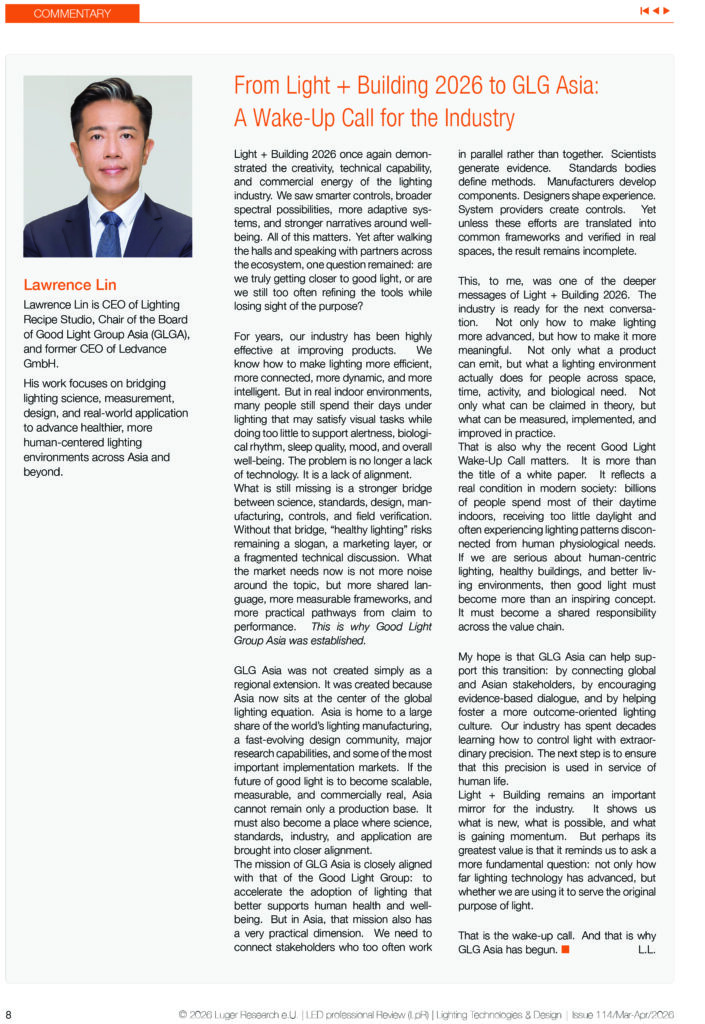
From Light + Building 2026 to the “Good Light Wake-up Call”
The lighting industry is shifting from “making products” to “re-understanding light.”
This year, Lawrence Lin was invited by LED professional Review (LpR) to publish a commentary in Issue 114, titled:
“From Light + Building 2026 to GLG Asia: A Wake-Up Call for the Industry.”
This short article is not a simple exhibition reflection. What Lawrence truly wanted to address is something deeper reflected by Light + Building 2026: the lighting industry is undergoing a shift in language and focus.
In the past, we tended to understand lighting through products, parameters, efficiency, control, and systems. Today, a clearer trend is emerging: light is no longer just a product category—it is becoming part of digital building infrastructure.
At the same time, we must also ask: as the industry becomes smarter and more systemized, are we truly moving toward “better light”?
This is the core question Lawrence raised in the LpR commentary.
01. What LpR and Siegfried Saw at L+B 2026
Lighting is becoming infrastructure, not just products
To start with the conclusion: LpR’s overall observation of Light + Building 2026 is highly worth the industry’s attention.
In the editorial of this issue, Siegfried Luger’s judgment is very clear in essence:
- Lighting is no longer just a product category
- It is becoming a component of digital infrastructure
- The industry is shifting toward system thinking
- Luminaires, sensors, controls, and data platforms are forming interconnected environments
- Light is taking on roles in sensing, processing, communication, and response
In other words, what L+B 2026 reveals is not simply more new products, but a shift in the industry’s narrative coordinate system.
From LpR’s analysis of key exhibitors and technology trends, this shift is reflected in several directions:
1. Deeper coupling between lighting and smart buildings
Light is being integrated into building management systems, spatial sensing, occupancy detection, environmental response, data collection, and energy optimization chains.
2. Adaptive and context-responsive lighting becomes mainstream language
Instead of preset scenes and static logic, systems increasingly respond dynamically to human activity, spatial conditions, time, and external environments.
3. Sustainability goes beyond “energy saving”
From materials, modularity, reparability, recyclability, lifecycle thinking to transparent environmental data—sustainability is now understood across the full value chain.
4. Experience returns to the center
“Experience” is no longer decorative language. More companies now recognize that light shapes spatial perception, visual comfort, emotional atmosphere, and behavioral experience.
From this perspective, Siegfried and LpR are correct: L+B 2026 is not just a product showcase—it is a demonstration of an industry-wide cognitive transition.
02. But Lawrence Real Question Is: If systems become stronger, does light automatically become better?
This is the deeper question Lawrence wanted to raise in the commentary.
L+B 2026 is impressive. Control is stronger, connectivity is broader, sensing is deeper, platforms are smarter, and systems are more complete.
All of this matters.
But the question is: When the industry becomes increasingly skilled at “turning lighting into systems,” does it also become equally skilled at “making better light”?
These are two different layers of concern.
Today, the industry is already very mature in:
- improving luminous efficacy
- building connectivity
- developing control systems
- collecting data
- enabling intelligent responses
- integrating platforms
However, in many real-world spaces, we still observe another reality:
- insufficient circadian support during daytime interiors
- nighttime lighting that does not respect relaxation and recovery
- lighting that supports visual tasks but not alertness, emotion, sleep quality, or long-term wellbeing
- “healthy lighting” often remains conceptual, marketing-driven, or fragmented technologically
Therefore, Lawrence wrote in the article: Today’s real gap is no longer just technology, but alignment.
Alignment between:
- science and products
- standards and applications
- design and manufacturing
- control and validation
- declared theory and real spatial performance
Without this alignment, “healthy lighting” easily becomes a slogan.
03. Why Lawrence Propose the “Good Light Wake-up Call”
Many people ask why Lawrence has been continuously promoting the Good Light Wake-Up Call recently.
It is because Lawrence increasingly feels that the lighting industry has reached a turning point: If we continue to revolve only around products, parameters, controls, and marketing language, the industry may become more advanced—but not necessarily closer to the true essence of light.
So what is the “Good Light Wake-up Call”?
It is not a new concept, nor a branding exercise.
It is meant to push three things:
1. Re-centering the industry on the human dimension
We must not only talk about output, control, efficiency, and connectivity, but also:
- what kind of light people receive at what time
- how light should be understood across spaces, activities, and physiological states
- how light affects alertness, comfort, rhythm, emotion, and recovery
- what constitutes “felt good light” vs. “verifiable good light”
2. Turning “good light” from slogan into framework
Truly valuable “good light” must evolve into:
- a shared language
- design methodologies
- measurable indicators
- deliverable spatial logic
- reproducible outcomes
3. Enabling value-chain collaboration instead of isolated efforts
Today’s industry challenge is that all stakeholders are working hard—but often in parallel, not in alignment:
- scientists publish evidence
- standards bodies define methods
- manufacturers develop components and luminaires
- designers shape experiences
- system companies build control platforms
- owners and operators focus on cost and outcomes
Without a bridge, these efforts easily remain disconnected.
Therefore, the essence of the Wake-Up Call is not emotional messaging, but a more rigorous collaborative logic:
science × standards × design × manufacturing × controls × field verification
This is the direction Lawrence has been consistently advocating.
04. Why the Establishment of GLG Asia
In the LpR article, Lawrence made an important statement: The establishment of GLG Asia is not just a regional extension—it reflects the fact that Asia is now at the center of the global lighting equation.
This can be expanded in three dimensions:
1. Asia as the global manufacturing hub
From components, modules, drivers, controls, to luminaires, a large portion of industrial capability is concentrated in Asia.
2. Asia as one of the most active application markets
From offices, education, healthcare, residential, hospitality, to smart buildings and cities—Asia provides abundant new scenarios, demands, and prototypes.
3. Asia as a key battlefield for “good light implementation”
If human-centric lighting, circadian support, and real-world validation cannot be strongly established in Asia, they cannot become a global foundational capability.
Therefore, GLG Asia’s mission is not “just another organization,” but:
- shifting Asia from a production base to a co-creation value base
- shifting Asia from manufacturing advantage to methodological and application advantage
- integrating Asia more deeply into the global dialogue on good light, health, and validation
This is why Lawrence emphasizes that GLGA is not only about community building, events, or communication—it is fundamentally a bridge platform.
05. What L+B 2026 Tells Us: The Next Stage Is Not More Noise, But More Direction
If viewed superficially, L+B 2026 is a great success.
There are many new technologies, platforms, controls, systems, materials, and expressions.
But from a longer-term industry evolution perspective, Lawrence sees two parallel trends:
Trend 1: Lighting is becoming more systemized, digitized, and platform-driven
As LpR and Siegfried clearly observed, the industry is shifting from “selling lamps” to “building environmental infrastructure.”
Trend 2: The industry must also re-answer: “Who is light ultimately for?”
If systems become more complex, connections stronger, and platforms smarter—but spatial light still does not better support human rhythm, comfort, and quality of life—then we have only strengthened the tool, not clarified the purpose.
Therefore, Lawrence increasingly believes the next stage of the lighting industry is not about more excitement, but more direction.
Not more concepts—but clearer questions.
Not more “human-centric” slogans—but deeper scientific, standards-based, design, and validation collaboration.
06. Why Lawrence Appreciates Siegfried and LpR
Lawrence is sincerely grateful for the invitation to contribute a commentary to LpR.
In the European lighting industry media landscape, LpR occupies an important position. It is not a mass media outlet, but one closer to professional, technical, and industry-level discourse.
To bring GLG Asia, the Good Light Wake-Up Call, and the reflections on L+B 2026 into this platform is meaningful.
More importantly, Siegfried and LpR’s observation goes beyond product-level reporting. Their framing of L+B 2026 clearly moves toward a broader industrial context:
- light as infrastructure
- light as part of systems
- light re-coupled with smart buildings, data, sustainability, and experience
Lawrence commentary builds on this and pushes one step further: If lighting is becoming a more powerful infrastructure, we must ensure it ultimately serves better human environments.
This is where our perspectives naturally align.
07. The Real Next Step
From “technology upgrade” to “value upgrade of light”
To summarize:
L+B 2026 shows us a technological upgrade in the industry.
The Good Light Wake-Up Call aims to drive a value upgrade.
Technology upgrade focuses on:
- smarter systems
- stronger connectivity
- higher efficiency
- better control
- deeper integration
Value upgrade asks:
- Does light truly support human biological rhythm?
- Does light improve spatial wellbeing?
- Does light move from visual performance to mind-body integration?
- Can light move from claims to validation?
- Can light move from product-centric thinking to holistic environmental thinking?
Lawrence firmly believes the future of lighting will not be defined solely by better hardware or larger platforms.
It will ultimately be defined by a more fundamental question: Are we willing to re-understand light—not as a commodity, but as a deep medium between people, space, time, behavior, and health?
This is the true “Wake-Up Call” in his view.
結語
Light + Building 2026 is important. LpR and Siegfried’s observations are equally valuable.
For Lawrence, this commentary represents an opportunity to once again articulate a question he has long wished to clarify on an international platform: What the lighting industry needs most today is not only more innovation, but a clearer understanding of why we innovate.
If the answer always returns to “people,” then the “Good Light Wake-Up Call” is not a slogan—it becomes a direction worth collectively advancing for the next stage of the industry.

 English
  Chinese (China)
  Chinese (Taiwan)