
Author | Lawrence Lin
Chairman of the Good Light Group Asia (GLGA), Board Member of Good Light Group (GLG), IWBI WELL Light Concept Advisor, Founder & CEO of Lighting Recipe Studio (LRS)
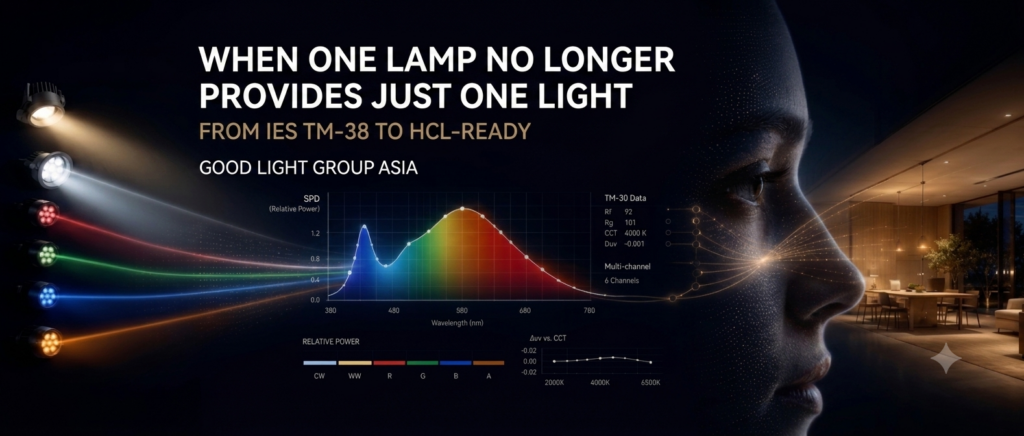
Recently, the Illuminating Engineering Society (IES) released ANSI/IES TM-38-21 (R2026), Photometric and Electrical Measurements of Tunable White Solid-State Lighting Products.

Strictly speaking, R2026 is a reaffirmation of the 2021 version, not a comprehensive rewrite or a new technical edition. However, it is still worthy of attention from LED chip manufacturers, packaging companies, driver suppliers, luminaire manufacturers, control system developers, measurement equipment providers, lighting design software companies, and certification bodies.
Because it reminds us to revisit a long-overlooked question:
When a luminaire can output hundreds or even thousands of different light states, can we still define it using only a single set of metrics such as luminous flux, power, CCT, and color rendering index?
The answer is clearly no.
As Chairman of the Good Light Group Asia (GLGA), Board Member of Good Light Group (GLG), IWBI WELL Light Concept Advisor, and Founder of Lighting Recipe Studio (LRS), I have been involved in related initiatives from multiple perspectives, including international public advocacy, healthy building practices, lighting industry development, and spectral measurement and verification.
These experiences have increasingly convinced me that:
The most important task for the next stage of the lighting industry is not simply to add more control channels, but to establish an engineering language that can explain “what light the source outputs, what light the space ultimately creates, and what light people actually receive.”
TM-38 is not yet the complete language, but it represents a very important step forward.
01 | In the past, we measured “a lamp”; in the future, we must measure “an optical state”
Traditional fixed white lighting products have relatively simple specifications.
A luminaire may be specified as: 3000 K; Ra 90; 4000 lm; 40 W; 100 lm/W. Because it has only one primary operating state, measurements based on methods such as ANSI/IES LM-79 can generally describe its main performance characteristics.
However, tunable white luminaires are completely different.
A luminaire with a nominal range of 2700–6500 K may theoretically have hundreds or even thousands of control states. Even when selecting only several representative points, we must answer: Are the luminous flux values the same at 2700 K, 4000 K, and 6500 K? Which CCT provides the highest efficiency, and which provides the lowest? Does Duv shift significantly during tuning? Are color rendering performances consistent between the warm and cool ends? When dimmed, do CCT, SPD, and flicker characteristics change? If the control system is set to 4000 K, does the luminaire actually output 4000 K? Can different luminaires receiving the same command produce comparable optical results?
In the past, many product specifications only presented one set of “best-looking” parameters.
The highest luminous flux may occur at 4000 K, the highest efficiency may occur at 5000 K, and the best color rendering performance may occur at 3000 K. However, these optimal values from different operating states are often placed together in a single specification sheet.
Clearly, this cannot fully represent a tunable white luminaire.
The significance of TM-38 is that it encourages the industry to move from a single static value toward a performance curve that can be measured, compared, interpolated, and delivered.

02 | TM-38 Truly Changes the Definition of “Product Performance”
LM-79 mainly answers: How should a specific operating state be measured?
TM-38 further addresses: For a tunable white product with a large number of operating states, which states should be measured, in what sequence, and how can the entire tuning range be described using limited data points?
Therefore, the future product data for a tunable white luminaire should not only include: 2700–6500 K, 4000 lm, 110 lm/W, Ra 90.
Instead, it should gradually develop into a set of state-based performance data:
- Actual CCT, Duv, luminous flux, power, efficacy, and SPD at the warm end;
- Actual CCT, Duv, luminous flux, power, efficacy, and SPD at intermediate color temperatures;
- Actual CCT, Duv, luminous flux, power, efficacy, and SPD at the cool end;
- Spectral characteristics, chromaticity, and temporal light modulation at different dimming levels;
- Maximum, minimum, and tolerance values across the entire tuning range;
- Interpolation methods and error ranges between measured points.
Behind this is a fundamental shift: A luminaire is no longer just a product model. It is a dynamic optical system jointly defined by LEDs, packaging, drivers, algorithms, controls, and thermal management.

03 | For LED Chip and Packaging Companies: The Era of Providing Only Single-Channel “Best-Case Data” Is Ending
TM-38 primarily targets tunable white luminaires, lamps, and light engines, but its impact will inevitably extend upstream to LED chip and packaging companies.
For dual-channel, multi-chip, or multi-channel packages, the final performance of a luminaire depends on:
- SPD of each channel;
- Luminous flux and radiant flux;
- Spectral shifts under different drive currents;
- Junction temperature variations;
- Thermal crosstalk between channels;
- Power derating when multiple channels operate simultaneously;
- Different lumen maintenance rates among channels;
- Color consistency between channels;
- Optical interactions within the package.
Especially for RGBW, RGBWA, RGBWAF, five-channel, or even eleven-channel light sources, manufacturers can no longer simply assume: The mixed SPD is always equal to the linear sum of the SPD measured from each individual channel.
In real products, junction temperature, driver nonlinearity, packaging materials, thermal coupling between channels, and aging differences can all alter the final spectral output.
Therefore, LED packaging companies will increasingly need to move from “providing a typical value” toward providing:
- Baseline SPD data for each channel;
- Spectral output and luminous flux under different drive currents;
- Temperature coefficients;
- Thermal coupling data when multiple channels operate simultaneously;
- Luminous flux, chromaticity, and spectral maintenance data;
- Channel-to-channel consistency data;
- Machine-readable data that enables luminaire manufacturers to build accurate models.
Without complete upstream data, downstream manufacturers can only rely on repeated trial-and-error tuning, while control algorithms remain dependent on empirical adjustments.
This not only reduces R&D efficiency but also makes final products difficult to accurately simulate, replicate, and validate.

04 | For Luminaire Companies: One Best Operating Point Cannot Represent the Entire Product
The most common issue with tunable white luminaires is using the “best state” to represent “all states.”
However, for designers and users, what truly matters is:
- What is the minimum luminous flux across the entire tuning range?
- What is the minimum efficacy?
- What is the worst Duv deviation?
- What is the lowest Ra or Rf?
- Does the distribution change at different CCT settings?
- Does low-level color mixing introduce flicker?
- Does scene transition cause chromaticity overshoot?
- Does the tuning trajectory remain stable after long-term use?
Therefore, luminaire manufacturers cannot focus only on endpoint design; they must also manage the entire tuning and dimming trajectory.
For multi-channel spectral luminaires, the challenge is even more complex.
The same 4000 K, identical Duv, and identical illuminance can be achieved through different channel combinations. They may appear visually similar, but their SPDs can be completely different.
This means their:
- TM-30 Rf, Rg, and hue shift;
- mel-DER;
- five alpha-opic DER values;
- power consumption and efficiency;
- material appearance;
- camera and sensor responses;
- photobiological safety and material degradation risks;
may all differ.
This is the true technical value of spectrally tunable systems, and it is an area not fully covered by existing one-dimensional tunable white approaches.
Therefore, future multi-channel luminaires should not only state “what CCT range they can achieve,” but also explain: Under the same visual appearance, what different spectral states can they generate? What outcomes do these states deliver for visual performance, energy efficiency, human factors, or specific applications?
05 | For Control System Companies: Control Commands Do Not Equal Optical Results
Today’s control systems can already transmit:
- CCT;
- xy chromaticity coordinates;
- RGB or RGBWAF values;
- dimming levels;
- scene numbers;
- time sequences;
- sensor feedback commands.
DALI DT8 also supports color control methods including Tc, xy, and RGBWAF.
However, it must be clearly understood: Electrical and communication interoperability does not equal final optical interoperability.
After a controller sends a “4000 K” command, the actual outputs may differ:
- Luminaire A outputs 3920 K;
- Luminaire B outputs 4070 K;
- Luminaire C shifts to 3800 K after dimming;
- SPD changes after replacing the driver;
- OTA firmware updates alter existing scene recipes;
- Multiple luminaires reach the target state at different speeds.
Therefore, future control systems should not only prove that “the command has been delivered.” They should also answer:
- How is the control value mapped to the actual SPD?
- Can different brands achieve comparable optical results?
- Can chromaticity remain stable during dimming?
- Can luminous flux remain consistent during color tuning?
- Do scene transitions create flicker, beat frequencies, or chromaticity overshoot?
- Can multiple luminaires change synchronously?
- After firmware upgrades, do existing optical states remain valid?
- After sensor feedback, does the system actually achieve the target eye-level light exposure?
The next-generation control architecture needs to establish: Control state → Channel output → SPD → Spatial result → Visual and human-factor outcome
The next evolution of the control industry is not simply “how many channels can be controlled,” but: whether the final delivered light can be controlled and verified.
06 | For Measurement Instruments and Laboratories: The Future Is Not Measuring One Point, but Mapping Performance
Traditional laboratory measurement workflows are usually: Power on → Stabilize → Measure → Report.
For tunable white, multi-channel, and spectrally tunable products, measurement systems must further provide:
- Automatic transmission and recording of control commands;
- Identification of actual optical states;
- Synchronized measurement of SPD, photometric, and electrical data;
- Automatic thermal stabilization assessment;
- Sequential switching of color and dimming states according to defined procedures;
- Recording of driver, hardware, and firmware versions;
- Development of interpolation or response surface models;
- Extraction of independent validation points not used in modeling;
- Calculation of prediction error between modeled and measured results;
- Output of machine-readable standardized data.
This means future competition among measurement equipment companies will not only depend on spectrometer accuracy, but also on:
- Automated testing;
- Control protocol integration;
- Multi-instrument synchronization;
- Data modeling;
- Measurement uncertainty analysis;
- Optical state management;
- Standardized reporting;
- Software and cloud data capabilities.
For multi-channel systems, testing every combination is impossible.
If a six-channel system provides 256 control levels per channel, the theoretical number of combinations reaches approximately 2.8 × 10¹⁴. Even with continuous testing, it would be impossible to measure every state.
Therefore, the scientifically appropriate approach in the future should not simply define “measure 9 points, 15 points, or 25 points,” but instead use: Channel fundamentals + color gamut boundaries + representative states + extreme states + independent validation points
The final standard should answer not only: “How many points were measured?”
but rather: Within the control range declared by the manufacturer, what is the maximum error between model predictions and actual output?
07 | For Design Software: One IES File Can No Longer Represent a Dynamic Luminaire
Traditional IES or LDT files usually describe the photometric distribution of a product under a single operating state.
This is acceptable for fixed white products, but inherently incomplete for tunable white and spectrally tunable systems.
Future designers need to know not only: How does the luminaire distribute light at 3000 K?
They also need to know:
- Does the distribution change at 4000 K and 6500 K?
- Is luminous flux identical across states?
- What is the SPD in each state?
- How does mel-DER change?
- Do flicker and chromaticity change after dimming?
- What is the eye-level mel-EDI in the space?
- How does daylight integration change the final spectral exposure at the eye?
- Which optical state should be applied at different times of day?
If TM-38 measurement results remain only as PDF reports and cannot enter DIALux, RELUX, BIM platforms, control systems, and digital twins, then only half of their value has been realized.
The future requires not simply generating an independent IES file for each CCT, but creating a dynamic lighting engineering data model: Control state × SPD × Distribution × Power × Visual quality × Temporal light modulation × Alpha-opics
Only when luminaires, controls, measurement instruments, and software share the same state language can dynamic lighting truly enter design, commissioning, acceptance, and operation.
08 | Why TM-38 Is Still Not Sufficient to Fully Cover Next-Generation Lighting
TM-38 is suitable for tunable white products where a single CCT axis is the primary input and where CCT adjustment is nominally independent from luminous flux control.
However, next-generation lighting is rapidly moving toward:
- RGBWAF wide-gamut systems;
- Multi-channel spectrally tunable white;
- Independent mel-DER adjustment under the same CCT;
- Dual optimization of visual quality and energy efficiency;
- Coordination between visible light and near-infrared;
- Daylight and electric-light closed-loop systems;
- Sensor and spatial-model feedback;
- Dynamic control based on time schedules and human-factor objectives.
At this stage, CCT is no longer sufficient as the sole product index.
The same CCT, Duv, and illuminance can correspond to multiple completely different SPDs.
Therefore, the fundamental unit of next-generation standardization should not simply be “4000 K,” but rather a traceable optical state dataset, including:
- Control vector;
- Measured SPD;
- Luminous flux and power;
- CCT, Duv, or color chromaticity;
- Applicable TM-30 metrics;
- Five alpha-opic DER values;
- Temporal light modulation;
- Temperature;
- Driver and firmware version;
- Measurement uncertainty;
- Valid range of the model.
Standardization should not force companies to disclose their core light recipes, optimization algorithms, or other commercial secrets.
What should truly be standardized is: Reproducible and verifiable output performance — not how companies internally calculate that output.
Companies may retain their algorithms and recipes, but designers, laboratories, and users must be able to understand: Under a defined control state, what light does the product actually produce?

09 | TM-38 Is the Foundation of HCL-Ready, but Not a Health Lighting Standard
As long as complete SPD data is available, the five alpha-opic metrics, including mel-DER, can be calculated according to CIE S 026.
Under specific eye-level spectral exposure conditions, it can be simplified as: mel-EDI = eye-level vertical illuminance × mel-DER
However, it must be emphasized: The total luminous flux of a luminaire does not equal the user’s eye-level mel-EDI.
Once a luminaire leaves the laboratory and enters a real space, the actual light exposure will also be affected by:
- Luminaire position and installation angle;
- Light distribution;
- Spectral reflectance of walls, floors, and furniture;
- Partitions and obstructions;
- User position;
- Viewing direction;
- Daylight contribution;
- Age;
- Exposure duration and timing;
- Whether the control system operates according to the intended design.
Therefore, a complete HCL-ready engineering chain should include: Multi-state product measurement → SPD and photometric engineering data → Control-state mapping → Spatial and human-factor simulation → On-site eye-level mel-EDI validation → Time-dose and long-term operational feedback loop
TM-38 primarily addresses the first step and provides the foundation for the second step.
It is highly important, but it should not be misunderstood as: A product measured according to TM-38 automatically becomes a health lighting product.
Measurement methods are responsible for accurately characterizing performance. Health lighting requires additional support from scientific evidence, application objectives, spatial validation, and time-dose considerations.

10 | Why is Good Light Group Asia promoting the HCL-ready initiative at this moment?
Asia is not only the world’s most important manufacturing base for LED packaging, drivers, luminaires, and control systems; it is also one of the key markets where healthy lighting, smart buildings, and emerging spectral technologies are being rapidly implemented.
However, we must objectively recognize that: Asia possesses the most complete lighting industry supply chain in the world, yet it still lacks a common engineering language capable of connecting light sources, controls, spaces, human factors, and on-site verification.
What the industry truly lacks today is not another isolated metric, but a bridge connecting science, standards, manufacturing, and real-world applications.
Within the existing ecosystem:
- CIE establishes scientific measurement systems for spectrum, colorimetry, and alpha-opic photometry;
- IES develops methods for photometric, electrical, color quality, and data exchange standards;
- IEC and DALI address control systems and device interoperability;
- IWBI, through frameworks such as WELL, promotes healthy building applications;
- GLG advocates Good Light from the perspectives of global public initiatives and public health;
- Instrument manufacturers provide traceable laboratory and field measurements;
- Software companies enable design, simulation, and digital delivery;
- Manufacturers develop LEDs, drivers, luminaires, and controllers;
- The life sciences community provides evidence related to circadian rhythms, sleep, cognition, emotions, and other physiological and psychological responses.
However, these elements have not yet been fully connected into an integrated chain: Light source → Luminaire → Control → Engineering data → Space → Eye-level light exposure → Human response
The HCL-ready Engineering Data Model initiative promoted by the Good Light Group Asia is not intended to replace CIE, IES, IEC, DALI, IWBI, or any other international organizations. Nor is it intended to prematurely establish another closed so-called “international standard.”
GLGA aims to serve three key roles:
1. Connecting Asian manufacturing with international science
To ensure that methodologies such as CIE S 026, IES TM-30, TM-38, and TM-33 no longer remain limited to academic papers, conferences, and laboratories, but can be integrated into product definitions, design software, test reports, and real engineering applications.
2. Connecting product data with human light exposure
To connect luminaire SPD, photometric distribution, and control states with real-world factors including space conditions, eye-level mel-EDI, time of day, exposure duration, and actual operational performance.
3. Creating verifiable pre-standardization outcomes
Through common terminology, minimum necessary data sets, cross-laboratory testing, machine-readable data profiles, and demonstration projects, GLGA aims to establish a technical foundation for future alignment with formal international standard systems.
This is not about creating a separate system from scratch. It is about enabling existing scientific knowledge, standards, and industrial capabilities to form a truly integrated closed loop.
11 | From My Four Professional Perspectives, I See the Same Missing Link
As a Board Member of Good Light Group, my concern is: how can we enable more people to receive good light with the right timing, the right intensity, and the right spectrum?
As an IWBI WELL Light Concept Advisor, my concern is: how can healthy building requirements move beyond written criteria and be implemented in real spaces, where they can be measured and verified at the eye level?
As the Chairman of the Good Light Group Asia, my concern is: how can Asia’s vast manufacturing and engineering capabilities evolve from price competition toward competition based on science, standards, and value?
As the Founder and CEO of Lighting Recipe Studio (LRS), I face a more direct technical challenge: From SPD, alpha-opics, flicker, and spatial measurement to eye-level mel-EDI and human response, how can we establish a truly practical R&D–design–control–verification closed loop?
These four perspectives ultimately point to the same conclusion: The lighting industry does not lack individual metrics.
What it truly lacks is an engineering data foundation that can connect metrics, products, controls, spaces, and people into one integrated system.
12 | What Should the Industry Do Next?
LED chip and packaging companies should move from single-channel typical values toward providing:
- Channel-level SPD data;
- Current and temperature models;
- Multi-channel thermal coupling data;
- Spectral and color maintenance performance;
- Digital data formats that enable downstream modeling.
Driver and control companies should move from command interoperability toward:
- Mapping between control states and actual SPD output;
- Scene state recognition;
- Synchronization among multiple luminaires;
- Dynamic process verification;
- Sensor feedback and closed-loop control.
Luminaire companies should move beyond providing only the best operating point and instead deliver:
- Full adjustment-range performance;
- Worst-case performance conditions;
- Representative optical states;
- Metameric capability under identical visual conditions;
- Dynamic transition quality;
- Traceability of hardware and firmware versions.
Measurement equipment companies and laboratories should move from single-point measurement toward:
- Multi-state automated testing;
- Control protocol integration;
- SPD, TLA, and alpha-opics measurements;
- Interpolation models and independent verification;
- Machine-readable reports;
- Integration between laboratory and field data.
Software companies should move beyond one luminaire and one IES file toward:
- Multi-state optical models;
- Integration of spectrum and photometric distribution;
- Spatial eye-level light simulation;
- mel-EDI time-series analysis;
- Connected data workflows across design, commissioning, acceptance, and operation.
Designers, building owners, and certification organizations should move beyond paper-based specification compliance toward:
- Deliverable design states;
- Traceable control intent;
- Measurable eye-level outcomes;
- Verifiable installation results;
- Sustainable performance throughout the operational phase.
Conclusion: The Asian Lighting Industry Must Take Responsibility for “What Kind of Light It Outputs”
Over the past several decades, the Asian lighting industry has become one of the most important manufacturing forces in the world.
We have built mature ecosystems for LEDs, drivers, luminaires, controllers, and supply chains, while continuously driving lighting products toward lower costs, higher efficiency, and broader adoption.
However, after becoming a global manufacturing powerhouse, we must also take greater responsibility for the future development of the industry.
As light sources enter the era of multi-channel systems, tunable spectra, intelligent control, and human-centric lighting, simply knowing how bright a lamp is, how many watts it consumes, or what its color temperature is, is no longer sufficient to explain what kind of light it actually produces — nor does it tell us what kind of light people ultimately receive.
The significance of TM-38 lies precisely in bringing this question to the forefront of the industry.
It is not the final destination, but it clearly points toward the next stage:
- From single-point parameters toward multi-state data;
- From CCT toward SPD;
- From control commands toward actual optical outcomes;
- From product performance toward spatial performance;
- From visual performance and energy efficiency toward complete human light exposure;
- From test reports toward engineering data that runs throughout design, control, commissioning, acceptance, and operation.
The 亚洲健康光联盟(Good Light Group Asia, GLGA) is committed to working in an open, rigorous, and internationally aligned manner with CIE, IES, IWBI, DALI, IALD, GLG, research institutions, life science experts, measurement equipment companies, and partners across the lighting value chain to advance the development of HCL-ready engineering data models and related validation efforts.
What GLGA aims to promote is not another marketing concept, but a practical and implementable pathway: Scientific evidence → Measurement methods → Engineering data → Products and controls → Spatial verification → Real human benefits
Because the truly good light of the future should not merely be claimed.
It must be able to be described, designed, controlled, measured, verified, and ultimately experienced by people in real life.

 English
  Chinese (China)
  Chinese (Taiwan)