
deLIGHTed talks Asia @ GILE 2026
Good Light Wake-up Call Series Report 16
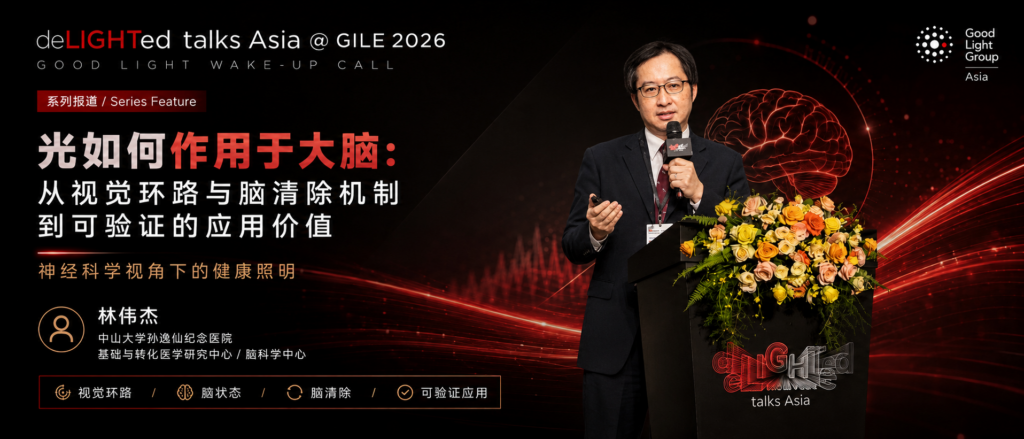
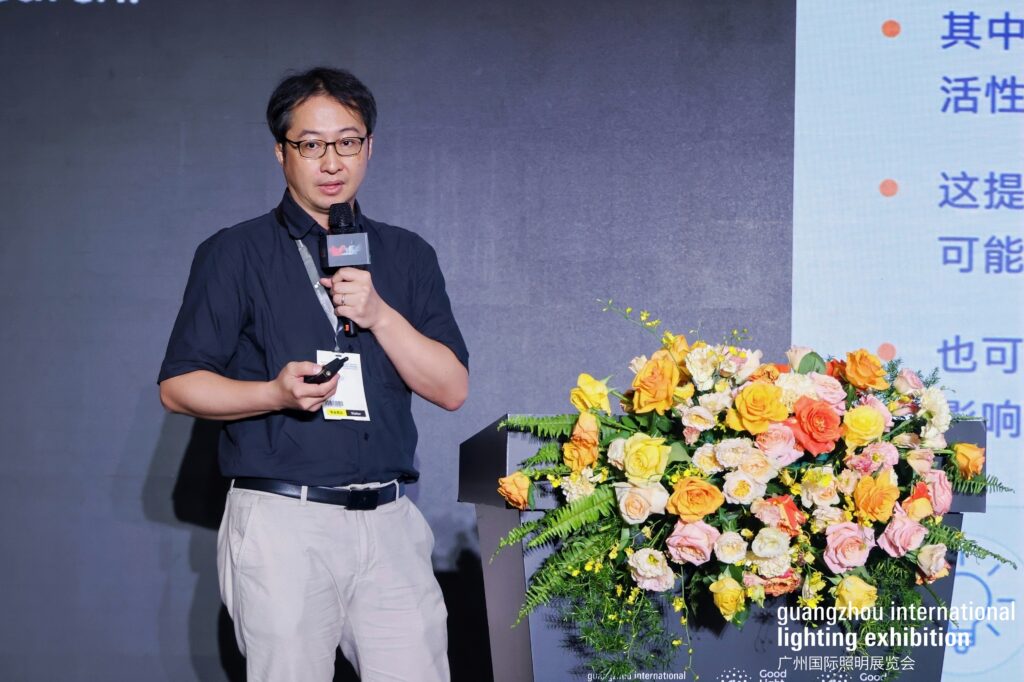
Dr. Wei-Jye Lin: How Light Acts on the Brain — From Visual Circuits and Brain Clearance to Verifiable Application Value
In the previous reports of the Good Light Wake-up Call|好光觉醒行动 series, we have explored healthy lighting from multiple perspectives.
Robert Lucas 教授告诉我们,传统 lux 不足以描述光如何告诉身体时间。
Marijke Gordijn 博士提醒我们,好光,是在正确时间给身体正确的光。
Jan Denneman 呼吁照明产业从 illumination 走向 human outcomes。
Kei Haraguchi / 原口圭 of Nichia showed how LED spectral innovation can support circadian-oriented lighting applications.
Anne Berends 则把健康光带到近红外、剂量与科学边界的新讨论。
赵弘轶主任 brought healthy lighting into healthcare, reminding us that light in hospitals must move from compliance lighting to clinical environment design.
Professor Yandan Lin brought the conversation back to homes, explaining why the next upgrade in residential lighting is not only smarter or more beautiful lighting, but healthier and more verifiable lighting environments.
林伟杰博士’s presentation goes one level deeper.
It asks a fundamental question: How does light act on the brain?
This is not only a lighting question. It is not only a visual question. And it is certainly not a question that can be answered by saying “it feels comfortable.”
His topic was: How Light Acts on the Brain: From Visual Circuits and Brain Clearance to Verifiable Application Value
The importance of this presentation is that it moves healthy lighting from spatial experience toward neural mechanisms.
In the lighting industry, we often say: Light affects sleep. Light affects circadian rhythm. Light affects alertness. Light affects emotion. Light affects cognition. Light may affect brain states.
But without mechanisms, parameters, scenarios and verification, these statements can easily become concepts rather than evidence.
Dr. Lin’s presentation reminds us: Healthy lighting should move beyond “lighting a space” or “feeling comfortable.”
It should enter a scientific stage where it can be designed, measured, verified and delivered.
In other words, healthy lighting should not only ask: Is the space bright enough? Does the lighting feel comfortable? Does the scene look healthy?
It should also ask: What happens after light enters the eye? How does the retina convert light into neural information? How does light reach brain circuits? What light parameters may influence brain states? Why might brain clearance become a new perspective for healthy lighting? How can animal research be carefully translated into lighting parameter optimization? How can the industry build a loop between mechanism, scenario, parameters, outcomes and verification?
This is the key value of 林伟杰博士’s presentation.
It does not encourage the lighting industry to rush into “brain-science products.”
Instead, it reminds us: If we want to talk about healthy lighting, we must understand the scientific pathways between light and the brain.
1 | Light first enables vision — but vision is only the beginning
For most people, the most familiar function of light is simple: Light allows us to see the world. External light enters the eye. It passes through the cornea and lens. It reaches the retina. Photoreceptors receive the signal. The retina converts light into neural information. The optic nerve sends that information to the brain. Eventually, we perceive brightness, colour, shape, motion, depth and space.
This is the most direct and familiar pathway through which light acts on the brain.
But this pathway is already highly complex.
The retina is not a passive film. It does not simply “take a picture” of the external world. The retina is part of the nervous system. It performs early processing of light information. The lateral geniculate nucleus, primary visual cortex and higher visual areas then extract features such as colour, edges, movement, direction and spatial relationships.
This is important for the lighting industry.
Lighting does not end when photons reach a surface. Lighting ultimately enters the human nervous system.
We may think we are designing brightness in a space. But we are also designing visual neural input.
This is why healthy lighting must understand visual circuits.
2 | Light is more than a visual stimulus. It can also affect brain states through non-image-forming pathways.
If light only formed images, healthy lighting might remain mainly about visual comfort, clarity, glare control and colour quality.
But modern photobiology tells us that light does more than support vision. In addition to classical image-forming pathways, light can also influence the body through non-image-forming pathways.
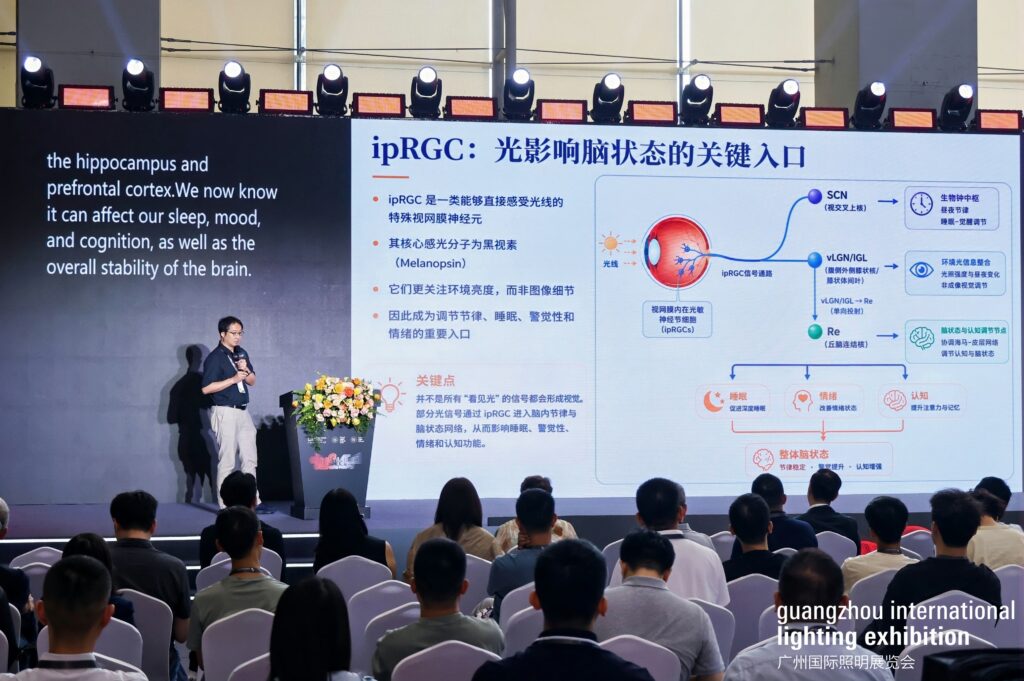
One of the most important entry points is the intrinsically photosensitive retinal ganglion cell, or ipRGC. ipRGCs contain melanopsin. They are especially sensitive to blue-cyan light.They are not primarily responsible for forming images. They help encode environmental brightness, timing information and circadian signals.
Through ipRGCs and related brain pathways, light may influence: Circadian rhythms. Sleep. Alertness. Emotion. Cognition. Brain states. Daytime performance.The body’s temporal structure.
This is why Professor Robert Lucas emphasized that traditional lux is not sufficient. It is also why CIE S 026, melanopic EDI, DER and alpha-opic quantities are becoming increasingly important.
Visual brightness and biological effectiveness are not always the same thing. A light may make a room look bright enough, yet provide an inappropriate time signal to the body. A light may feel soft, but at the wrong time it may still stimulate the circadian system unnecessarily.
Therefore, healthy lighting must understand: Visual pathways. Non-visual pathways. Circadian pathways. Brain-state pathways.
Light is visual input. It is also neural information. And in some contexts, it may become an environmental signal that helps regulate brain state.
3 | Why 40 Hz blue light became a scientific entry point
One important research entry point in Dr. Lin’s presentation is: Low-intensity 40 Hz blue light.
Before discussing this topic, one boundary must be made clear. This does not mean that 40 Hz blue light is ready to be used as a human treatment. It does not mean that lighting products can claim to improve Alzheimer’s disease. It does not mean that everyone should receive flickering light stimulation.
Dr. Lin’s presentation positions this carefully as: a scientific entry point in animal research.
Why is this direction meaningful?
First, 472 nm blue light is close to the melanopsin-sensitive region. This makes it relevant to ipRGC-related non-image-forming pathways.
Second, 40 Hz lies within the gamma frequency range. Gamma-band activity is often studied in relation to brain network synchronization, higher cognition and information integration.
Therefore, low-intensity 40 Hz blue light allows researchers to ask: Can rhythmic visual input influence brain network activity?
But the key point is this: External 40 Hz light stimulation does not automatically mean that the whole brain synchronizes. A rhythmic input does not automatically mean a health outcome. Whether there is a true neural network response must be verified through EEG, physiological recording, imaging and behavioural experiments.
This distinction is critical.
The healthy lighting industry must not treat a scientific-sounding parameter as proof of efficacy.
The true value of 40 Hz blue light research is that it opens a window into mechanism. It helps us study how light may influence brain networks. It should not become a premature marketing label.
4 | Clues from AD animal models: light may influence brain networks and behaviour
Dr. Lin’s handout discusses findings in Alzheimer’s disease mouse models.
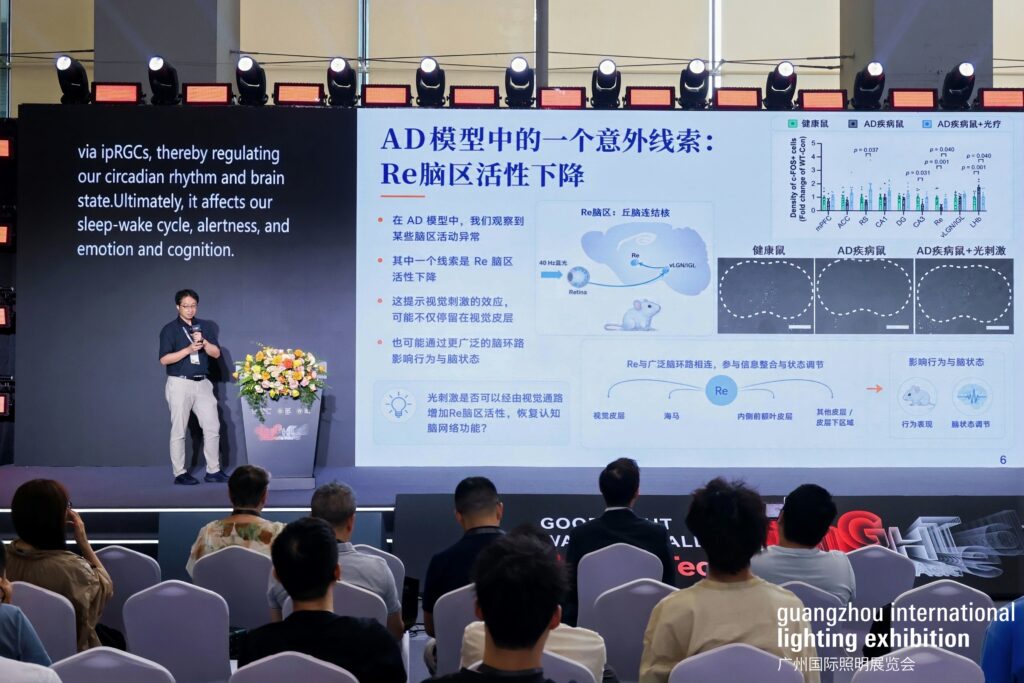
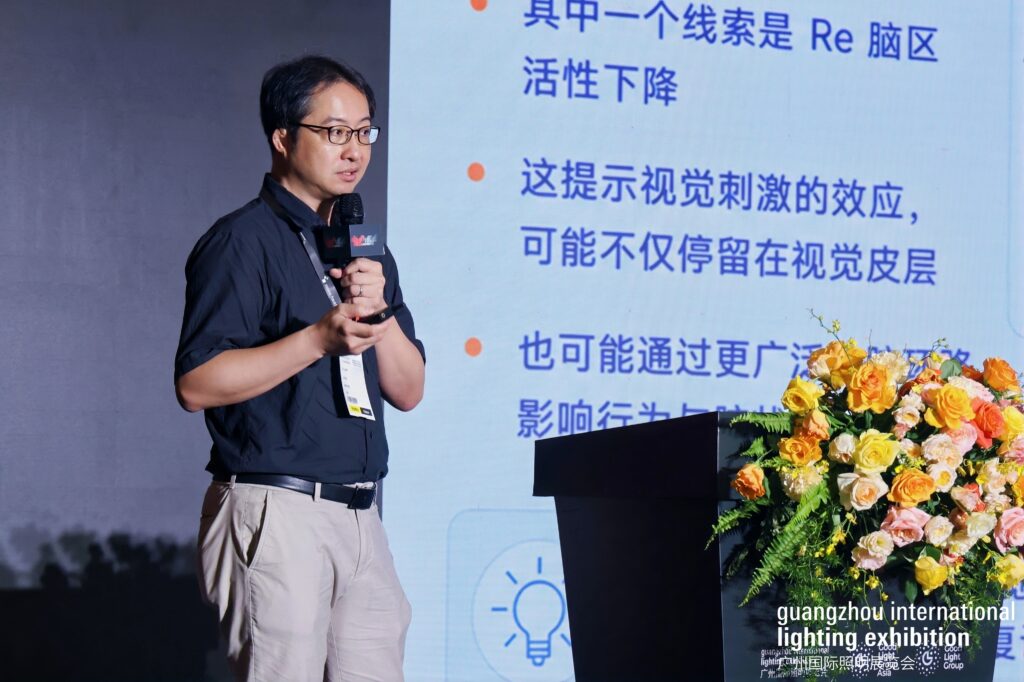
In AD model mice, neural activity changes can be observed across brain regions. One important clue is reduced activity in the midline thalamic Re nucleus. After light stimulation, activity in the Re region showed partial recovery.
This suggests an important possibility: Visual input may influence not only the visual cortex, but also broader brain circuits related to cognition and brain state.
Further research described in the presentation showed that after two weeks of low-intensity 40 Hz blue light stimulation, AD model mice improved in selected cognitive, activity and motivation-related behavioural indicators.
This is highly meaningful for healthy lighting research.
It suggests that: Light may enter the brain through the retina. It may influence brain circuits through visual and non-visual pathways. Under specific parameters, it may affect brain network activity and behaviour. These effects may go beyond visual perception and involve deeper brain-state regulation.
But all of this must be communicated carefully.
This is animal-model evidence. It is not a direct human therapeutic conclusion. It should not be directly converted into product claims. It should not be simplified into consumer promises.
The value of animal research is not that it gives the market an immediate answer.
Its value is that it helps identify mechanisms, generate hypotheses, extract candidate parameters and provide a foundation for more rigorous human studies, scenario validation and industrial translation.
5 | Light effects may persist after exposure: healthy lighting must ask not only “how bright,” but “when” and “for how long.”
Traditional lighting design often asks: How much illuminance? What colour temperature? How much power? Does it meet the standard? Is glare controlled? Is energy efficiency acceptable?
These remain important questions.
But Dr. Lin’s research reminds us that healthy lighting must also ask: How long is the exposure? When does it happen? Does the effect persist after exposure? Do different time windows produce different responses? Does the effect depend on the current brain state?
The handout notes that after light stimulation, neural activity and spontaneous firing in related brain circuits may remain altered for a period of time.
This is important for the lighting industry. It means healthy lighting design cannot focus only on instantaneous parameters. It cannot look only at brightness at one moment. It cannot look only at colour temperature in a single scene. It cannot rely only on one-time measurement. It must also consider exposure duration, timing and after-effects.
例如:
- Is daytime light sufficient to support activity and circadian synchronization?
- Does evening light gradually reduce stimulation?
- Does pre-sleep lighting continue to send daytime signals to the body?
- Can a short exposure to bright light at night create excessive arousal?
- Does a specific rhythmic light stimulation require strict control of duration and frequency?
- Are certain users more sensitive to after-effects of light?
This is where healthy lighting moves from static lighting to temporal lighting. Healthy lighting is not a static parameter table. It is a dynamic system involving light, time, people and scenarios.
6 | An unexpected finding: light may influence brain clearance
One of the most significant and communicative parts of Dr. Lin’s presentation is the discussion of brain clearance.
The handout describes tracer experiments showing impaired fluid exchange and drainage in AD model mice. After light exposure, tracer inflow and outflow efficiency improved. This suggests that light may influence brain homeostasis.
Why does this matter?
In recent years, brain clearance has become an important topic in brain health research. Brain clearance involves cerebrospinal fluid, perivascular spaces, interstitial fluid exchange and meningeal lymphatic drainage. It is closely linked with sleep, brain states and neurodegenerative disease research.
In simple terms, the brain is not only a working machine. It also needs to clear metabolic waste.
Sleep and brain state may be related to this clearance process. If light can influence brain state, sleep, brain network activity or related physiological processes, it may indirectly connect with brain clearance mechanisms.
This expands the healthy lighting conversation beyond: Can we see? Can we sleep? Are we more alert? Do we feel comfortable?
It introduces a new research perspective: Could light be related to brain homeostasis?
But again, this must be interpreted carefully. This is an animal research clue. It is not a human therapeutic conclusion. It is not a product claim.
It should not be simplified into: This light clears the brain.
A responsible interpretation is: Brain clearance provides a new scientific perspective for healthy lighting research. It suggests that healthy light may relate not only to rhythm and sleep, but also to brain homeostasis.
However, moving from animal mechanisms to human application and then to lighting products requires a long, rigorous and reproducible evidence chain.
This is exactly the scientific attitude emphasized by the Good Light Wake-up Call|好光觉醒行动.
The more frontier the topic, the more restraint it requires. The more imaginative the possibility, the stronger the evidence must be. The closer we get to health, the clearer the boundaries must be.
7 | From animal research to healthy lighting parameter optimization: not direct commercialization, but mechanism extraction
The greatest industrial implication of Dr. Lin’s presentation is not that it gives companies an immediately commercializable parameter.
Rather, it shows the industry a scientific translation pathway. Animal research does not directly produce product parameters. Animal research helps identify mechanisms and candidate parameters. Real industrial translation requires a longer process.
This process may include: Animal research. Mechanistic interpretation. Brain-region and pathway analysis. Candidate parameter extraction. Human safety and acceptability studies. Real-world scenario design. Field measurement. Long-term feedback. Definition of product boundaries. Development of standards and validation methods.
This is very different from typical market logic.
The market often wants to ask: Which wavelength is best? Which frequency works? How long should exposure last? Can it become a product? Can we claim cognitive improvement? Can we say it helps with AD?
Science does not move in that way.
Science first asks: What is the mechanism? Who is the target user? What is the dose? What are the risks? How is the outcome measured? Can the result be repeated? Is it suitable for real environments? Is it linked with human outcomes? Does it require a clinical pathway?
If the healthy lighting industry wants to mature, it must move from searching for selling points to building evidence chains.
Animal research is a starting point, not an endpoint. Scientific discovery is a clue, not an advertising sentence. Parameter hypotheses are research objects, not immediate product promises.
8 | What should healthy lighting verify?
Dr. Lin’s handout raises a crucial question: What should healthy lighting verify?
This is also one of the central questions of the Good Light Wake-up Call|好光觉醒行动.
In traditional lighting projects, we verify: Illuminance. Colour rendering. Glare control. Flicker. Installation quality. Energy performance. Compliance with design.
These remain important. But healthy lighting must verify more complex human and scenario outcomes.
These may include: Sleep. Circadian rhythm. Daytime performance. Emotion. Cognition. Pain. Activity state. Brain-health-related readouts. Subjective satisfaction. Long-term user feedback. Real operational performance.
Subjective comfort, ambience and satisfaction matter. But they are not enough.
- If a project claims to support sleep, sleep-related outcomes should be considered.
- If it claims to support circadian rhythms, light exposure and timing should be evaluated.
- If it claims to support cognition, cognitive tasks or brain-state indicators may be relevant.
- If it claims to support healthcare or eldercare, clinical and human-factor boundaries must be defined.
- If it touches brain health, the communication must be especially cautious.
Healthy lighting verification should not rely on one metric.
It should form a loop: Mechanism. Scenario. Parameters. Outcomes. Verification. Boundaries.
Mechanism asks: why might this work?
Scenario asks: where is it used?
Parameters ask: what light, when and for how long?
Outcome asks: what is expected to change?
Verification asks: how can this be shown?
Boundary asks: what cannot be claimed?
Only through this loop can healthy lighting move from concept to deliverable value.
9 | From lighting parameters to health parameters: the industry language must evolve
The lighting industry has long been skilled at lighting parameters: Luminous flux. Power. Efficacy. CCT. Colour rendering. Colour consistency. Distribution. UGR. Lifetime. Dimming protocols. Flicker metrics. Installation methods.
These are the foundation of the industry.
But healthy lighting requires a further step: From lighting parametersto health parameters.
This does not mean abandoning lighting parameters. It means placing them inside health application logic.
例如:
- Illuminance is not only about whether the space is bright enough. It also relates to eye-level exposure.
- CCT is not only about visual warmth or coolness. It also relates to spectrum and melanopic stimulation.
- Dimming is not only about brightness adjustment. It also relates to temporal rhythm across the day.
- Control is not only about convenience. It also relates to behaviour and daily routines.
- Spectrum is not only about being “full.” It depends on scenario, timing and user group.
- Rhythmic stimulation is not only an innovative parameter. It must be linked with neural response and safety.
- Comfort is not only about feeling good. It should support long-term use and validated outcomes.
The future of healthy lighting is not about attaching scientific words to traditional lighting parameters.
It is about building a new parameter system.
This system must connect: Light sources. Luminaires. Controls. Spaces. Users. Time. Physiological responses. Validation outcomes. Long-term operation.
This is the key transition from product to system.
10 | Neuroscience is not a marketing word. It is a higher responsibility.
In recent years, the lighting industry has increasingly used the word “neuroscience.” Brain-science lighting. Brain-health light. Cognitive enhancement. Emotion regulation. Sleep support. Brain clearance. Neural modulation.
These terms sound advanced and highly communicable.
But precisely because they sound powerful, they are also risky.
Most consumers, owners and even many designers may not be able to judge the scientific boundaries of these claims.
Dr. Lin’s presentation reminds us: Neuroscience is not a marketing word.
It is a higher responsibility. If we say light affects the brain, we must be rigorous. If we mention AD, brain clearance, gamma activity, 40 Hz or brain networks, we must not over-extrapolate. If we present animal findings to industry audiences, we must clearly explain the distance between animal models and human applications. If we want to develop products, we must return to parameters, safety, scenarios and validation.
This is not a negative message.
It is what gives healthy lighting a future.
Only by respecting scientific boundaries can healthy lighting avoid becoming a short-term concept. Only by building verification loops can healthy lighting become long-term value. Only by respecting mechanisms and evidence can the industry earn the right to enter healthcare, homes, senior living, education and public buildings.
Responsible healthy lighting does not make neuroscience sound more mysterious. It translates neuroscience more clearly, more carefully and more verifiably.
11 | What this means for the lighting industry: from fast application to scientific translation
The lighting industry is strong in fast application.
When a new concept emerges, products can appear quickly. Full spectrum. Eye-care lights. Circadian lights. Sleep lights. Senior-care lights. Brain-science lights. Smart healthy lighting.
This speed shows industrial strength. But once healthy lighting enters the field of brain science, speed alone is not enough. The industry must move toward scientific translation.
Fast application asks: Can we make it? Can we sell it? Can it create differentiation?
Scientific translation asks: Is the mechanism clear? Are the parameters reasonable? Is the user group defined? Is the scenario appropriate? Can the outcome be measured? Are the risks controlled? Can the effect be verified over time?
The future competition in healthy lighting will not be about who can turn concepts into products the fastest. It will be about who can translate scientific findings into real scenario value most responsibly.
This requires deeper collaboration between lighting companies and universities, hospitals, brain science laboratories, sleep medicine centres, testing bodies, design practices and standards organizations.
Start from scientific questions. Start from scenario needs. Start from validation methods. Then move into product development.
This is how the industry can move beyond low-price competition and concept inflation.
12 | Verifiable application value comes from a closed loop
The English subtitle of Dr. Lin’s presentation includes an important phrase: Verifiable Application Value
This is essential. Healthy lighting should not serve only papers. Nor only laboratories.
It must eventually enter real spaces, real projects and real lives.
But real application must be verifiable. Verifiable application value requires a closed loop.
First: mechanism.
- Why might light affect health? Through visual comfort? Circadian regulation? ipRGC pathways? Brain state? Behavioural pathways? Sleep improvement? Brain clearance mechanisms?
Second: scenario.
- Where is this mechanism relevant? Homes? Hospitals? Schools? Senior living? Offices? Sleep medicine centres? Laboratories? Rehabilitation spaces?
Third: parameters.
- What wavelength? What spectrum? What illuminance? What frequency? What timing? What duration? What direction? What eye-level exposure?
Fourth: outcome.
- What should change? Sleep? Circadian rhythm? Mood? Cognition? Activity? Pain? Safety? Brain state? User experience?
Fifth: verification.
- How can it be shown? Subjective questionnaires? Sleep data? EEG? HRV? Behavioural tests? Light exposure measurements? Long-term tracking? Controlled experiments?
Sixth: delivery.
- How does this become luminaires, control systems, design methods, operation strategies and project acceptance criteria?
Without this loop, healthy lighting remains a concept. With this loop, healthy lighting may become industrial value.
13 | Why Good Light Wake-up Call needs a neuroscience perspective
The goal of the Good Light Wake-up Call|好光觉醒行动 is not to create another marketing phrase.
Its goal is to help healthy lighting move from concept to action. From concept to action, we need a scientific foundation.
A neuroscience perspective helps answer several key questions: Why is light more than illumination? How does light enter the nervous system? What kind of light may influence brain state? Which findings are still animal evidence? Which findings can become scenario hypotheses? Which findings should not become product claims? What human responses should healthy lighting verify? How can the industry avoid turning frontier research into consumer mythology?
This is the significance of Dr. Wei-Jye Lin’s presentation. It does not turn neuroscience into packaging.
It shows the industry that: Light enters the brain through real pathways. Light-related health effects require real mechanisms. Application requires real parameters. Industrial value requires real verification.
This makes the Good Light Wake-up Call|好光觉醒行动 more complete.
Robert Lucas gives us a measurement language.
Marijke Gordijn gives us the rhythm perspective.
Jan Denneman gives us the industry call.
Yandan Lin gives us the healthy home closed loop.
赵弘轶主任 gives us the healthcare scenario.
郑红成 gives us EEG verification.
林伟杰 explains from the neural science foundation why light may truly enter the conversation about brain health.
Closing: the future of healthy lighting is not better claiming, but better proving
Dr. Wei-Jye Lin’s presentation brings an important neuroscience perspective to deLIGHTed talks Asia @ GILE 2026.
It tells us: Light not only enables vision. It may also affect rhythms, alertness, emotion, cognition and brain states.
The retina is not a passive film. It is a neural gateway.
ipRGC is not merely a technical term. It is an important pathway for non-image-forming effects of light on the brain.
Low-intensity 40 Hz blue light is not a consumer slogan. It is a scientific entry point in animal research.
Brain clearance is not a marketing phrase. It is a new perspective for understanding brain homeostasis.
Animal research is not a product efficacy statement. It is a path for mechanism identification and parameter exploration.
The healthy lighting industry should not simply attach scientific words to luminaires. It must build a loop connecting mechanisms, scenarios, parameters, outcomes and verification.
That is the real upgrade.
The future of healthy lighting should not be about who makes the strongest claims. It should be about who better understands mechanisms. Who defines boundaries more clearly. Who designs parameters more responsibly. Who understands scenarios more deeply. Who verifies outcomes more rigorously. And who can translate science into real spaces with care and evidence.
From visual circuits to brain states.
From brain clearance mechanisms to parameter optimization.
From animal research to real-world scenarios.
From scientific discovery to verifiable application value.
This is the message 林伟杰博士 brought to the Good Light Wake-up Call.
The future of healthy lighting is not better claiming. It is better proving.
Good Light Wake-up Call. 好光觉醒。

 English
  Chinese (China)
  Chinese (Taiwan)