
deLIGHTed talks Asia @ GILE 2026
好光觉醒系列报导之八
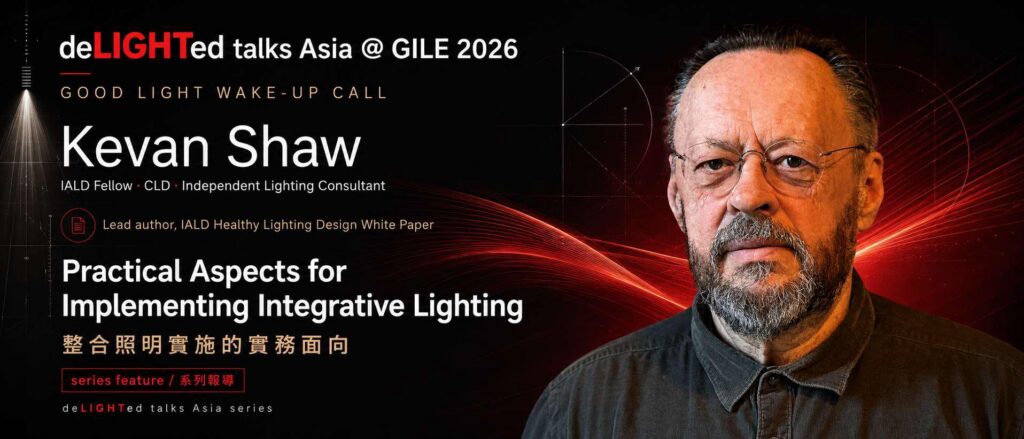
Kevan Shaw: Practical Aspects for Implementing Integrative Lighting
前几篇报导中,我们已经从不同角度看见了健康光的版图。
Robert Lucas 教授告诉我们,传统 lux 不足以描述光如何影响人的昼夜节律,我们需要 melanopic EDI、DER 等新的测量语言。
Marijke Gordijn 博士提醒我们,好光,是在正确时间给身体正确的光。
Jan Denneman 呼吁照明产业从 illumination 走向 human outcomes。
Kei Haraguchi 从 LED 光源端提出,白光 LED 30 年后不能只追求光效,而要创造人的节律价值。
Anne Berends 把健康光讨论推进到近红外光、剂量和科学边界。
Jeff Miller 则提醒我们,设计师是把科学翻译成人的体验的关键角色。
但所有这些讨论,最后都会落到一个更现实的问题: 健康光,到底如何真正落地?
不是在论坛上说得漂亮。 不是在产品目录里写得完整。 不是在 PPT 上画出一条漂亮的日夜曲线。
而是在真实项目里,真正做到: 可设计。 可计算。 可安装。 可调试。 可测量。 可验证。 可运营。
这正是 Kevan Shaw 所关注的核心: Practical Aspects for Implementing Integrative Lighting 实施整合照明的实践问题
Kevan Shaw 是国际知名照明设计师,也是 IALD 健康照明设计白皮书的主笔者之一。这一身份非常重要。 因为他所谈的,不是从产品端出发的健康光销售语言,也不是纯粹从实验室出发的科学语言。
他代表的是国际照明设计师社群最关心的问题: 当科学已经告诉我们光会影响节律、睡眠、警觉、情绪与健康,设计师到底要如何把这些知识转化为真实项目中的可交付结果?
换句话说,Kevan 的演讲不是在问:
健康光是否重要?
而是在问: 如果健康光真的重要,我们如何把它做出来?

1 | The hardest part of healthy lighting is not the science. It is implementation.
The scientific foundation of healthy lighting is much clearer today than it was ten years ago.
We know that light affects more than vision. We know that melanopsin and ipRGCs play an important role in circadian signaling. We know that daytime light matters. We know that evening and nighttime exposure should be carefully controlled. We know that spectrum, timing, eye-level exposure and human behaviour all affect outcomes.
But between science and the built environment, there is a long and fragile chain.
Many healthy lighting projects do not fail because the concept is wrong. They fail because the delivery chain breaks. A product may claim to support circadian lighting. The designer may not have the data needed to calculate eye-level exposure. The software may still output only photopic lux. The control system may offer only a few cool-to-warm scenes. The contractor may install the luminaires as if it were a conventional lighting project. The commissioning team may not verify melanopic exposure. The operator may not know when or how the scenes should run. The owner may end up with a system that sounds advanced but delivers unclear value.
This is where Kevan Shaw’s practical perspective becomes essential.
Healthy lighting is not a single product. Healthy lighting is a system.
It requires the connection of light source data, luminaire data, design calculation, spatial modelling, human exposure modelling, control strategy, site measurement and long-term operation.
If any one of these links is missing, the final result may become a claim rather than a delivered environment.
2 | From photopic lux to melanopic exposure: what are we actually designing?
Conventional lighting design has long been built around photopic lux. Horizontal illuminance. Task-plane illuminance. Uniformity. Glare. Colour rendering. Colour temperature. Efficacy. Distribution.
These still matter.
Healthy lighting does not replace good visual lighting. On the contrary, any healthy lighting environment must first be good lighting for vision, comfort and space.
But if we want to talk about circadian rhythms, non-visual effects and integrative lighting, photopic lux is not enough. Photopic lux primarily describes the response of the visual system under photopic conditions. It does not fully describe biological responses related to circadian regulation.
This is why melanopic metrics have become so important.
But Kevan’s question is practical: If science tells us that melanopic exposure matters, are our design tools, product data and project workflows ready?
In many cases, the answer is still no.
Most lighting calculation software still primarily outputs photopic illuminance. Many design workflows do not handle full spectral data. Surface reflectance data are often simplified and photopic. Luminaire files are usually built around traditional IES, LDT or ELUMDAT formats. Spectral information and melanopic-relevant data are often missing or difficult to integrate.
This creates a gap.
The industry talks about healthy lighting, but the tools often remain rooted in conventional lighting practice.
- If the software cannot calculate it, designers struggle to design it.
- If designers cannot design it, projects struggle to specify it.
- If projects cannot specify it, sites cannot verify it.
- If sites cannot verify it, healthy lighting cannot scale.
3 | The key is not what the luminaire can do. It is what the human eye actually receives.
One common misunderstanding in healthy lighting is to confuse product potential with human exposure.
- A light source may have an excellent spectrum.
- A luminaire may have a strong melanopic ratio.
- A system may be capable of high m-EDI output.
- A scene may be labelled “daytime circadian mode.”
But none of these is the final result.
The real question is: How much biologically relevant light does the human eye receive in the actual space, at the actual position, at the actual time?
This is one of Kevan Shaw’s most important implementation points.
Source potential is not the same as application exposure. A high-melanopic light source, if placed incorrectly, may not reach the eye.
A bright luminaire that mainly illuminates the desk may not provide sufficient vertical eye-level exposure. A space that feels visually bright may still deliver limited circadian stimulation if the light comes from the wrong direction or at the wrong time.
A “daytime” mode may be ineffective if it is too short or too weak.
Therefore, healthy lighting cannot ask only:
What does the luminaire output?
还要问:
- Where does the light go?
- Where is the person?
- Where is the person looking?
- Does the light enter the eye?
- 进入多少?
- 持续多久?
- 它在不同色温与调光状态下表现如何?
- For which user group?
- In which task or activity?
This is why healthy lighting design must move beyond horizontal task-plane illuminance and toward vertical illuminance, cylindrical illuminance and eye-level exposure.

4 | Eye level, vertical planes and cylindrical illuminance are becoming new design basics
Traditional office lighting has long focused on the desk.
- Is the workplane bright enough?
- Does it reach 300 or 500 lux?
- Is the uniformity acceptable?
- 眩光是否控制?
这些问题当然重要。
But circadian lighting and integrative lighting introduce a new focus: The eye.
If light is to influence the circadian system, it must enter the eye.
Horizontal workplane illuminance cannot directly represent non-visual light exposure.
This leads to several important design considerations:
- Vertical illuminance.
- Eye-level illuminance.
- Cylindrical illuminance.
- Viewing direction.
- Seated and standing eye height.
- Direction of gaze.
- Luminaire position in the visual field.
- Indirect light contribution.
- Spatial reflectance.
Where seating positions, beds or workstations are known, designers can define vertical measurement planes at eye level.
例如:
- Office desks.
- Classroom seats.
- Hospital beds.
- Nursing stations.
- Hotel room desks.
- Senior living activity areas.
In spaces where people move freely or face multiple directions, cylindrical illuminance may offer a broader way to consider exposure from multiple directions.
This requires a shift in design habits.
Designers cannot rely only on plan-view workplane illuminance. They cannot simply arrange luminaires on the ceiling and assume the job is done. They cannot judge healthy lighting only by power, CCT or luminaire spacing.
还包括:
- 人在哪里?
- What is the eye height?
- What are the main viewing directions?
- How does light reach the eye?
- 白天是否足够?
- Can evening exposure be reduced?
- Do different users experience different conditions?
This is where integrative lighting begins to enter real design practice.
5 | Without HCL-ready data, healthy lighting cannot scale
Healthy lighting requires better product data.
Traditional luminaire data usually include:
- 光通量。
- 功率。
- Efficacy.
- CCT.
- CRI.
- Distribution files.
- 寿命。
- 尺寸。
- Installation details.
- 调光协议。
These are necessary.
But for healthy lighting, they are not enough.
- If designers need to calculate melanopic exposure, they need to know spectral output under different settings.
- If control systems must deliver time-based scenes, they need to know how spectrum changes with dimming and tuning.
- If software must calculate m-EDI or DER, it needs spectral data or at least melanopic-relevant data.
- If projects must be verified, product data must connect to field measurement.
This is the meaning of HCL-ready data.
It is not a label that says “this product is healthy.” It means the product is ready to participate in a healthy lighting design and verification workflow.
A genuinely HCL-ready luminaire or system may need to provide:
- Spectral power distribution.
- Spectral data under different CCT and dimming states.
- Melanopic ratio.
- m-EDI or DER support information.
- Relationship between photopic and melanopic output.
- 频闪与 temporal light modulation 信息。
- Dimming curves.
- Control scene parameters.
- Data structures that can connect to IES, ELUMDAT, DIALux, RELUX, BIM and BMS workflows.
This is not a burden. It is infrastructure.
- Without data, designers cannot calculate.
- Without calculation, projects cannot specify.
- Without specification, sites cannot verify.
- Without verification, owners cannot trust.
- Without trust, healthy lighting cannot become a real market.
6 | Lighting design software must also evolve
Healthy lighting cannot scale if every project depends on expert manual conversion.
If melanopic exposure must always be calculated by a small number of specialists outside regular design tools, healthy lighting will remain limited to special projects.
- Designers need tools.
- Consultants need tools.
- Manufacturers need tools.
- Owners need understandable outputs.
But most lighting design software is still built primarily around photopic logic.
- It can calculate lux.
- It can calculate UGR.
- It can generate illuminance maps.
- It can import IES files.
- It can simulate light distribution.
- It can output visual lighting performance.
But without spectral data, melanopic calculations, eye-level models and time-based scenes, healthy lighting remains outside the normal workflow.
This is one of the key bottlenecks Kevan identifies.
Science has moved forward. Products are beginning to move forward. But design tools have not fully caught up.
Future healthy lighting software will need to support:
- Spectral or melanopic data import.
- Calculation under different dimming and tuning states.
- Eye-level vertical m-EDI outputs.
- Cylindrical exposure modelling.
- Time-based scene simulation.
- User position and activity modelling.
- Control system linkage.
- Measurement points and target values for site verification.
When these capabilities enter mainstream design software, healthy lighting can move from expert projects to ordinary projects. Without this, it will remain difficult to deliver at scale.
7 | Controls are not decorative features. They are the time engine of healthy lighting.
One of the greatest differences between healthy lighting and conventional lighting is time.
Traditional lighting often asks:
- 够不够亮?
- Does it look good?
- 是否节能?
Healthy lighting must also ask:
- When should it be bright?
- When should it be dim?
- When should melanopic stimulation increase?
- When should it decrease?
- How gradual should transitions be?
- How long should scenes last?
- Are they aligned with human routines?
- Are users overriding the system?
- Is it operating as intended over time?
This makes control systems essential. But in many projects, controls remain little more than scene buttons:
- Meeting mode.
- Presentation mode.
- Cleaning mode.
- Relax mode.
- 「日间模式」
- Night mode.
If these scenes are not based on circadian logic, eye-level exposure, time scheduling and user behaviour, they are not truly healthy lighting controls.
Healthy lighting controls must do something deeper. They must connect spectrum, intensity, timing, space and human activity. For example:
- Provide stronger eye-level stimulation in the morning.
- Maintain sufficient daytime support during work hours.
- Reduce melanopic exposure in the evening.
- Provide low-stimulation navigation light at night.
- Respond to daylight availability.
- Respond to occupancy and activity.
- Record operation.
- Support commissioning and later optimization.
In this sense, controls are not a nice extra. They are the time engine of healthy lighting.
- Without controls, healthy lighting is only static design.
- Without operation, healthy lighting cannot persist.
- Without feedback, healthy lighting cannot improve.
8 | Field measurement is the last mile from design intent to real performance
Even the best design is only a prediction until it is measured. This is especially true for healthy lighting.
Real spaces introduce many variables:
- Luminaire aiming.
- Dimming settings.
- 控制逻辑。
- Wall and furniture reflectance.
- Curtain position.
- Daylight variation.
- User location.
- User behaviour.
- Maintenance changes.
- Installation deviations.
- Design calculations predict.
- Field measurement confirms.
This is why the Good Light Wake-up Call repeatedly emphasizes: No verification, no responsible healthy lighting claims.
Field measurement cannot stop at desk lux. It should include:
- Eye-level vertical illuminance.
- m-EDI or EML.
- 光谱。
- CCT and Duv.
- Colour quality.
- 频闪。
- Scene performance.
- Daytime, evening and nighttime conditions.
- Control system operation.
Verification does not make projects unnecessarily complex. It makes the industry more credible.
- If a project claims to support circadian lighting but does not measure eye-level exposure, the claim is weak.
- If a space claims healthy lighting but does not verify performance after installation, trust is limited.
- If a system claims to improve experience but has no data loop, it is difficult to replicate.
Verification is not a burden. It is the bridge between story and value.
9 | Reflectance is not only about colour. It is also about spectrum.
In traditional lighting design, surface reflectance is often simplified into percentages. Ceiling reflectance. Wall reflectance. Floor reflectance. Furniture reflectance.
For photopic calculations, this may often be sufficient.
But in healthy lighting, reflectance becomes more complex. Different materials reflect different wavelengths differently.
A surface that appears visually bright may not reflect melanopic-relevant wavelengths in the same way. A warm-coloured surface may absorb more short-wavelength energy. A dark surface may significantly reduce indirect circadian contribution.
If a space relies heavily on reflected light, spectral reflectance can affect melanopic eye-level exposure.
This is why spatial modelling matters.
Healthy lighting is not only about luminaires. It is not only about the light source spectrum. It is also about how the space modifies light. Walls. Ceilings. Floors. Furniture. Curtains. Glass. Shading. Material colour. Surface reflectance.
All of these influence the light that finally reaches the human eye.
Future healthy lighting practice will need a more refined understanding of interior materials. Not only as aesthetic materials. But as spectral materials.
This will require new collaboration between lighting designers, interior designers, architects, material suppliers and software developers.
10 | Different spaces need different implementation strategies
Integrative lighting cannot be applied with one universal template.
Offices, schools, hospitals, senior-care environments, hotels, homes and public buildings all have different goals.
- Offices may focus on daytime alertness, focus, comfort, fatigue management and long-term work experience.
- Schools may focus on learning, visual comfort, children’s rhythms and eye health.
- Hospitals may focus on patient recovery, staff performance, nighttime safety, circadian support and emotional stress.
- Senior-care facilities may focus on daytime activity, nighttime safety, dementia care and sleep quality.
- Hotels may focus on guest experience, sleep, jet lag and brand value.
- Homes may focus on family routines, evening reduction and sleep preparation.
- Public buildings may focus on flow, safety, visual guidance and public health identity.
Therefore, healthy lighting cannot be reduced to a universal “cool in the morning, warm at night” program.
It must begin with a project-specific goal.
- Who is the space for?
- What are the most important times of day?
- What health or experience outcome matters most?
- Is the goal alertness, recovery, sleep preparation, safety or emotional comfort?
- How should direction and dose change?
- Is user-specific control required?
- Should daylight be integrated?
- Should operation data be collected?
This is the shift from selling luminaires to delivering scenario outcomes.
Products are the foundation. Design is the translation. Controls are the time engine. Measurement is the trust mechanism. Operation is the long-term value.
11 | The international lighting industry needs an implementation chain
The global lighting industry does not lack products. It has light sources. Luminaires. Controls. Sensors. Full-spectrum concepts. Smart lighting systems. Healthy lighting narratives.
What remains underdeveloped is the implementation chain that connects all of these capabilities into verified project outcomes.
Healthy lighting competition may increasingly move through three levels:
First, product competition.
Better spectrum, better colour quality, better dimming, lower cost.
Second, solution competition.
Complete scenario strategies for offices, schools, healthcare, senior living, hospitality and homes.
Third, verification and operation competition.
Evidence that the project actually achieves eye-level exposure goals, operates over time and delivers owner value.
Many companies are strongest at the first level. But the real moat may emerge at the second and third levels.
Healthy lighting is not a short-term product sale. It is long-term trust.
Companies that provide HCL-ready data, support design software, offer control strategies, assist measurement, align with healthy building goals and help owners understand operational value will move beyond selling luminaires. They will become providers of healthy lighting system capability.
This is one of Kevan Shaw’s strongest messages: Do not compete only at the product level. Connect products, design, data, controls, verification and operation.
The companies and design teams that build this chain first will help define the future of Good Light.
12 | From concept awakening to engineering awakening
The first step of the Good Light Wake-up Call|好光觉醒行动 is awareness.
The industry must understand: Light is not only illumination. Light affects rhythm, sleep, mood, cognition, recovery and health. Healthy lighting cannot be based only on claims. It requires science, standards, design, data and verification.
But Kevan Shaw’s practical perspective reminds us that the next step must be an engineering awakening.
Without engineering and delivery capability, healthy lighting remains a slogan.
Engineering awakening means:
- Scientific metrics must enter design tools.
- Spectral data must enter luminaire files.
- Control strategies must enter project delivery.
- Eye-level exposure must enter measurement procedures.
- Scenario goals must enter design briefs.
- Verification results must enter owner decisions.
- Operation data must enter long-term maintenance.
This is harder than promoting a concept.
But it is also more important.
Only what can be engineered can become commercially viable. Only what can be delivered can earn owner investment. Only what can be verified can earn trust. Only what can be operated can truly serve people.

Closing: healthy lighting is not spoken into existence. It is delivered.
Kevan Shaw’s practical perspective adds one essential layer to the Good Light Wake-up Call|好光觉醒行动: Healthy lighting is not spoken into existence.
It is delivered. It is not a product label. Not a scene name. Not a colour temperature curve. Not a slogan of human-centricity. Not a set of beautiful visuals.
It must become: Usable data. Calculable models. Executable design. Commissionable systems. Measurable results. Maintainable operation. Owner value.
- From science to space.
- From metrics to eye-level exposure.
- 从产品到系统。
- From design to verification.
- From installation to long-term operation.
This is the real challenge of integrative lighting. It is also the pathway for healthy lighting to become an industry.
Good Light Wake-up Call|好光觉醒行动 is not only asking the industry to believe in healthy lighting. It asks us to deliver it. To calculate it. Measure it. Verify it. Operate it. And make it real in spaces where people live, work, heal, learn and rest.
- Good Light must be designed.
- Good Light must be measured.
- Good Light must be verified.
- Good Light must be operated.
Only then will Good Light become more than an ideal. It will become value that people can experience in real environments.
Good Light Wake-up Call. 好光觉醒。

 English
  Chinese (China)
  Chinese (Taiwan)