
deLIGHTed talks Asia @ GILE 2026
Good Light Wake-up Call Series Report 18
Zoe Xia (IWBI): From Storytelling to Value Evaluation — Defining and Measuring Healthy Lighting

Throughout the Good Light Wake-up Call|好光觉醒行动 series, we have gradually built a comprehensive picture of healthy lighting—from science, circadian rhythms, residential environments, healthcare, neuroscience, EEG validation, design practice, to product innovation.
Professor Robert Lucas explained why traditional lux is no longer sufficient to describe how light tells the human body what time it is.
Dr. Marijke Gordijn reminded us that good light is about delivering the right light to the body at the right time.
Jan Denneman challenged the lighting industry to shift its focus from illumination to human outcomes.
Kei Haraguchi / 原口圭 demonstrated how, thirty years after the introduction of white LEDs, the industry’s next challenge is no longer simply improving luminous efficacy, but creating circadian value for people.
Dr. Anne Berends expanded the discussion to near-infrared light, dosage, and the scientific boundaries of healthy lighting.
赵弘轶主任 highlighted that lighting in healthcare environments must evolve beyond regulatory compliance toward clinically informed environmental design.
林燕丹教授 brought the conversation back to residential spaces, emphasizing that the next generation of home lighting is not about smarter luminaires, but healthier homes.
林伟杰博士 explained how light influences the brain through visual pathways and the brain’s waste-clearance mechanisms.
郑红成 reminded us through EEG research that without validation, there can be no truly evidence-based healthy lighting.
Finally, Zoe Xia of IWBI addressed another highly practical—and perhaps one of the most important—questions:
How can healthy lighting evolve from an inspiring wellness narrative into something that owners, designers, consultants, manufacturers, and facility operators can define, adopt, verify, and ultimately deliver as measurable value?
Her presentation, “From Storytelling to Value Evaluation: Defining and Measuring Healthy Lighting,” captures the essence of this challenge.
This message is especially significant because if healthy lighting remains only a compelling story, it risks becoming little more than a wellness narrative—appealing to hear, promising in presentations, effective for branding, and useful as a marketing message.
But building owners ask different questions.
Why is this worth investing in?
How should the objectives be defined?
How can healthy lighting be incorporated into a design brief, procurement specifications, commissioning, and post-occupancy verification?
How can we demonstrate that it delivers measurable outcomes rather than simply being another trend?
How does it contribute to building asset value, occupant experience, tenant satisfaction, ESG performance, and long-term operational excellence?
If these questions cannot be answered, healthy lighting will struggle to become a mainstream investment in real-world projects.
Zoe‘s presentation therefore brings the Good Light Wake-up Call|好光觉醒行动 series to a pivotal point for the industry: Healthy lighting cannot rely on storytelling alone.
It must become something that can be defined, measured, verified, operated, and understood as real value by building owners and the entire project ecosystem.
1 | Why Healthy Lighting Must Evolve from Storytelling to Value Evaluation
Over the past several years, concepts such as healthy buildings, healthy lighting, human-centric lighting, circadian lighting, full-spectrum lighting, eye-friendly lighting, sleep-friendly lighting, and mood lighting have rapidly gained attention.
This reflects an important shift in the industry: light is no longer viewed simply as a means of illuminating space. It is increasingly recognized as a factor that influences sleep, circadian rhythms, wellbeing, cognitive performance, and the overall human experience.
This is undoubtedly a positive development.
However, as more concepts emerge, so does a new challenge: they can easily become narratives rather than measurable solutions.
The strength of storytelling is that it is compelling. It captures attention, differentiates brands, and communicates an inspiring vision. But storytelling also has its limitations. It often lacks clear boundaries, measurable performance metrics, objective validation, and a shared framework that helps building owners distinguish genuine value from marketing claims.
This is precisely where Zoe Xia‘s presentation makes a critical contribution.
Her message is about moving healthy lighting beyond storytelling and toward value evaluation.
In other words, the conversation is no longer simply about promoting the vision of healthy lighting—it is about clearly defining the problems healthy lighting is intended to solve.
It is no longer enough to claim that lighting improves wellbeing. We must identify which performance indicators, design strategies, and application scenarios can be intentionally designed, measured, and verified.
Likewise, describing a space as “comfortable” is no longer sufficient. Through recognized standards, performance verification, and documented project deliverables, the value of healthy lighting must become something that owners, consultants, designers, and facility operators can all understand, evaluate, and trust.
This represents one of the industry’s most significant milestones.
We are moving from “We believe good light is important” to “We can demonstrate how good light creates measurable value throughout the lifecycle of a project.”
2 | What Is IWBI, and Why Is It Important to the Healthy Lighting Industry?
To fully understand Zoe Xia‘s presentation, we must first understand the role of IWBI.
The International WELL Building Institute (IWBI) is the organization behind the WELL 建筑标准, one of the world’s leading frameworks for advancing health and wellbeing in the built environment.
Its role extends far beyond providing another building certification.
More importantly, IWBI seeks to answer an increasingly important question: How do buildings and indoor environments influence people’s health, wellbeing, performance, and long-term quality of life?
For decades, building evaluation has focused primarily on factors such as safety, energy efficiency, fire protection, structural integrity, materials, environmental impact, and operational performance.
These remain essential.
But the WELL framework introduces another equally important dimension: How well does a building serve the people inside it?
It asks how the built environment can support healthy sleep, emotional wellbeing, physical comfort, movement, social interaction, concentration, and overall quality of life—and how organizations can use environmental design to improve long-term human outcomes.
This perspective is especially important for healthy lighting.
If healthy lighting remains only a concept within the lighting industry, it risks becoming isolated.
Lighting manufacturers discuss spectrum and photometric performance. Designers focus on atmosphere and visual experience. Building owners consider investment and cost. Consultants think about certification and compliance. Facility managers prioritize operations and maintenance. Occupants simply ask whether a space feels comfortable and supports their daily activities.
Everyone is talking about light—but they are often speaking different professional languages.
The value of IWBI and the WELL 建筑标准 lies in providing a common framework that bridges these disciplines.
Healthy lighting is no longer viewed merely as the performance of a luminaire. Instead, it becomes an integral part of healthy buildings, occupant experience, human wellbeing, asset value, and long-term building operations.
This is precisely why IWBI‘s participation in the Good Light Wake-up Call|好光觉醒行动 initiative is so significant.
It helps translate the concept of good light from the technical language of the lighting industry into the language of architects, developers, building owners, and the broader built environment—making healthy lighting not only scientifically credible, but also strategically relevant and economically meaningful.
3 | The Significance of WELL: Transforming Health from an Ideal into a Building and Organizational Strategy
The WELL 建筑标准 is not a product certification or a specification for individual technologies. Rather, it is a comprehensive framework that integrates health and wellbeing into the design, operation, and management of buildings, organizations, and communities.
Drawing on scientific research, industry best practices, and performance-based requirements, WELL translates complex health concepts into practical strategies that can be adopted in building projects, interior environments, and organizational policies.
At its core, WELL is not simply concerned with whether a building is energy efficient or aesthetically pleasing.
Instead, it asks a broader and more important question: How does the built environment influence people, and how can organizations create spaces that actively support health, wellbeing, and human performance?
The framework encourages environmental strategies that are not only well designed, but also implementable, measurable, verifiable, and manageable throughout the lifecycle of a building.
This perspective is especially significant for healthy lighting.
When healthy lighting is discussed only within the lighting industry, the conversation can easily become a competition of technical specifications: Whose spectrum is more complete? Whose color rendering is higher? Whose flicker is lower? Whose control system is smarter? Whose lighting scenes are more sophisticated? Whose marketing sounds more convincing?
While these technical characteristics are important, they do not, by themselves, define the value of healthy lighting.
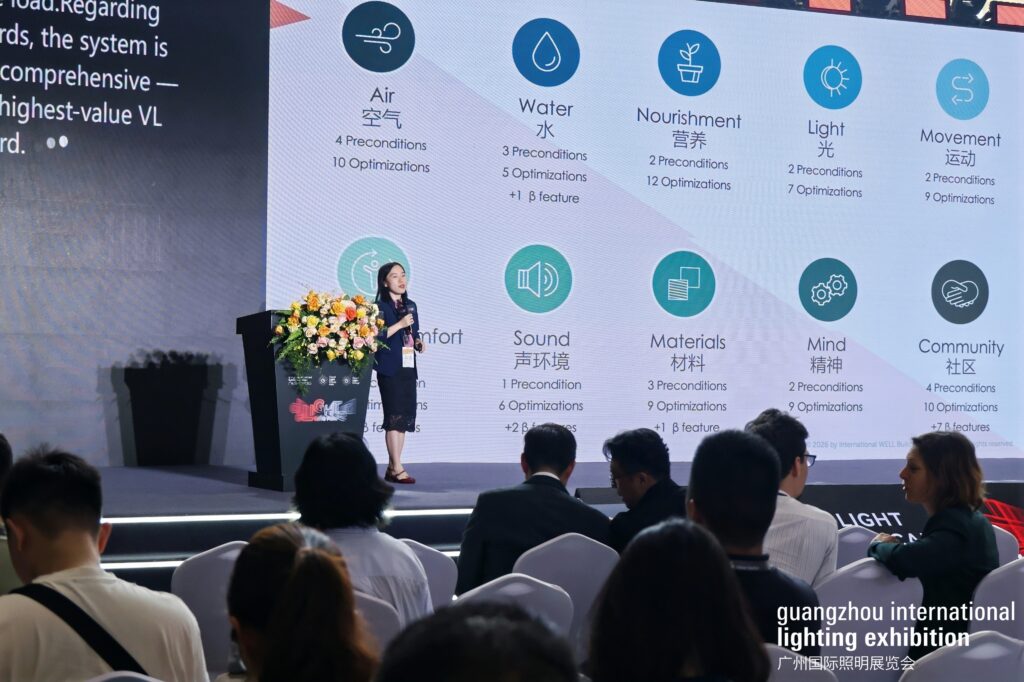
The WELL framework places lighting within a much broader ecosystem of human health.
Lighting is considered alongside air quality, water, thermal comfort, acoustics, materials, mental wellbeing, physical activity, nutrition, and community—together forming a holistic approach to healthy buildings and healthy living.
As a result, healthy lighting can no longer remain an isolated discipline discussed only among lighting professionals.
It must become part of a common language shared by architects, developers, building owners, ESG leaders, human resources teams, asset managers, facility operators, and the people who ultimately occupy the space.
This is perhaps the first and most important lesson that WELL offers the healthy lighting industry: Healthy lighting should not be understood merely as a lighting specification—it should be recognized as a contributor to building value, organizational performance, and human wellbeing.
4 | WELL Light: Healthy Lighting Is Not a Single Metric—It Is a Project Language
Within the WELL Building Standard, Light is one of the most important concepts. It is not simply about the lighting fixtures themselves; rather, it focuses on how people experience an appropriate light environment within the built environment.
The WELL Light concept encompasses multiple dimensions, including light exposure, visual lighting design, circadian lighting design, glare control for electric lighting, daylight design strategies, daylight simulation, visual balance, electric lighting quality, and occupant control of the lighting environment.
This highlights a fundamental principle: healthy lighting cannot be defined by a single metric. It is not just about melanopic EDI. It is not only about correlated color temperature (CCT), full-spectrum lighting, low flicker, glare control, daylight, or intelligent lighting controls.
Instead, healthy lighting is the result of an integrated design approach that considers multiple aspects of the light environment. It requires adequate light exposure, support for visual tasks, circadian considerations, effective glare management, thoughtful use of daylight, daylight simulation and evaluation, balanced visual conditions, high-quality electric lighting, and appropriate user control over the lighting environment.
This is one of the most important messages that WELL brings to the lighting industry:
Healthy lighting is not a single product feature—it is a project language.
Once healthy lighting becomes part of the project language, it can be incorporated into design briefs, construction documents, product specifications, commissioning processes, acceptance criteria, performance verification, and long-term building operations.
This is the true pathway from storytelling to value evaluation.
5 | Performance Verification: The Defining Difference Between Healthy Lighting and Health Storytelling
One of the most important terms in Zoe Xia‘s presentation is Performance Verification.
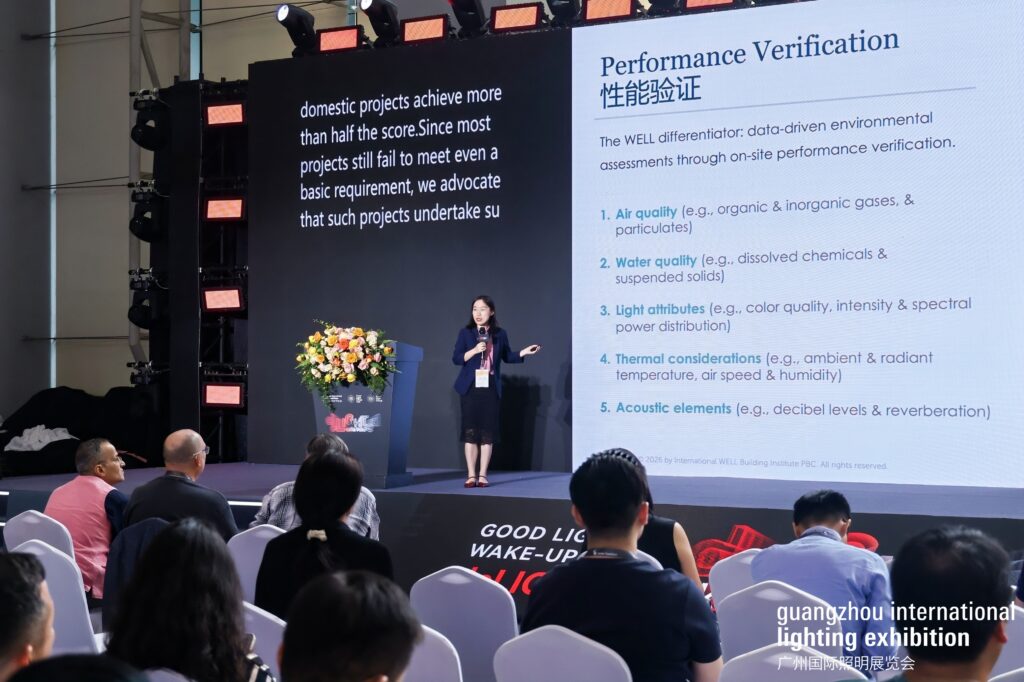
It is also one of the key distinctions between the WELL 建筑标准 and many other health-related concepts. Too often, discussions of healthy buildings or healthy lighting stop at design documents, product brochures, project presentations, or subjective user experiences.
WELL takes a different approach by emphasizing on-site performance verification. Air quality must be measured. Water quality must be tested. Lighting conditions must be verified. Thermal comfort must be assessed. Acoustic performance must also be evaluated.
For healthy lighting, this principle is especially significant.
Healthy lighting should not exist only in PowerPoint presentations, architectural renderings, manufacturers’ catalogs, or marketing narratives. It must be demonstrated in the real built environment.
Has the original design intent been achieved? Does vertical eye-level light exposure meet the specified targets? Does the installed spectral performance match the design calculations? Has glare been effectively controlled? Does the lighting system comply with flicker requirements? Are the lighting scenes operating as intended? Are occupants experiencing the outcomes the design was meant to deliver?
Performance verification transforms healthy lighting from a promise into an observable and measurable outcome.
This reflects a principle that Good Light Wake-up Call|好光觉醒行动 has consistently emphasized:
Without measurement, there is no credibility.
Without verification, there is no basis for making health claims.
Without proven performance in the built environment, healthy lighting cannot deliver genuine value to building owners or project stakeholders.
6 | The Objectives of WELL Light: Enhancing Alertness, Enriching Experience, and Supporting Sleep
In Zoe Xia‘s presentation, the value of the WELL Light concept can be understood through three primary objectives.
1. Alertness
The first is alertness.
This is closely related to daytime light exposure, cognitive performance, workplace productivity, and circadian entrainment. A space that remains too dim throughout the day may provide sufficient illumination for visual tasks, yet still fail to deliver a strong enough daytime signal to the body’s biological clock.
2. Experience
The second is experience.
Light is more than a physiological stimulus. It shapes our perception of space, visual comfort, emotional wellbeing, material appearance, color rendering, and the relationship between people and their environment.
Healthy lighting should never come at the expense of good design. On the contrary, healthy lighting must also be beautiful, comfortable, and thoughtfully integrated into the architectural experience.
3. Sleep
The third is sleep.
The value of healthy lighting cannot be evaluated only by its daytime performance. It must also consider whether the pattern of light exposure throughout the day helps reinforce a healthy circadian rhythm, enabling the body to transition naturally into restorative sleep at night.
These three objectives provide a clear and practical way to communicate the value of healthy lighting to building owners:
- Greater alertness during the day.
- A richer and more comfortable spatial experience.
- Better support for restful sleep at night.
This is far more meaningful than simply claiming that “this is a healthy light.” It translates the benefits of healthy lighting into outcomes that owners, developers, and project stakeholders can readily understand and value.
7 | From Project Certification to the Product Ecosystem: Why Works with WELL Matters
In Zoe Xia‘s presentation, the discussion extends beyond the value of WELL at the project level to an equally important question: How can healthy lighting products become part of the WELL ecosystem?
This is where Works with WELL plays a significant role.
Works with WELL is an authorization and licensing program developed by the International WELL Building Institute (IWBI) for products and services. Its purpose is not simply to provide another product label, but to help connect product capabilities with the language and objectives of the WELL 建筑标准.
For the lighting industry, its value goes far beyond adding another badge to a product.
More importantly, it creates a bridge between technical product performance and project-level health strategies.
Today, many lighting manufacturers emphasize features such as: High color rendering, Low flicker, Eye-friendly lighting, Lighting that more closely resembles natural daylight, Circadian lighting support, Intelligent lighting controls.
These are all valuable product attributes.
However, building owners, designers, and WELL consultants are asking a different set of questions:
How do these product capabilities support specific WELL strategies? How can the supporting data be incorporated into project documentation? Are the test reports presented in a way that consultants can understand and evaluate? Can the product contribute meaningfully to a project’s healthy building objectives? Can its performance be verified during commissioning and post-occupancy evaluation? Are the product claims clearly defined, with appropriate boundaries that avoid overstating health benefits?
This is where Works with WELL provides its greatest value. It helps shift products from self-promotion to standards-based communication. It is not a substitute for WELL Building Certification. Nor does it imply that an individual product, by itself, constitutes a healthy building or serves as a medical or health endorsement.
Instead, it functions as a bridge between products and WELL project strategies.
It enables manufacturers to clearly communicate:
- What their products are designed to do.
- Which WELL-related strategies their products support.
- How they contribute to healthier indoor environments.
- What testing data and technical documentation support their claims.
- How designers, building owners, and WELL consultants can evaluate and specify them.
- How the products can be appropriately applied within real building projects.
This is critically important for the future of the healthy lighting industry.
The next stage of competition will not be determined solely by technical specifications. It will be defined by whether products can become part of the language of healthy building projects—integrated into design workflows, consultant evaluations, project documentation, and the value propositions that building owners ultimately invest in.
8 | The Real Value of Works with WELL for the Lighting Industry: From Product Features to Project Evidence
Many companies mistakenly believe that the value of Works with WELL lies simply in obtaining a label or designation. In reality, the true value is not the label itself—it is the process of translating product capabilities into the language of healthy building projects.
For a lighting product to become part of a healthy building project, it is no longer enough to simply claim that it is “healthy.” It must be supported by: Clearly defined product performance, Reliable testing and certification data, Technical documentation that project teams can readily understand, A clear relationship to relevant WELL strategies, Guidance on appropriate application scenarios, Defined boundaries for product claims and intended use, A clear explanation of how the product contributes to project objectives.
This requires manufacturers to move beyond sales materials and develop project documentation.
The purpose of sales materials is to persuade customers. The purpose of project documentation is to support designers, consultants, commissioning teams, facility managers, and long-term building operations.
For healthy lighting products to compete successfully in the high-value market, they can no longer rely solely on marketing brochures, sales presentations, technical specification comparisons, concept-driven messaging, or individual product showcases.
Instead, manufacturers must be prepared to provide comprehensive project-ready documentation, including:
- Product data packages
- Spectral power distribution and color rendering data
- Flicker and glare performance documentation
- Lighting control logic and operating sequences
- Application guidelines for different project scenarios
- A clear mapping between product capabilities and relevant WELL features
- Information required for project delivery, commissioning, and on-site performance verification
- Clearly defined application boundaries and explanations of what the product can—and cannot—be expected to deliver
This is the transition from product features to project evidence.
And this is precisely where Works with WELL creates lasting value.
Rather than serving as just another product designation, it provides manufacturers with a structured pathway to communicate their products in the language of healthy buildings—making them more understandable, more credible, and ultimately more valuable within real-world projects.
9 | The GLGA Member Pathway: Not About Lowering Standards, but About Helping Companies Speak the Language of WELL
For GLGA members, Works with WELL presents another important opportunity. Through the collaboration between GLGA and IWBI, GLGA can serve as a bridge between the healthy lighting industry and the IWBI/WELL ecosystem, providing more targeted support for member companies.
It is important to be clear about one point: the GLGA member pathway is not a fast track. It does not lower the requirements, guarantee approval, or replace the review process through relationships or special access.
Its real value lies in helping companies avoid unnecessary detours, understand the language of WELL, assess whether their products are suitable for application, prepare more complete submission materials, translate product specifications into the language of healthy building projects, avoid inappropriate health claims, and communicate with greater accuracy, professionalism, and efficiency throughout the application process.
Specifically, GLGA can support its members by explaining the Works with WELL program, providing an initial assessment of eligible product categories and their applicability, helping align product capabilities with relevant WELL features, outlining submission requirements, providing guidance on preparing test reports and product documentation, assisting with the organization of product groups, measurement scopes, and performance thresholds, supporting communication throughout the review process and responses to reviewer feedback, offering recommendations for future project case studies and joint promotional opportunities, and helping companies develop standardized internal documentation that can be reused across future projects.
This is particularly valuable for lighting manufacturers. Many companies already have excellent products. The challenge is not the product itself, but knowing how to communicate its value in the language of WELL. It is not a lack of data, but uncertainty about which data are meaningful to healthy building consultants. It is not a lack of technical capability, but a lack of understanding of how to communicate genuine value while avoiding exaggerated or misleading health claims.
That is the true significance of the GLGA member pathway: helping healthy lighting companies transition from the language of products to the language of WELL projects.
10 | Why Should GLGA Members Pay Attention to Works with WELL?
For GLGA member companies, the potential value of Works with WELL can be understood from five key perspectives.
First, it enhances credibility within the international healthy building ecosystem.
If a healthy lighting company simply claims in its own product literature that its products are “healthy,” it is difficult to establish genuine trust. However, when product capabilities are connected to the language and framework of WELL, they become much easier for consultants, building owners, designers, and international project teams to understand and evaluate.
Second, it helps products become part of project specification language.
Future healthy building projects will not evaluate products based solely on price and technical specifications. Increasingly, they will consider whether a product can support WELL strategies, healthy building objectives, ESG goals, employee experience, and occupant wellbeing.
Third, it enables companies to evolve from selling individual products to supporting complete project solutions.
Rather than simply selling lighting fixtures, companies provide healthy lighting capabilities that can be specified, implemented, and adopted by project teams.
Fourth, it helps companies establish clearer and more responsible boundaries for health-related claims.
What can legitimately be claimed? What should not be claimed? Which claims require specific conditions of use to be explained? Which statements should avoid implying medical benefits? Addressing these questions is essential to building long-term trust in the healthy lighting market.
Fifth, it helps GLGA establish a common language for the healthy lighting industry across Asia.
As more member companies communicate the value of healthy lighting in a consistent, professional, and verifiable manner, the industry can move beyond fragmented marketing messages and isolated technical claims.
Over time, this shared approach will help build a stronger industry consensus around what healthy lighting truly means and how its value should be communicated.
11 | For Building Owners: Healthy Lighting Is Not About Buying Fixtures—It’s About Buying Certainty
Zoe Xia‘s presentation highlights an important reality: building owners do not view healthy lighting in quite the same way as the lighting industry.
Within the lighting industry, discussions often focus on spectral power distribution, color rendering, illuminance, glare, flicker, lighting controls, daylight, software, sensors, and luminaire technologies.
Building owners, however, are asking a different set of questions. Will this increase the value of my asset? Will it help the project achieve certification? Will it enhance the tenant experience? Can it support employee health, wellbeing, and performance? Will it reduce occupant complaints? Can it create meaningful differentiation? Will it be recognized by consultants? Can its performance be measured and verified during commissioning? Can it continue to deliver value throughout the building’s operational life?
From an owner’s perspective, investing in healthy lighting is not simply about purchasing a lighting system—it is about investing in certainty. Certainty that the design objectives can be achieved. Certainty that the product will perform as specified. Certainty that on-site results will match the design intent. Certainty about the certification pathway. Certainty in the user experience. Certainty in long-term operation and maintenance. And ultimately, certainty that the investment will contribute to asset value and deliver measurable returns.
If healthy lighting remains nothing more than a compelling story, it will be difficult for building owners to justify sustained investment.
Only when healthy lighting can be clearly defined, properly measured, objectively verified, and effectively managed throughout a building’s lifecycle can it become a genuine asset that creates lasting value.
12 | A Message for Lighting Manufacturers: Don’t Just Sell the Story—Provide Verifiable Evidence
Zoe Xia‘s presentation offers a clear message to the lighting industry.
In the future, it will no longer be enough for healthy lighting companies to simply say, “Our lighting is healthier,” “Our products are better for the eyes,” “Our solutions are more circadian-friendly,” “Our light is closer to natural daylight,” or “Our control system is smarter.” These claims alone are no longer sufficient.
Instead, manufacturers need to provide reliable spectral data, color rendering data, flicker performance data, glare-related design information, dimming curves, control logic, application guidance aligned with WELL Light requirements, design parameters that lighting professionals can readily specify, test data that can support on-site performance verification, and operational data that can be documented and monitored throughout the building’s lifecycle.
In other words, healthy lighting products must evolve from sales materials into project documentation.
Sales materials are designed to persuade. Project documentation is designed to support design. Verification data builds confidence. Operational documentation creates long-term value.
The healthy lighting companies that will lead the market in the future will not be those that tell the most compelling stories. They will be the companies that best enable building owners, designers, consultants, and project teams to achieve measurable project outcomes and deliver lasting value.
13 | A Message for Designers: Healthy Lighting Is Not an Added Label—It Is an Integrated Design Responsibility
The multi-dimensional requirements of WELL Light demonstrate that healthy lighting is not defined by a single metric. It involves multiple aspects, including visual performance, circadian considerations, glare control, daylight strategies, visual balance, electrical lighting quality, and occupant control.
Therefore, designers should not treat healthy lighting as a final add-on label. It should not be a process where a conventional lighting design is completed first, followed by a statement that it “supports healthy lighting principles.” Instead, healthy lighting should become part of the design process from the very beginning.
Designers need to ask:
Who will use this space? When will they use it? What are the visual tasks being performed? How much daylight is required? What level of vertical light exposure will occupants receive? Is circadian support needed? Are there potential glare risks? Is the brightness distribution balanced? Is the electrical lighting quality reliable? Do occupants have appropriate control over their lighting environment? How will performance be measured on site? How can the intended outcomes be maintained throughout operation?
These questions represent the true professional practice of healthy lighting design.
Healthy lighting does not diminish the role of designers.
On the contrary, it requires designers to develop stronger integration capabilities—bringing together science, technology, human needs, architectural intent, and operational considerations to create lighting environments that genuinely support people.
14 | Implications for the Healthy Lighting Industry in China and Asia: Moving from Concept Competition to Verification-Based Competition
The lighting industry in China and Asia has always demonstrated a strong ability to quickly respond to emerging concepts. Eye-friendly lighting, full-spectrum lighting, low blue light, circadian lighting, smart lighting, sleep lighting, wellness lighting, and healthy lighting—once these concepts appear, the market quickly follows with a wide range of solutions and products.
However, without clear definitions, measurement methods, and performance verification, an increasing number of concepts can lead to greater market confusion and internal competition. Eventually, the competition may become focused on who has the more exaggerated marketing claims, lower prices, more attractive specifications, more certifications, or more sophisticated packaging.
Zoe Xia‘s presentation provides a critical direction for the healthy lighting industry:
The industry should not compete only through health storytelling; it must move toward competition based on value evaluation and performance verification.
The companies that can provide more credible data, support healthy building frameworks such as WELL, deliver solutions that designers can genuinely apply, demonstrate performance through on-site verification, help building owners create measurable asset value, and move beyond product features toward successful project implementation will be the ones best positioned to enter the next stage of healthy lighting development.
This is particularly important for companies in China and across Asia.
Historically, many companies have built their strengths around manufacturing capability, cost efficiency, speed, and scale. To succeed in the high-value healthy lighting market of the future, the industry must further develop capabilities in standard-based communication, performance verification, project delivery, cross-disciplinary collaboration, and communicating value from the perspective of building owners and stakeholders.
The next stage of competition in healthy lighting will not only be a competition of technology.
It will also be a competition of trust.
15 | The Synergy Between GLGA and IWBI/WELL: Creating a Clearer Pathway for Healthy Lighting in Asia
The goal of Good Light Wake-up Call|好光觉醒行动 is not to create more slogans, but to help healthy lighting move from concepts into real-world action.
IWBI / WELL provides an international language for healthy buildings and performance verification.
Works with WELL provides a bridge for products to connect with the WELL ecosystem and its project-based framework.
GLGA can play a key role within the Asian healthy lighting industry by connecting science, standards, products, design, building owners, and market communication.
For GLGA members, this represents a new direction. It is not only about attending forums, listening to expert presentations, showcasing products, or increasing brand exposure. It is about entering a more systematic process of building capabilities within the healthy lighting industry.
This journey begins with understanding WELL language, organizing product data, establishing clear boundaries for health-related claims, preparing relevant Works with WELL materials, applying solutions in real project scenarios, implementing measurement and verification, and communicating value from the perspective of building owners.
This is where GLGA can create meaningful value as a healthy lighting platform for Asia.
Not by simply endorsing companies, but by helping businesses engage more professionally with the language of international healthy building standards.
Helping building owners better understand the value of healthy lighting.
Helping designers identify solutions that can be effectively applied.
Helping the industry establish a more credible and evidence-based way to communicate healthy lighting value.
Conclusion | The Value of Healthy Lighting Is Not About Convincing People Once—It Is About Being Continuously Proven
The presentation by Zoe Xia / IWBI brought a critical perspective on value evaluation to Good Light Wake-up Call|好光觉醒行动.
Her message was clear: healthy lighting cannot rely only on emotional storytelling, product claims, design visions, spatial atmosphere, or simply the impression that something “looks healthy.”
Healthy lighting must be defined, designed, measured, verified, managed, and operated—ultimately transformed into value that building owners can understand and evaluate.
The significance of IWBI / WELL is not to create more terminology for the lighting industry.
Instead, it translates healthy lighting into a language that can be integrated into real project delivery: light exposure, visual lighting design, circadian lighting strategies, glare control, daylight strategies, daylight simulation, visual balance, electrical lighting quality, occupant lighting control, performance verification, and long-term operation.
The value of Works with WELL is also not simply a product label. It helps healthy lighting products move beyond technical specifications and connect with WELL project language, project documentation, and the value framework understood by building owners.
The significance of the GLGA member pathway is to provide healthy lighting companies across Asia with a clearer, more professional, and more systematic route for engagement.
Helping companies understand.
Helping companies prepare.
Helping companies translate their capabilities into the language of healthy buildings.
Helping companies avoid excessive health claims.
Helping companies move from simply selling lighting products to supporting the delivery of healthy building projects.
The healthy lighting solutions that will truly succeed in the future will not be those that tell the most compelling stories, but those that can continue to be proven through real projects.
Lighting that supports alertness during the day.
Lighting that enhances spatial experience.
Lighting that supports better sleep at night.
Lighting that can be measured on site.
Lighting whose outcomes can be verified.
Lighting that can be maintained through operation.
Lighting that building owners can understand and occupants can experience.
This is the key to bringing healthy lighting into the mainstream market.
From Storytelling to Value Evaluation.
This is the important message that Zoe Xia brought to deLIGHTed talks Asia @ GILE 2026.
And this is the next step that Good Light Wake-up Call|好光觉醒行动 is committed to advancing.
Good Light Wake-up Call. 好光觉醒。

 English
  Chinese (China)
  Chinese (Taiwan)