
deLIGHTed talks Asia @ GILE 2026
Good Light Wake-up Call Series Report 12
Oliver Stefani: Evening Light, Sleep, and Family Wellbeing
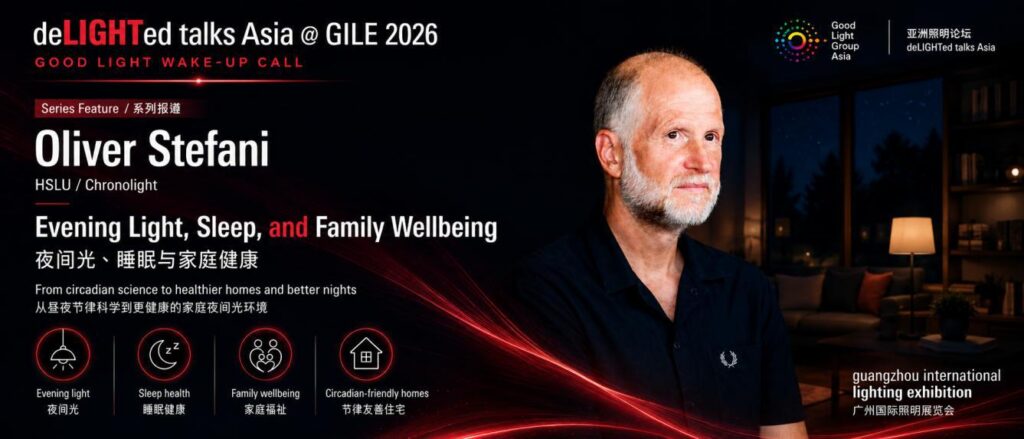
In the previous reports of the Good Light Wake-up Call|好光觉醒行动 series, we explored Good Light from many different perspectives.
Robert Lucas 教授告诉我们,传统 lux 不足以描述光如何告诉身体时间。
Marijke Gordijn 博士提醒我们,好光,是在正确时间给身体正确的光。
Jan Denneman called on the industry to move from illumination to human outcomes.
Kei Haraguchi 从 LED 光源端提出,白光 LED 30 年后不能只追求光效,而要创造人的节律价值。
Dr. Anne Berends of SunLED Life Science expanded the discussion beyond visible light, toward near-infrared light, dose and scientific boundaries.
Jeff Miller 则提醒我们,设计师是把科学翻译成人的体验的关键角色。
Kevan Shaw emphasized that healthy lighting must be designed, calculated, measured, verified and operated.
The owner value article asked how healthy lighting can move from wellness story to verified asset value.
Amardeep Dugar introduced a salutogenic framework, reminding us that Good Light should make spaces more comprehensible, manageable and meaningful.
Martin Klaasen and VLDC brought the Future Forum perspective: from ideas on stage to ideas in action.
Oliver Stefani’s topic brings us back to something that touches every person, every home and every family: The night.
Daytime light helps the body understand that it is day.
Evening and night-time light determine whether the body can truly recognize that it is time to rest.
Healthy lighting is incomplete if it only designs for the day and fails to protect the night.
Sleep does not begin only when we go to bed. Sleep begins to be shaped in the evening.
It begins with the light in the living room, the dining room, the bathroom, the children’s room, the bedroom, the corridor, the night-time route to the toilet — and also the light from mobile phones, tablets, televisions, computers and other screens.
This is why Oliver Stefani’s theme is so important: Evening Light, Sleep, and Family Wellbeing
It reminds the lighting industry that healthy lighting should not only ask whether daytime light is sufficient. It must also ask whether evening and night-time light can truly step back.
It should not only design offices, hotels and hospitals. It must also design the night after people return home.

1 | The challenge is not only to provide enough light during the day. It is also to reduce light at night.
In healthy lighting, we often emphasize the importance of sufficient daytime light.
Daytime light supports alertness. It helps synchronize circadian rhythms. It contributes to mood, attention and the body’s sense of time.
This is correct. But it is only half of the story. The other half is:
Evening and night-time light must be reduced.
If the day is too dim, the body does not receive a clear daytime signal. If the evening is too bright, the body does not receive a clear night-time signal.
Modern life often creates both problems at the same time:
- Too little light during the day. Too much light in the evening.
- Too little daylight indoors. Too much electric light and screen light at night.
- Too little circadian support in the daytime. Too much stimulation before sleep.
Therefore, healthy lighting cannot only be about strengthening the day. It must also protect the night.
This is especially important in homes.
We discuss healthy lighting in offices. We discuss classroom lighting in schools. We discuss ward lighting in hospitals. We discuss sleep-friendly rooms in hotels. But for most people, the light that affects them every night is the light at home.

2 | Sleep is shaped before the lights go out
Many people think sleep begins in the bedroom. The bed. The pillow. The room temperature. The noise level. Whether the room is dark.
All of these matter.
But from a circadian perspective, sleep preparation starts earlier.
The evening is already part of the sleep process. The body begins to prepare for night. Melatonin begins to rise. Core body temperature changes. Alertness starts to decline. The brain gradually shifts away from daytime activation.
If, at this stage, the home environment remains very bright, very cool-white, very stimulating and screen-heavy, the body receives a mixed signal.
The clock says evening. But the eyes and brain may still be receiving a daytime-like light message. This is one of the key problems of modern evening light.
The problem is not that one lamp is bad. The problem is not that blue light is always an enemy. The problem is not that every screen must be demonized.
The real problem is: The wrong light at the wrong time.
When the body is preparing for rest, we often continue to give it signals of daytime activity. Therefore, family healthy lighting is not simply about replacing all lamps with warm light. It is about creating an evening transition system.
From early evening to bedtime, light should gradually become: Lower. Softer. Less direct to the eye. Lower in melanopic stimulation. Lower in glare. Less sudden.
More aligned with the body’s preparation for rest.
3 | Night light is not about making everything dark. It is about low stimulation with usability.
When we talk about night-time light, it is easy to go to another extreme. Should the evening be as dark as possible? Should all lights be turned off? Is warmer always healthier? Is low CCT enough?
The answer is not that simple.
Yes, evening and night-time light exposure should be reduced, especially light that enters the eye and stimulates the circadian system.
But homes are not laboratories.
People still live at night. They eat. Talk. Read. Take care of children. Support older family members. Use the bathroom. Walk to the kitchen. Move through corridors. Find things. Stay safe.
Therefore, the goal of night-time lighting is not “no light.”
It is: Low stimulation, but usable.
Night-time light should allow people to see, move and take care of themselves and others. But it should not pull the body back into daytime.
This requires more careful design:
- Lower eye-level brightness.
- Avoidance of direct glare.
- Less high-angle intense light.
- Less cool-white stimulation at night.
- More local, low-level, indirect and soft lighting.
- Safe but non-intrusive navigation lighting.
- Avoidance of sudden bright light in bathrooms and corridors.
- Reduced high-brightness screen use before sleep.
- More careful strategies for children’s rooms and older adults’ rooms.
Healthy night lighting is not darkness ideology. It is the lighting order of the night.

4 | Homes need a 24-hour light recipe
If we view the home as a 24-hour light environment, it becomes clear that no space should have only one lighting mode.
- The living room is not only “bright.”
- The dining room is not only “warm.”
- The kitchen is not only “task lighting.”
- The bathroom is not only “clear visibility.”
- The bedroom is not only “sleep lighting.”
- The children’s room is not only “eye-care study lighting.”
- The room of an older adult is not only “safety lighting.”
Each space needs different light strategies depending on time and activity.
In the morning: The home should help the body wake up. Daylight should be welcomed. Brighter and clearer light can help start the day.
During the day: Activity areas should not be too dim. If people work or study at home, the light should support focus. If older adults remain indoors, daytime light should not be chronically insufficient.
In the evening: Light should become softer. The home should move from activity toward conversation, dinner and relaxation.
Before sleep: Illuminance should decrease. Eye-level stimulation should be reduced. Cool-white light and bright screens should be limited. The body should receive a clear signal that the day is ending.
At night: Safety navigation should remain possible. Sudden bright light should be avoided. People should be able to move without disrupting rest.
This is the idea of a 24-hour family light recipe. It does not need to be impossibly complicated.
It simply follows a basic principle:
The day should feel like day.
The evening should feel like evening.
The night should feel like night.
Screens are part of the night-time light environment.
When we discuss evening light at home, we cannot talk only about luminaires.
Today, one of the most powerful light sources at night may not be a ceiling light. It may be a screen. Phones. Tablets. Televisions. Computers. Gaming devices. Smart home displays. Children’s learning screens. Devices used in bed.
Screens have several characteristics: They are close to the eyes. Their brightness changes. They are used for long durations. They often appear before sleep. They combine light with content, emotion, work and social stimulation.
Therefore, screens are not just light sources. They are a combination of light, information, behaviour and psychological arousal. If family healthy lighting ignores screens, it cannot truly protect the night.
At the same time, it is unrealistic to simply say: No screen use before sleep. Many people will continue to use screens.
A more practical approach is: Reduce screen brightness. Use night mode where appropriate. Avoid highly stimulating content before bed. Avoid long phone use in bed. Set clearer screen boundaries for children and adolescents. Return the bedroom as much as possible to sleep. Manage home lighting and digital behaviour together.
In the future, healthy lighting and smart homes should not control only lamps. They should also understand screen behaviour. Night-time light exposure has become a combined issue of lighting, screens, content and lifestyle.

5 | Children, adolescents and family routines require greater care
Children and adolescents deserve special attention in evening light design.
They are still developing. They often face academic pressure. They use screens frequently. Their sleep duration may already be insufficient. Their circadian timing may be sensitive to evening light and social schedules.
In many homes, children study at night. The desk is bright. The screen is bright. The room is bright. Mental activation is high.
Then they are expected to fall asleep quickly. But the body does not switch instantly.
This is one of the real challenges of family healthy lighting.
Children’s rooms and study areas should not focus only on “eye-care.” They should also consider:
- Is the study light sufficient but not excessive?
- Is there a transition after study?
- Does the light gradually decrease before sleep?
- Is direct glare avoided?
- Is the night light low-stimulation?
- Is screen use managed?
- Do parents understand that evening light affects sleep preparation?
For children and adolescents, healthy lighting is not only about seeing homework clearly. It is also about helping them build better daily rhythms.
6 | Older adults, night-time movement and family safety
Another important group in night-time family lighting is older adults.
Older adults may experience: Reduced vision. Greater sensitivity to glare. More frequent night-time waking. Slower movement. Higher fall risk. Lighter sleep. Weaker circadian rhythms.
Therefore, lighting for bedrooms, corridors, bathrooms, stairs and bedside areas becomes highly important.
If night-time light is too low, fall risk increases. If it suddenly becomes too bright, it may be uncomfortable and disrupt sleep. If switches are difficult to find, older adults may move in darkness. If the light shines directly into the eyes, it creates discomfort. If the bathroom light is too strong, it may become harder to return to sleep.
Lighting for older adults should therefore provide:
- Low-level navigation light.
- Soft indirect light.
- Automatic sensing that is not abrupt.
- A clear path from bed to bathroom.
- Reduced glare.
- Enough safety, but low stimulation.
- Sufficient daytime light to support activity and rhythms.
This shows that family healthy lighting is not only a lifestyle upgrade for younger consumers. It is also environmental support for an aging society.
7 | Neurodiversity and sensitive users: lighting cannot be designed only for the “average person.”
Oliver Stefani’s work connects architecture, light, sleep and human sensitivity.
One increasingly important theme in healthy lighting is neurodiversity.
Not everyone responds to light in the same way. Some people are more sensitive to flicker. Some are more sensitive to glare. Some feel discomfort under cool-white or high-brightness environments. Some children and adults with autism spectrum conditions, ADHD, migraine, anxiety, sleep problems or sensory sensitivities may respond more strongly to light environments.
This does not mean we should claim that a specific light causes or treats such conditions.
But it reminds us that lighting should not be designed only for an average user.
This is especially important at home.
A single family may include children, older adults, shift workers, people with sleep difficulties, sensitive users and people working from home.
Their lighting needs differ.
Therefore, healthy family lighting should provide:
- Adjustability.
- Choice.
- Lower glare.
- Reduced flicker risk.
- Lower night-time stimulation.
- Sufficient daytime light.
- Room-specific strategies.
- Personal control where needed.
Healthy lighting is not about one universal answer. It is about helping different people in the same home find more suitable light.
8 | Blue light and HEVL: do not demonize, but do not ignore timing and dose
When evening light is discussed, blue light quickly enters the conversation.
The market is full of claims about blue-light protection, low-blue light, eye-care light and anti-blue light products.
This needs caution. Blue light is not inherently bad.
During the day, short-wavelength light is important for vision, alertness and circadian synchronization.
A world without blue light is not a healthy world. Natural daylight contains significant short-wavelength energy.
The real issue is: Too much high-stimulation light entering the eye at the wrong time, especially before sleep.
Therefore, we should not simply say: Blue light is harmful.
A more accurate statement is: The impact of light depends on wavelength, intensity, timing, duration, direction, eye-level exposure and individual sensitivity.
HEVL, or high-energy visible light, should not become fear-based marketing either. It requires scientific boundaries.
A more responsible industry message should be:
- Daytime short-wavelength signals should not be unnecessarily weakened.
- Night-time high-stimulation light exposure should be reduced.
- Eye-care does not mean removing blue light at all times.
- Sleep-friendly lighting is not only about low CCT.
- Healthy lighting must understand time, dose and context.
This is exactly what the Good Light Wake-up Call|好光觉醒行动 has been emphasizing: From simple labels to verifiable design logic.
9 | Family healthy lighting is not about selling one lamp. It is about reshaping evening life.
Oliver Stefani’s topic has very practical implications for the consumer lighting market.
Residential lighting has long focused on: Ceiling lights. Downlights. Smart lights. Eye-care desk lamps. Children’s study lamps. Ambient lighting. Night lights. Whole-home smart lighting. Interior aesthetics.
All of these matter.
But in the age of healthy lighting, they are not enough.
Family healthy lighting should not be only about selling products. It should help families reshape evening life.
例如:
- How should living room light gradually relax after dinner?
- How should a child’s room transition from study mode to sleep preparation?
- How can older adults move safely at night without being exposed to strong light?
- How can bedrooms reduce screen and light intrusion?
- How can bathroom lighting avoid sudden awakening?
- How can smart systems guide the home into a low-stimulation night mode?
- How can family members with different schedules avoid disturbing each other?
This is the shift from residential lighting products to a 24-hour family light environment.
The most valuable future brands will not only say: Our light is more eye-friendly. Our light is smarter. Our light is full-spectrum.
They will be able to say: We help families feel more alert during the day, relax better in the evening, move more safely at night and reduce sleep disruption before bedtime.
10 | From eye-care to sleep-care
Many consumer lighting markets have been strongly focused on eye-care.
This is a good starting point. It helps consumers understand that light quality matters. Flicker, glare, colour rendering, illuminance and blue-light risk all deserve attention.
But the next stage of consumer healthy lighting cannot stop at eye-care. It must expand toward:
- Circadian care.
- Sleep-care.
- Family routines.
- Older adult night safety.
- Children’s evening transitions.
- Comfort for sensitive users.
This does not mean creating more exaggerated claims. It means building better education around family light environments.
Consumers need to understand: Homes should not be too dim during the day. Evenings should not remain as bright as daytime. Bright screens before bed matter. Night lights should not be too bright.
Low CCT is not the only answer.
Children’s study lamps should also consider the transition after study. Older adult safety requires low-level, soft and sensor-friendly night light. Whole-home intelligence should serve daily rhythms, not only convenience.
From eye-care to sleep-care is one of the most important upgrades for consumer healthy lighting.
11 | From smart home to circadian-friendly home
Many smart home systems can already provide: Voice control. App control. Scene switching. Timers. Occupancy sensing. Curtain integration. Colour temperature tuning. Dimming.
But these functions do not automatically create healthy lighting.
The real question is: Do these functions serve human rhythms?
A smart system can be impressive, but if it sets the living room to high-brightness cool-white light at night, it is not supporting sleep.
A system can have many scenes, but if they are not organized around the day, they are simply feature stacking.
A sensor can be useful, but if it turns on a harsh bathroom light at night, it may disrupt sleep.
Future smart homes should move from convenience to circadian friendliness.
They should understand:
- How to support morning wake-up.
- How to support daytime activity.
- How to transition in the evening.
- How to reduce stimulation before sleep.
- How to provide safe navigation at night.
- How to personalize for different family members.
- How to connect light, daylight, curtains, temperature, sound and sleep devices.
This is the healthy future of smart homes. Not simply making lights more obedient. But making light more aware of time.
12 | Hotels, homes and residential development: the same problem in different business contexts
Although Oliver’s theme focuses on family wellbeing, it also connects strongly with hotels and residential development.
Hotels and homes share a fundamental question: How does a person spend a full day — especially the night — in this space?
Hotel guests may cross time zones. They may be tired. They may check in late. They may need recovery. They may be sensitive to unfamiliar light environments.
Residential users care about daily family life.
Developers care about show homes, fit-out standards and differentiation.
Smart home brands care about system value.
Lighting brands care about consumer upgrading.
Therefore, evening light and sleep can become a shared value language for homes and hotels.
Not by claiming simply: You will sleep better.
But by defining:
- How does evening light reduce stimulation?
- How does night lighting support safe movement?
- How does the bedroom reduce disruption?
- How does bathroom lighting avoid sudden awakening?
- How does morning light support wake-up?
- How do light, curtains, temperature, sound and screens work together?
If these questions can be turned into systems that are designable, measurable, experiential and marketable, healthy lighting will no longer remain only a concept. It can become real value for homes and hotels.
13 | Healthy night lighting needs verification, not only feeling
Even in homes and hotels, night-time lighting needs verification.
It cannot rely only on statements such as: It looks warm. It feels comfortable. The colour temperature is low. The brightness is not high. The product claims to support sleep.
我们更应该思考:
- What is the eye-level exposure before bedtime?
- Is melanopic stimulation reduced?
- Is night navigation safe enough?
- Is direct glare avoided?
- 频闪是否安全?
- Is discomfort reduced?
- Can users return to sleep after night-time movement?
- Is the system suitable for children, older adults and sensitive users?
- Will users continue to use it?
Of course, homes do not need to be measured like laboratories.
But the industry must develop a basic verification mindset.
At minimum, it must move from product claims to scenario validation.
This is a key principle for healthy lighting in the consumer market: The closer we get to consumers, the more responsibly we must communicate. The closer we get to sleep, the more careful we must be. The more ordinary the home environment, the better we must translate complex science into simple, reliable life guidance.

Closing: Good Light must wake the day and protect the night
Oliver Stefani’s theme brings a crucial reminder to the Good Light Wake-up Call|好光觉醒行动: Healthy lighting is not only for the day. It is not only for offices. It is not only for hospitals and hotels. It is not only for high-end projects.
Healthy lighting must enter the home.
The evening. The bedtime routine. The children’s room. The older adult’s night-time path. The bedroom. The bathroom. The screen habits. The rhythm of family life. Daytime light helps us wake up. Evening light should help us step back.
Truly good lighting does not simply make spaces brighter. It does not simply make lighting smarter. And it should never reduce health to a product label.
Good Light should help the day feel like day. The evening feel like evening. And the night feel like night.
It helps the body understand time. It helps families create rhythm. It helps children prepare for sleep. It helps older adults move safely at night. It helps each person return to rest at the end of the day.
From eye-care to rhythm-care.
From smart control to circadian-friendly homes.
From single luminaires to 24-hour family light recipes.
From lighting a room to protecting the night.
This is the message Oliver Stefani brought to deLIGHTed talks Asia @ GILE 2026.
And it is one of the most important questions healthy lighting must answer as it moves into everyday life.
Good Light Wake-up Call. 好光觉醒。

 English
  Chinese (China)
  Chinese (Taiwan)