
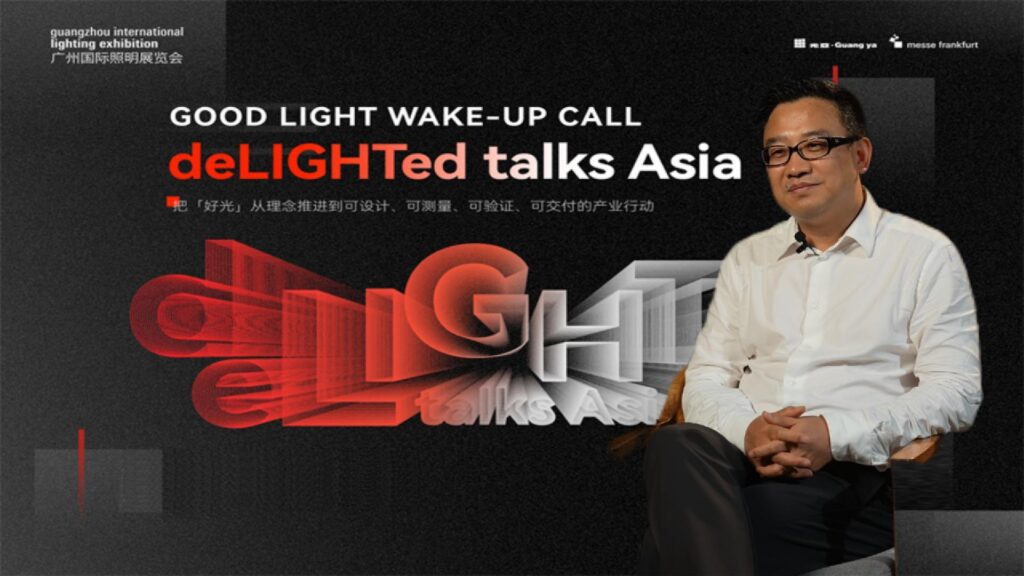
Watch an insightful interview with Zhu Liyi, R&D General Manager of PAK (三雄极光), who shared his perspective on the future of healthy lighting from the intersection of research, product technology, and engineering implementation.
One message stood out: Healthy lighting is no longer just about creating better luminaires—it’s about building intelligent, adaptive lighting ecosystems.
According to Zhu, the industry is evolving beyond traditional lighting metrics toward Healthy Lighting 2.0, where lighting systems respond dynamically to people and their environments through sensors, IoT, algorithms, and real-time data.
Another key takeaway is that healthy lighting should be evaluated based on the light that actually reaches the occupant’s eye, rather than relying solely on laboratory measurements of the luminaire.
By integrating eye-level sensing, continuous monitoring, and intelligent controls, lighting systems can create a closed-loop process that measures, adjusts, and optimizes lighting conditions over time.
Perhaps the greatest challenge—and opportunity—is bridging the gap between scientific research and real-world implementation.
As Zhu explains, achieving this requires collaboration across the entire ecosystem, from research and product development to software, AI, IoT, and engineering.
As our industry continues to advance Human-Centric Lighting and Healthy Lighting, the conversation is shifting from: “What can the luminaire do?” to “How can the entire lighting system deliver measurable outcomes for people?”

 English
  Chinese (China)
  Chinese (Taiwan)