

Whenever we ask how to understand people’s real experiences of light, several familiar answers tend to emerge in the industry:
“People are too different.”
“The industry has not reached a consensus yet.”
“Existing project budgets don’t support it.”
“Customers are unwilling to pay for it.”
These difficulties are real.
But if the problem were simple, the answers clear, and the market already mature, what would the industry still need leaders for?
The job of a leader is not to wait for certainty. It is to turn complex problems into the next step that can be collectively tested and verified.
1 | Consensus Is Not a Prerequisite for Action
Industry consensus rarely emerges suddenly from a single meeting or a grand declaration.
It usually comes from a series of real projects: Form a hypothesis, document the conditions, implement the solution, measure the results, acknowledge failures, refine the method, and test again.
We do not need to establish a perfect answer for everyone and every space from the beginning.
We only need to first choose a scenario worth taking responsibility for.
Schools, hospitals, senior care, offices, industrial spaces, or public spaces can all be starting points.
The question must be specific enough: For whom, at what time and during which activities, and what do we hope to improve?
2 | Turn Slogans into Value Hypotheses
“Healthy lighting,” “emotional lighting,” or “human-centric lighting” cannot directly become project objectives.
They must be rewritten as hypotheses that can be challenged.
例如:
In a classroom on winter mornings, can increasing daytime light exposure at students’ eye level support classroom alertness and user experience?
In senior-care spaces during the evening, can reducing unnecessary short-wavelength stimulation while optimizing visual contrast support safe activities while also preparing occupants for nighttime rest?
Light is only one of many influencing factors.
Therefore, objectives must remain appropriately constrained, research boundaries must be transparent, and correlation must not be presented as causation.
3 | Establish a Real Baseline First
Before renovation, document the space, eye level, orientation, time, activities, daylight, patterns of use, and necessary occupant conditions.
Based on the value hypothesis, select indicators such as illuminance, luminance, visual contrast, actual glare, SPD, mel-EDI, flicker, energy use, subjective experience, or task performance.
More indicators do not necessarily mean more scientific rigor. Every indicator must answer a clear question.
Without a baseline, a good result after renovation may simply be an impression. Without real-world spatial conditions, laboratory performance cannot automatically represent the delivered outcome.
4 | After Implementation, We Must Allow the Answer to Look Bad
Once the product, controls, and spatial solutions have been completed, they should be measured again under comparable conditions and continuously tracked.
Which results improved?
Which did not?
Which were affected by seasons, behavior, or changes in the space?
Does the original value hypothesis need to be revised?
A truly responsible pilot cannot publish only success stories.
If the industry allows only positive results, what we ultimately obtain is not evidence, but promotional material.
Leaders must create room for methodology, data, and failure.
5 | From One Project to an Industry Tool
The end of an individual pilot should not simply be an award or the publication of a white paper.
It should further develop into: Measurement procedures, data formats, product descriptions, control logic, design tools, training methods, procurement language, and acceptance requirements.
When different companies can adopt the same basic methodology to reproduce and compare results, evidence can gradually develop into standards. When those standards enter products, software, projects, and operations, the market can truly begin to emerge.
This requires the participation of owners, manufacturers, designers, researchers, testing organizations, system integrators, and standards organizations, with responsibility, budget, timeline, data rights, and boundaries for public disclosure clearly defined in advance.
6 | Leadership Means Taking Responsibility for the First Step
We do not need to pretend that we know all the answers.
But leading companies cannot use “there is no consensus” as the sole explanation for why they do not act; industry organizations cannot simply hold meetings; research institutions cannot only publish papers; and manufacturers cannot simply wait for customers to present mature demand.
Reducing difficulty, building consensus, and creating the market are precisely the work of leaders.
There is no need to start by changing the whole world.
Start with one real-world scenario.
Within a defined timeframe, formulate a hypothesis, establish a baseline, implement a solution, measure the results, and openly share the first imperfect answer.
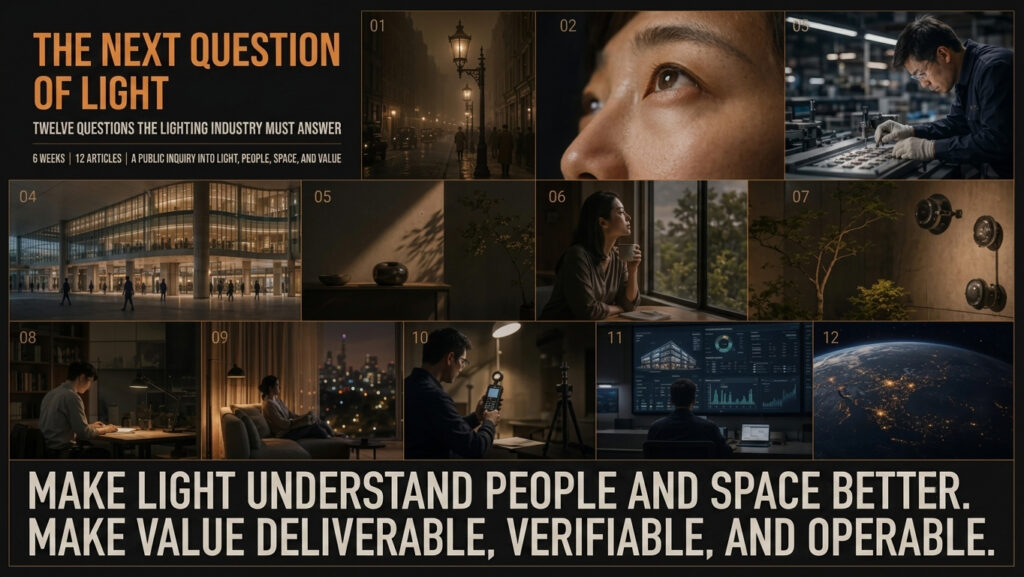
This is Question 12 of “The Next Question of Light”: If you had to launch a pilot tomorrow, what scenario would you choose, and what value would you test? Who would be willing to lead and take responsibility for the first imperfect answer?
Please respond in the following format: Pilot scenario|Value hypothesis|Validation method|Lead role
This is not a conclusion. It is Question 12.
And hopefully, it is also the first question of the next action.

 English
  Chinese (China)
  Chinese (Taiwan)