
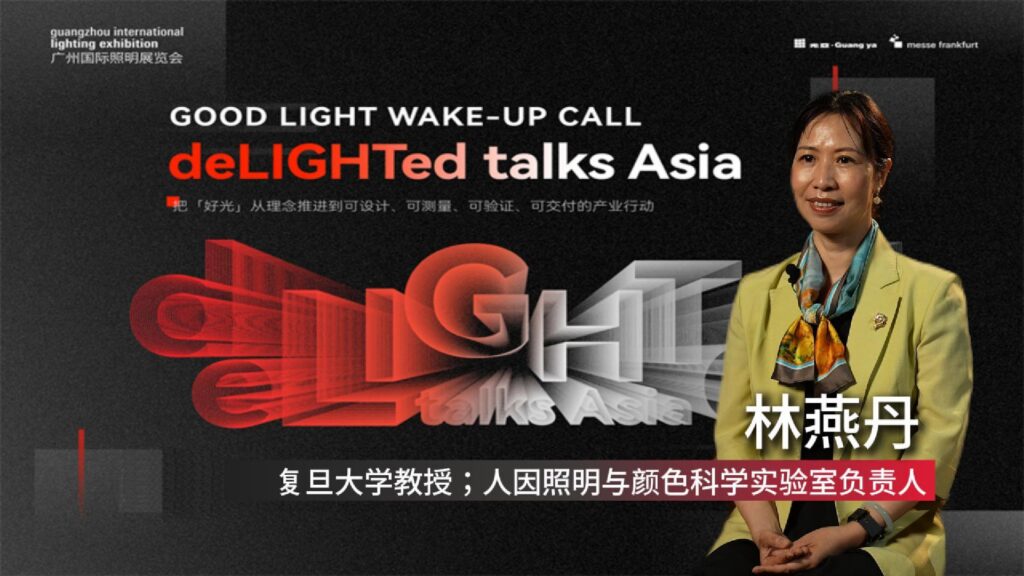
In her recent reflection, 林燕丹教授 highlighted a key challenge facing the healthy lighting industry: before we can fully implement healthy lighting, we need a stronger shared understanding of what “healthy light” truly means.
Healthy lighting is interpreted differently across applications, industries, and user needs. However, moving from concept to practice requires common evaluation methods, scientific evidence, and measurable approaches.
International frameworks such as CIE S 026 have established important foundations, including quantitative approaches based on: Melanopic DER, Melanopic Lux, and Melanopic Equivalent Daylight Illuminance (M-EDI).
At the same time, emerging standards such as China’s GB/T 46119 on non-visual light exposure demonstrate how scientific understanding is advancing toward practical application.
Professor Lin emphasized that the greatest opportunities for healthy lighting often exist in the most challenging environments:
- Enclosed spaces with little or no daylight exposure, where lighting can have a direct impact
- Long-duration visual task environments, such as education spaces
- Environments connected with long-term health factors, including sleep, metabolism, and endocrine rhythms
She also shared an important message for the lighting industry: healthy lighting should not become just a product label. It must be built on scientific understanding, scenario-based needs, and validated outcomes.
Every product should aim to solve a specific human problem. Through continuous research and innovation, the industry can progress along a meaningful pathway:
Understanding healthy lighting → Implementing healthy lighting → Creating practical tools that improve human wellbeing
This journey requires long-term commitment, scientific investment, and collaboration across the entire ecosystem — researchers, standards organizations, designers, manufacturers, and users.
Professor Lin also recognized the important role of Good Light Group Asia in connecting science with practice — translating scientific knowledge into the language of applications and products, while helping build a more complete healthy lighting ecosystem.
The future of healthy lighting will not be created by one organization alone. It will emerge through collaboration, evidence, and a shared commitment to designing healthier environments for people.

 English
  Chinese (China)
  Chinese (Taiwan)